Clear Sky Science · en
Enhancing the efficiency of time-dependent density functional theory calculations of dynamic response properties
Why Sharper X‑Ray Views of Extreme Matter Matter
Modern X‑ray lasers let scientists watch matter being crushed and flash‑heated to conditions like those inside giant planets or fusion capsules. But turning these ultra‑precise X‑ray measurements into useful information about a material’s behavior is brutally expensive on supercomputers. This paper introduces a new way to make one of the key simulation tools, time‑dependent density functional theory (TDDFT), dramatically more efficient without sacrificing accuracy, helping researchers keep pace with rapidly advancing experiments.
Probing Matter with Scattered X‑Rays
When an intense X‑ray beam hits a dense material, the light scatters in patterns that encode how electrons move and interact inside. This technique, called X‑ray Thomson scattering, is central for diagnosing materials at high pressure and temperature—conditions relevant to planetary interiors, laser‑driven experiments, and inertial fusion energy research. The core quantity extracted from such measurements is the dynamic structure factor, which describes how electrons respond across different energy and momentum scales. TDDFT is one of the most accurate ways to compute this response from first principles, but at extreme conditions it becomes painfully slow, because many electronic states are thermally excited and the simulations must be repeated over many configurations and experimental settings.
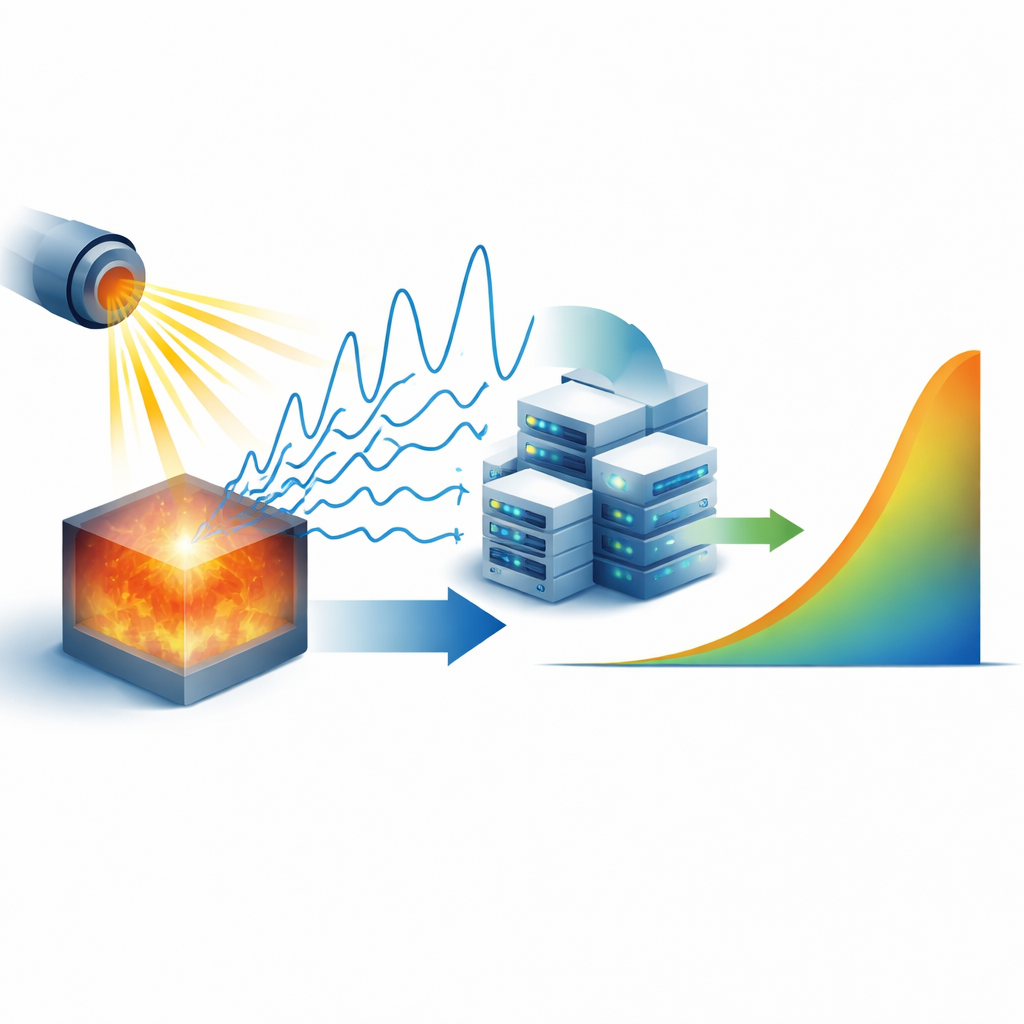
The Hidden Cost of Smoothing the Signal
In practice, TDDFT produces a noisy spectrum, full of artificial wiggles that arise from finite numerical sampling rather than real physics. To tame this noise, researchers traditionally smear the spectrum using a broadening parameter, which smooths the curves but also blurs sharp physical features. Ideally, that parameter would be taken to zero, but doing so amplifies noise unless the numerical sampling—especially the grid of electronic momenta—is made extremely dense, causing the computational cost to explode. Up to now, many studies have simply chosen the smoothing by eye, trading off clarity against bias in a somewhat ad‑hoc way.
Looking Sideways in Imaginary Time
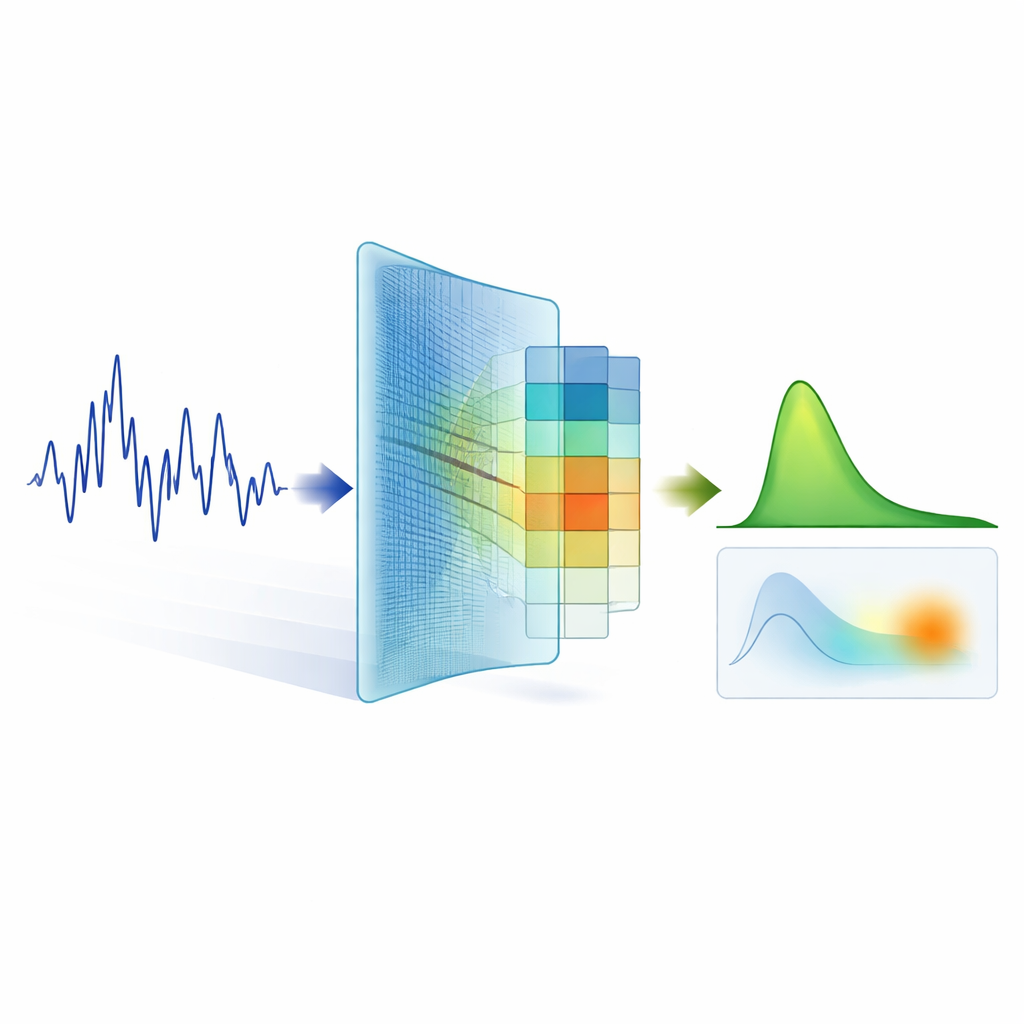
The authors propose a more principled route by exploiting a mathematical twin of the dynamic structure factor: the imaginary‑time density–density correlation function. This alternative representation encodes exactly the same physics but naturally suppresses high‑frequency, narrow‑band noise in the spectrum. By transforming TDDFT results into this imaginary‑time domain, the team can define clean numerical tests showing when the broadening is small enough to be physically accurate but still large enough to keep noise under control. This provides an objective way to pick an “optimal” smoothing value that avoids the severe bias introduced by over‑broadening.
Smart Filtering Instead of More Supercomputers
Once this optimal reference spectrum is identified, the authors go a step further. They treat the TDDFT output as a sum of a smooth, physical signal plus quasi‑periodic numerical artifacts. Using a carefully tuned filtering procedure—based on a widely used smoothing method adapted with extra constraints—they remove those narrow‑band fluctuations while insisting that the transformed signal in imaginary time barely changes. This ensures that key physical quantities, such as integral properties and frequency moments tied directly to experiments, remain essentially untouched. In tests on dense hydrogen and heated aluminum, the filtered spectra match high‑precision quantum Monte Carlo benchmarks and reproduce fine spectral features, while avoiding the heavy cost of vastly denser numerical sampling.
From Faster Calculations to Better Experiments
By combining imaginary‑time diagnostics with constraint‑based filtering, this work shows that TDDFT simulations can deliver smooth, trustworthy X‑ray scattering spectra and related properties at a fraction of the previous computational cost—often gaining close to an order of magnitude in speed. That efficiency gain is crucial for modern experiments, which require many simulations across a range of temperatures, densities, and scattering angles. In plain terms, the method lets scientists extract sharper, more reliable information about matter in extreme environments while using fewer supercomputer hours, accelerating progress toward fusion energy and a deeper understanding of materials under the most demanding conditions found in the laboratory and beyond.
Citation: Moldabekov, Z.A., Schwalbe, S., Acosta, U.H. et al. Enhancing the efficiency of time-dependent density functional theory calculations of dynamic response properties. npj Comput Mater 12, 168 (2026). https://doi.org/10.1038/s41524-026-02088-9
Keywords: x-ray Thomson scattering, time-dependent density functional theory, warm dense matter, dynamic structure factor, computational spectroscopy