Clear Sky Science · en
Rational design of polymeric dielectrics guided by insightful understanding of electron transfer/transport in aperiodic systems
Why safer plastics for electricity matter
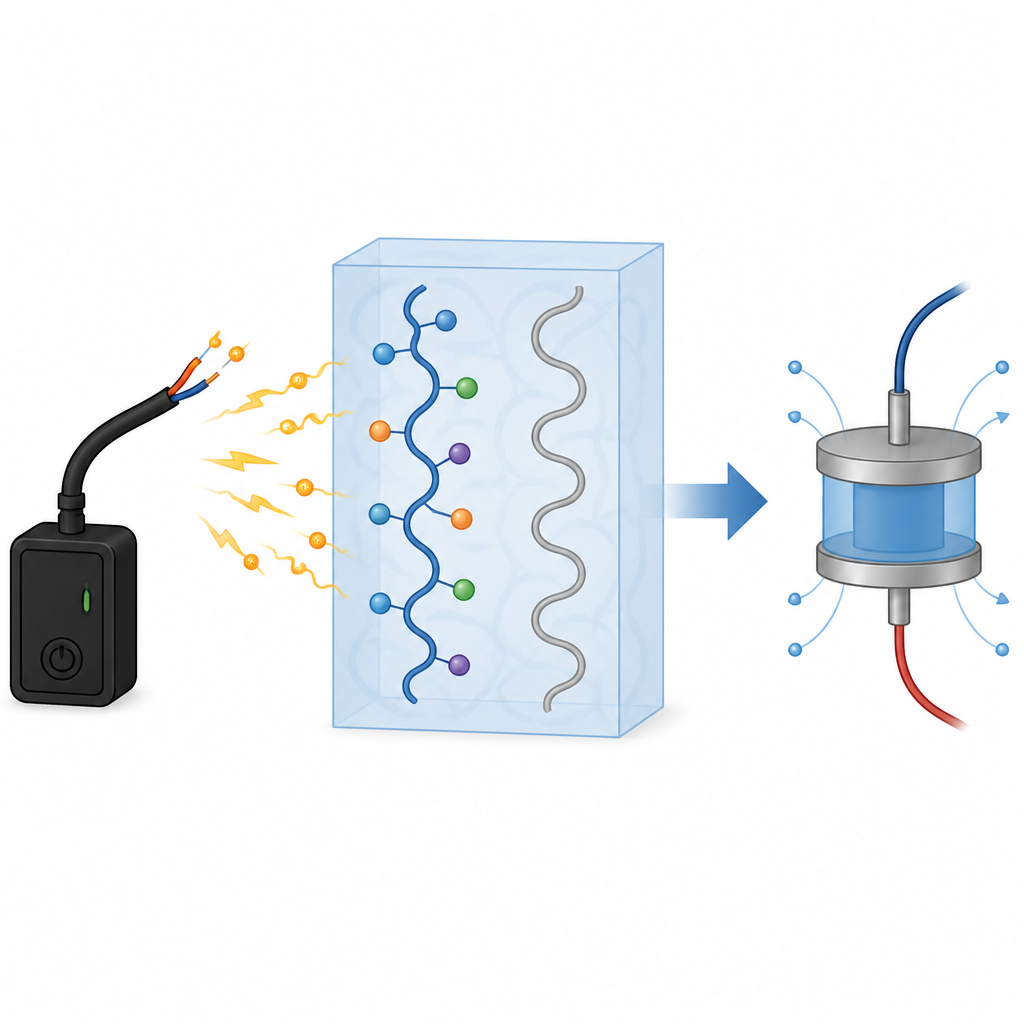
Modern life runs on high-voltage power cables, compact electronics, and fast-charging devices, all of which rely on thin plastic films to stop electricity from leaking or sparking. When these plastics fail under heat or intense electric fields, equipment can lose efficiency or even break down. This study shows a new way to redesign a common plastic, polypropylene, so that it blocks unwanted electron motion more effectively, pointing toward safer, longer-lasting insulation and better energy storage components.
How electrons misbehave inside everyday plastics
Inside an insulating plastic, electrons are not supposed to roam freely, yet under strong electric stress they can still sneak through, gradually degrading performance. Traditional design rules treat the material as if it were perfectly regular, focusing on simple properties like the overall energy gap between filled and empty states. Real plastics, however, are mostly disordered: their chains twist and pack in irregular ways, giving electrons a maze of paths and temporary resting places known as traps. The authors argue that to control this motion, we must look directly at the detailed shapes and locations of the emptier regions where electrons can hop, rather than rely only on broad averages.
Turning molecular side-groups into electron traps
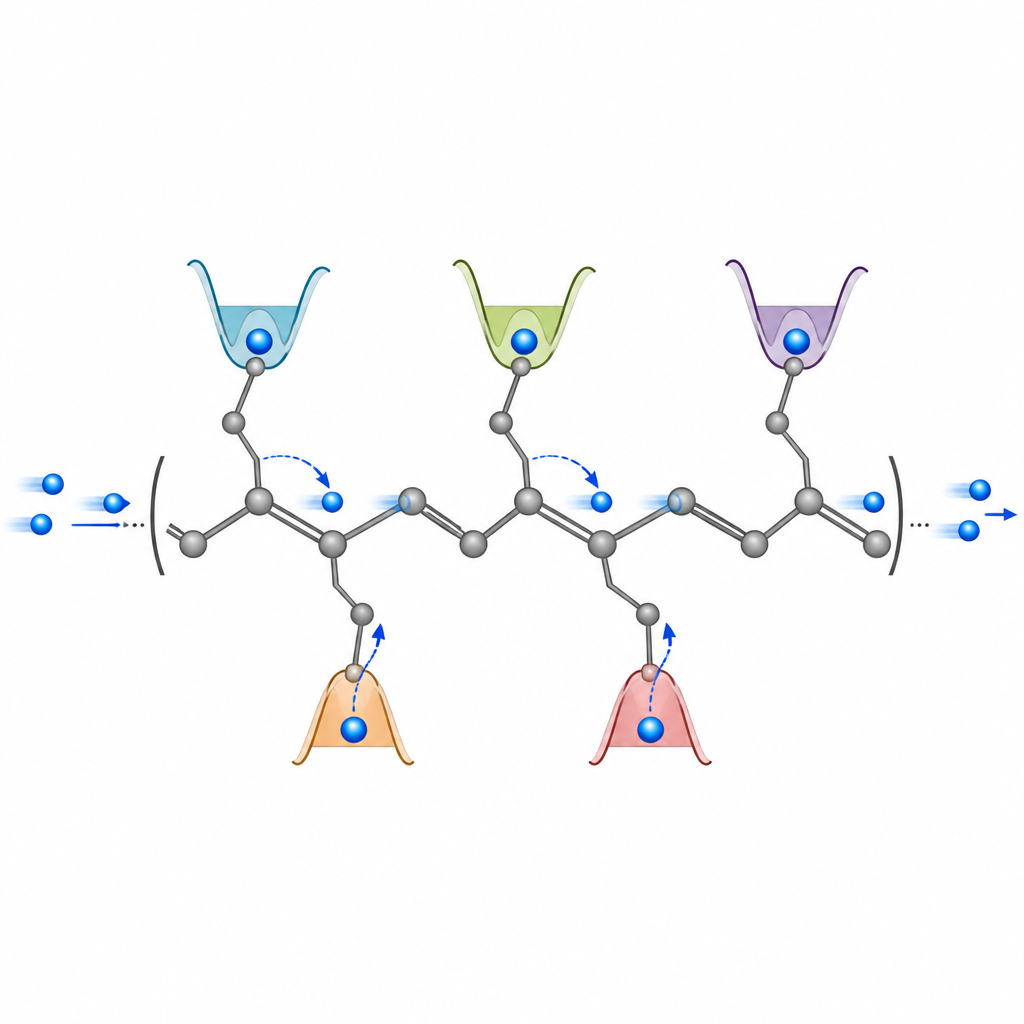
The team focuses on polypropylene, a workhorse plastic in power cables and capacitors, and explores what happens when different chemical side-groups are grafted onto its chain. Each side-group subtly reshapes the “frontier” empty orbitals that are ready to accept electrons. Using quantum calculations, the researchers find two key traits that determine how well a side-group can trap electrons: the energy barrier an electron must climb to escape the trap, and how tightly the trap is confined in space. A deeper and more localized trap holds electrons more stubbornly, making it harder for them to contribute to unwanted current. Among six candidate side-groups, a ring-shaped unit called vinyl-carbazole stands out, offering both a very deep and very narrow trap compared with the unmodified plastic.
From computer predictions to real materials
To see if these theoretical ideas hold up, the authors synthesize polypropylene grafted with each side-group and test thin films under electric and thermal stress. They confirm, through infrared and X-ray measurements, that the new groups attach where the plastic’s own sensitive sites lie, effectively replacing the original frontier orbitals. Light-absorption experiments and advanced calculations show that excitations now occur mainly within the grafted groups, confirming that these new orbitals dominate electron behavior. For the vinyl-carbazole version, the films withstand up to about half again as much electric stress before breaking down and show roughly fifty times higher electrical resistivity at 130 °C than the original polypropylene, even though the basic polymer softens slightly at that temperature.
Watching trapped charges at different scales
The study then probes how charges actually become trapped and released. Heating previously polarized samples while recording tiny currents reveals distinct peaks linked to different trap depths. The deepest traps in the modified plastic line up almost exactly with the energy barriers predicted by the quantum models, confirming that the new side-groups introduce stronger holding sites for electrons. Nanoscale measurements of surface potential decay on crystalline and amorphous regions further show that both areas share similar trap characteristics, with the grafted material clearly hosting deeper traps than the pure plastic. Large-scale simulations of thousands of atoms visualize electrons hopping from extended, conducting parts of the chain into localized regions around the grafted groups, matching the experimental trap energies.
A built-in brake on quantum current
Besides trapping and release, the team analyzes how the molecular structure sets an intrinsic quantum current when a tiny bias is applied across a single chain bridged between metal electrodes. Using a specialized quantum transport method, they find that vinyl-carbazole grafting lowers this current by up to four orders of magnitude relative to neat polypropylene. The probability that an electron tunnels through the molecule is reduced across a wide energy range, and the current becomes less sensitive to voltage changes. Although this idealized current is not a direct measurement of bulk conductivity, it provides a third practical descriptor for comparing how different chemical designs inherently resist electron flow at the molecular level.
Design rules for tougher insulating plastics
Taken together, the results show that the behavior of just a few specific empty orbitals can steer the macroscopic performance of a plastic dielectric. By choosing side-groups that create deep, tightly confined traps and that also suppress quantum transport, engineers can markedly improve breakdown strength, resistivity, and energy storage capability. The authors propose three simple descriptors, all rooted in quantum calculations, as a recipe for tailoring future polymer insulators. Although demonstrated on polypropylene, the same thinking could guide the design of many other plastics used in demanding electrical and electronic applications, helping devices run hotter and harder while staying safely insulated.
Citation: Hu, S., Meng, L., Wang, M. et al. Rational design of polymeric dielectrics guided by insightful understanding of electron transfer/transport in aperiodic systems. npj Comput Mater 12, 181 (2026). https://doi.org/10.1038/s41524-026-02052-7
Keywords: polymeric dielectrics, polypropylene insulation, electron trapping, energy storage films, high temperature cables