Clear Sky Science · en
From ultrathin to bulk: decoding thickness-unrestricted ferroelectricity in Y:HfO2 via first-principles
Why film thickness matters for future chips
Modern memory chips and tiny energy-storage devices increasingly rely on special materials that can hold an electric polarization, much like a microscopic electret. In most of these materials, this useful behavior fades away when the film becomes too thick, forcing engineers to work with fragile, nanometer-scale layers. This study explores a version of hafnium oxide, a material already used in today’s silicon technology, that keeps its polar state from ultrathin layers all the way to bulk crystals, promising simpler and more versatile electronic designs. 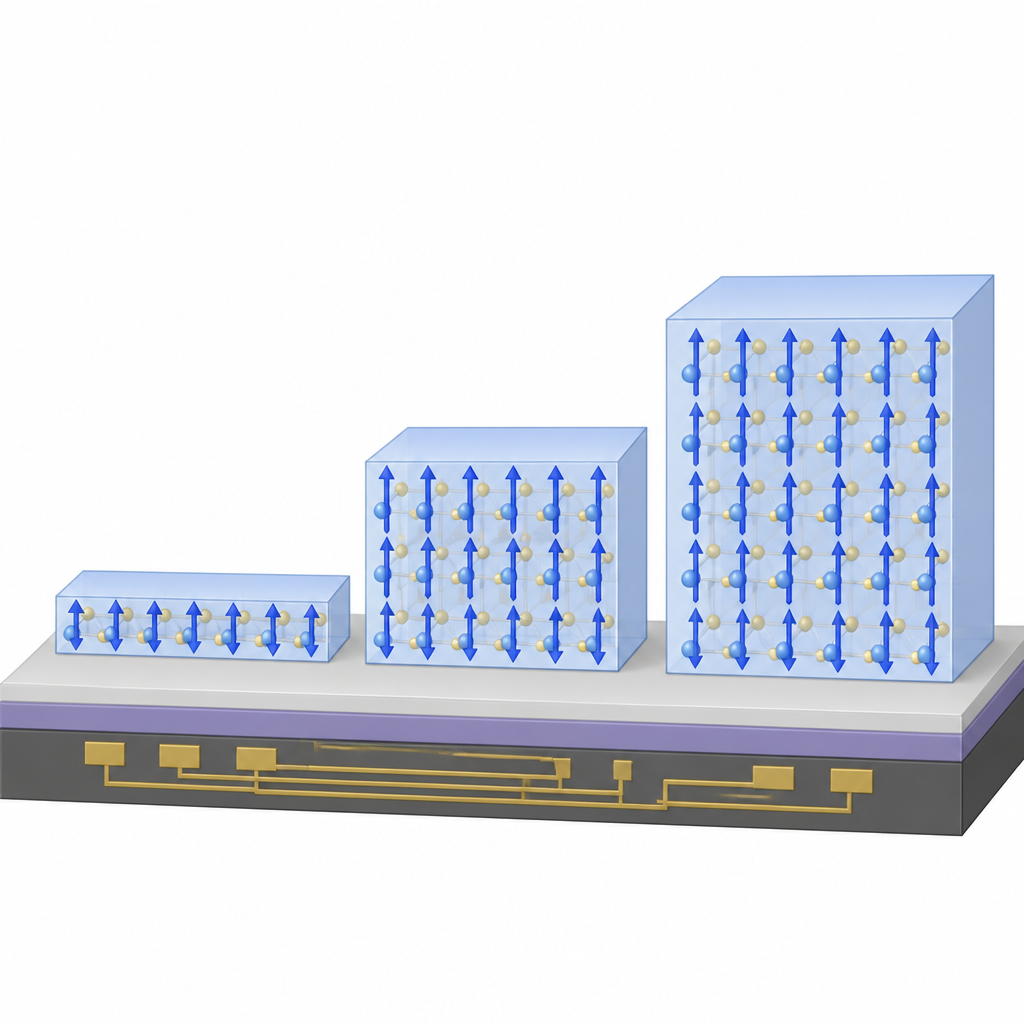
A material that breaks the usual thickness rules
Hafnium oxide is a workhorse insulator in advanced transistors, but in its usual crystal forms it is nonpolar. Only a rare, metastable structure known as the polar orthorhombic phase gives it ferroelectric behavior, letting it act as a tiny switchable capacitor. In most doped hafnium oxides this phase appears only in very thin films, where surface effects and built-in strain help stabilize it. Yttrium-doped hafnium oxide, however, behaves differently: experiments show strong polarization in both ultrathin layers just a few nanometers thick and in films approaching bulk dimensions, defying the long-accepted size limit. The present work uses detailed quantum mechanical calculations to uncover why this material is so unusually forgiving about thickness.
How missing atoms and dopants reshape the crystal
The authors first examined how different types of imperfections change the balance between competing crystal structures. They focused on yttrium atoms substituting for hafnium and on oxygen vacancies, the tiny missing oxygen atoms that commonly appear during film growth. Not all vacancies are equal: removing an oxygen that helps drive the polar distortion harms ferroelectricity, while removing a more passive oxygen in a spacer layer can actually favor the polar phase. When a yttrium atom teams up with one of these helpful vacancies, forming a so-called defect pair, the local crystal relaxes and charge is neatly balanced. The calculations show that such pairs lower the energy cost of the polar phase and that an intermediate defect concentration is especially effective, matching experimental trends in real films.
Working together: strain, electric fields, and defects
Next, the team explored how these defect pairs interact with mechanical strain and electric fields, two knobs that device engineers can tune. Compressive strain, like gently squeezing the film in the plane of the wafer, already helps the polar phase in pure hafnium oxide. Introducing yttrium–vacancy pairs widens this favorable region: as their concentration rises, the amount of strain needed to stabilize the polar structure shrinks, and at modest levels the polar phase can win out even with little or no strain. Applying an electric field along the direction in which the material wants to polarize amplifies this effect, making it easier to flip the crystal from a nonpolar to a polar arrangement. Together, defects, strain, and field form a cooperative trio that can support ferroelectricity even in thick, substrate-relaxed samples. 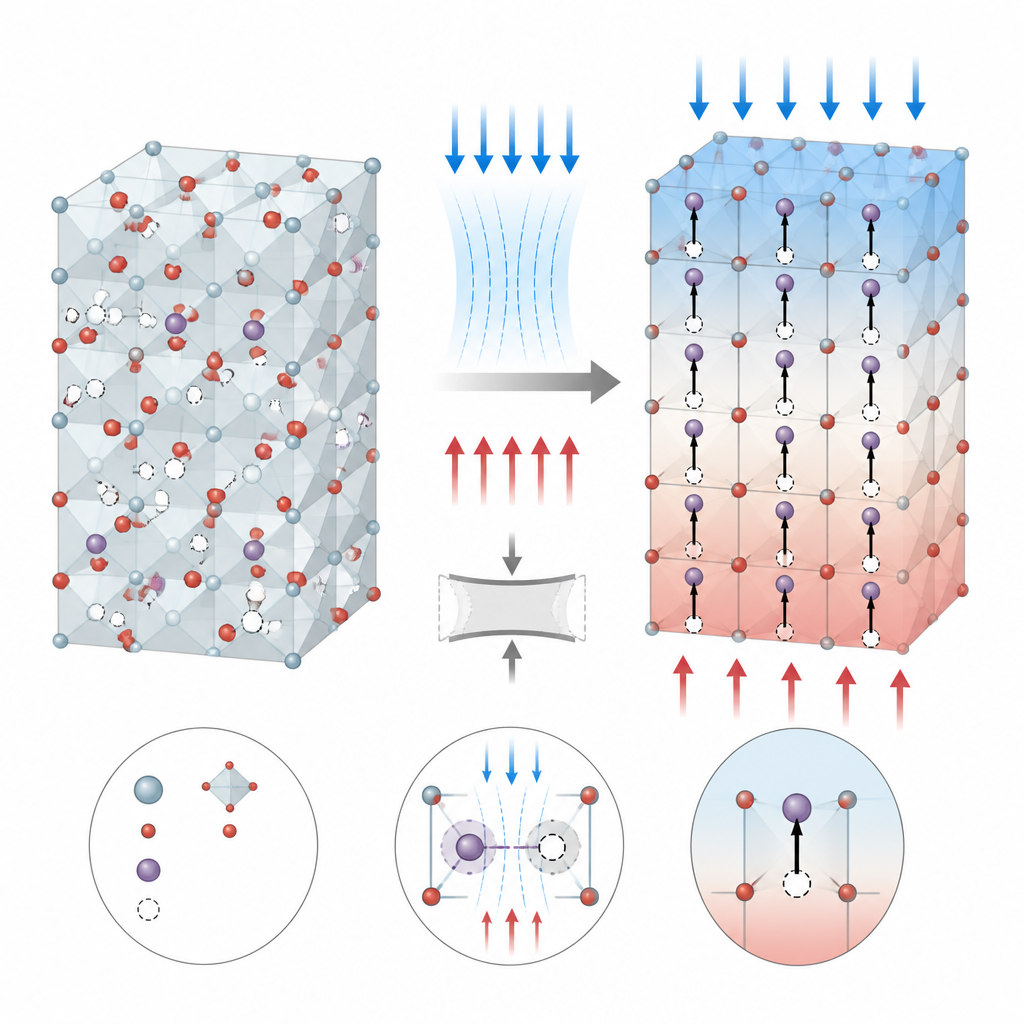
Why surfaces matter more in thin films
Finally, the researchers tackled the thin-film limit, where surfaces strongly influence which crystal phase is most stable. They built slab models of different crystal cuts and calculated their surface energies, then combined this information with bulk energies in a simple thermodynamic model that tracks how stability changes with thickness. For undoped hafnium oxide, a nonpolar phase usually wins near the surface. When yttrium–vacancy pairs are added on certain crystal faces, however, the polar phase can have the lowest overall free energy across a surprisingly large thickness range. In particular, on one common surface orientation these defect pairs push the critical thickness for a stable polar layer much higher than in systems with yttrium alone, mirroring experiments where strong polarization persists in films tens of nanometers thick and beyond.
What this means for future devices
In everyday terms, this work explains how a carefully chosen combination of dopant atoms, missing oxygens, strain, and electric fields lets a single material behave like a reliable polar medium from the thinnest coatings to near-bulk crystals. The key players are composite yttrium–vacancy defects that locally tip the energetic balance toward the polar structure and, in thin films, reshape the surface environment in its favor. By mapping out how these ingredients interact, the study offers a recipe for fabricating hafnium-oxide-based memories and energy devices that no longer suffer from strict thickness limits, easing integration with existing silicon processes while preserving robust, switchable polarization.
Citation: Huang, J., Yang, J., Jia, S. et al. From ultrathin to bulk: decoding thickness-unrestricted ferroelectricity in Y:HfO2 via first-principles. npj Comput Mater 12, 184 (2026). https://doi.org/10.1038/s41524-026-02046-5
Keywords: hafnium oxide, ferroelectricity, yttrium doping, oxygen vacancies, thin film devices