Clear Sky Science · en
Flat topological nodal lines in heavy-fermion compound CeCoGe3
A Quantum Metal with a Hidden Twist
Most of today’s electronics rely on materials whose electrons behave in fairly ordinary ways. But some crystals host electrons that act as if they are thousands of times heavier, move in strange patterns, and may even give rise to new forms of superconductivity. This paper explores one such material, the heavy-fermion compound CeCoGe3, and shows that it hides a special kind of “looped” electronic structure near the energies that matter most for electricity, potentially setting the stage for an unusual type of superconducting state.
Why Heavy Electrons Matter
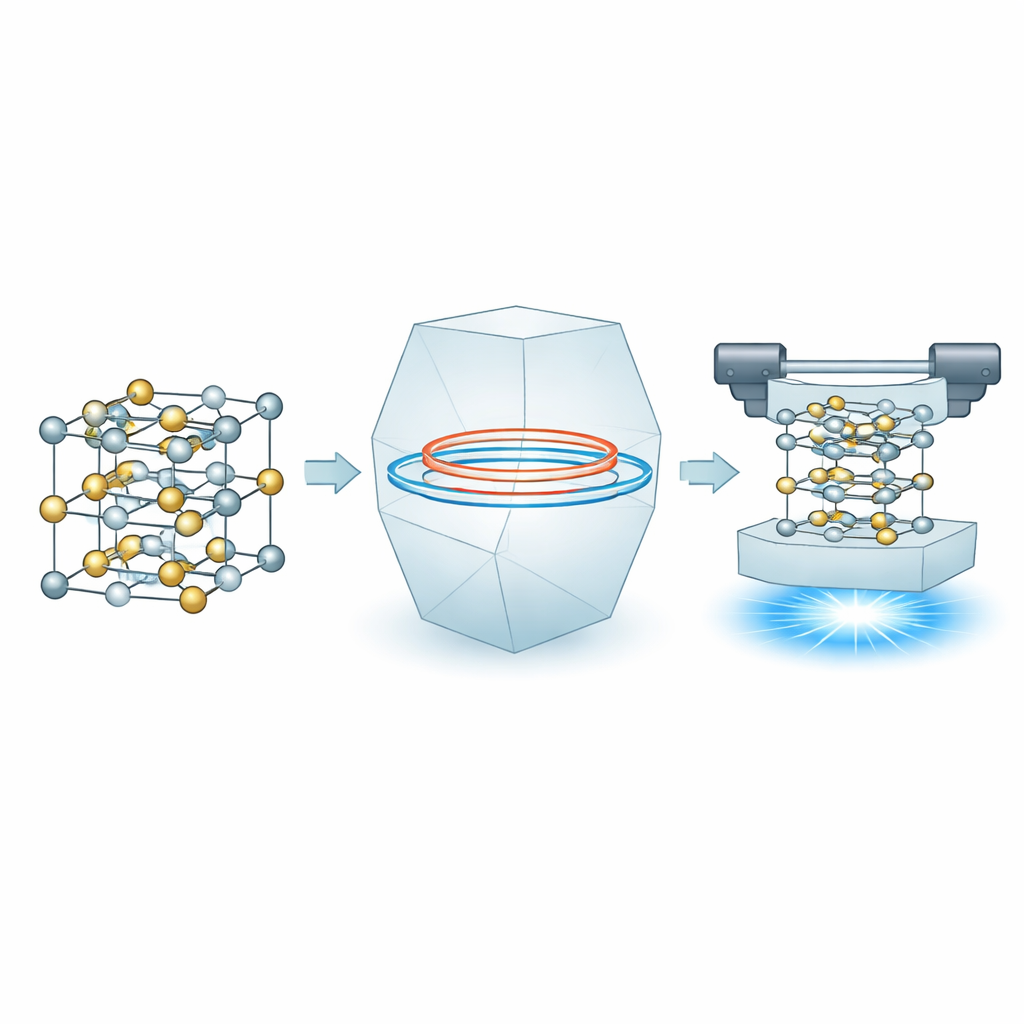
In heavy-fermion materials, the electrons associated with certain atoms—here, the 4f electrons of cerium—interact so strongly with their surroundings that they effectively gain an enormous mass. At high temperatures these electrons behave like disorganized local magnets, but as the crystal is cooled they become entangled with mobile electrons in a process known as the Kondo effect. Below a characteristic temperature, this entanglement produces new, very flat electronic bands, meaning electrons can only change their energy very slowly. Because flat bands pack many electronic states into a tiny energy range, they can dramatically amplify subtle quantum effects, including magnetism and superconductivity.
From Disordered Electrons to Heavy Waves
The authors used a state-of-the-art computational approach that combines density functional theory with dynamical mean-field theory to follow how CeCoGe3 changes as it is cooled. At high temperature, the electronic states are broad and fuzzy, signaling that electrons scatter frequently and do not form well-defined waves. As the temperature drops below roughly 50 kelvin, a sharp resonance appears right at the energy where electrons are most active, signaling the onset of coherent heavy quasiparticles. By 25 kelvin, the effective mass of these quasiparticles is more than fifty times larger than what simpler calculations would predict, in line with experimental measurements and confirming the material’s extreme heavy-fermion character.
Loops of Quantum States in Momentum Space
Beyond the sheer heaviness of the electrons, CeCoGe3 has an additional twist: its crystal structure lacks a center of symmetry, and the electrons feel a strong coupling between their spin and motion. Together, these ingredients force certain energy bands to cross along closed loops in momentum space, forming so-called nodal lines. The calculations reveal two kinds of such loops. One type is guaranteed by the underlying crystal symmetries and persists as long as those symmetries remain intact. The other type appears only when bands invert their order, but is still protected by mirror-like symmetries. Importantly, electronic correlations flatten the bands that take part in these crossings, pinning the nodal lines within about 10 millielectronvolts of the Fermi level, where they can contribute a large density of electronic states.
Pressure as a Tuning Knob
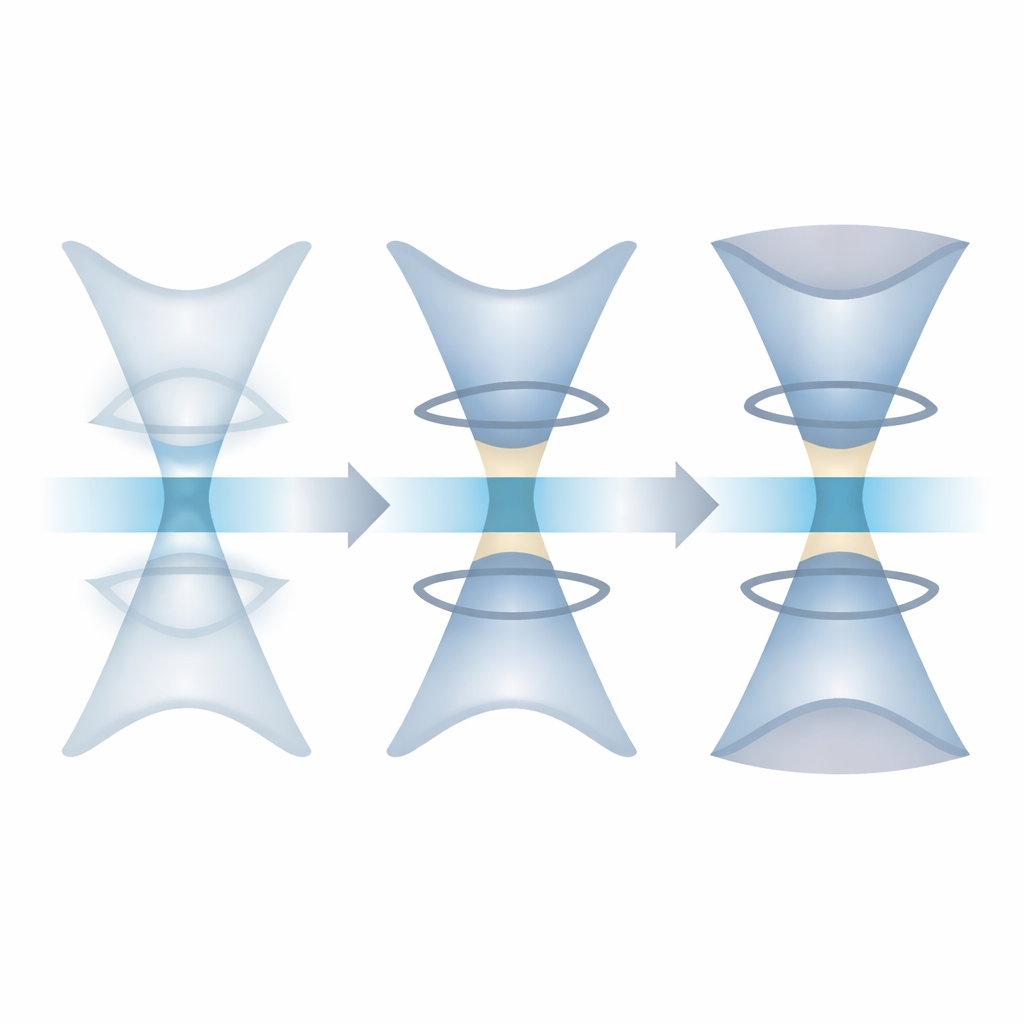
CeCoGe3 is known experimentally to become superconducting when squeezed under high pressure. The authors therefore repeated their analysis at a pressure where the superconducting transition temperature peaks. They find that pressure makes the heavy quasiparticles somewhat lighter and broadens their flat band, but the symmetry-protected nodal lines remain anchored near the Fermi level. At the same time, electron scattering is greatly reduced, so the nodal features become sharper and more coherent. This suggests that, under pressure, the material hosts long-lived heavy quasiparticles arranged along nearly flat loops in momentum space, exactly the kind of environment theorists expect to favor unconventional forms of electron pairing.
Toward Topological Superconductivity
Putting these pieces together, the study identifies CeCoGe3 as a prototype “topological nodal line Kondo semimetal” in which heavy electrons, looped band crossings, and superconductivity may all be intertwined. The flat nodal lines boost the number of available electronic states, while the strong spin–orbit coupling imprints a locked-in spin pattern around them. According to the authors, this combination can support exotic superconducting states that differ fundamentally from those in conventional metals and could host robust, topology-protected excitations. Future experiments under pressure, they argue, will be crucial for testing whether CeCoGe3 truly realizes a form of topological superconductivity rooted in its heavy, looped electronic landscape.
Citation: Wang, Y., Wu, W. & Zhao, J. Flat topological nodal lines in heavy-fermion compound CeCoGe3. npj Comput Mater 12, 171 (2026). https://doi.org/10.1038/s41524-026-02036-7
Keywords: heavy fermion, topological nodal line, Kondo semimetal, quantum materials, topological superconductivity