Clear Sky Science · en
Impact of higher-order exchange on the lifetime of skyrmions and antiskyrmions
Tiny Magnetic Whirls as Future Data Bits
Imagine storing information not in electric charges, but in tiny whirlpools of magnetism only a few billionths of a meter across. These objects, called skyrmions and antiskyrmions, could make computer memories smaller and more efficient. But for that to happen, these whirls must survive heat and random jostling inside a device for long enough to be useful. This article explores a subtle magnetic effect that can dramatically extend their lifetime and even keep them stable in materials once thought unsuitable for such exotic states.
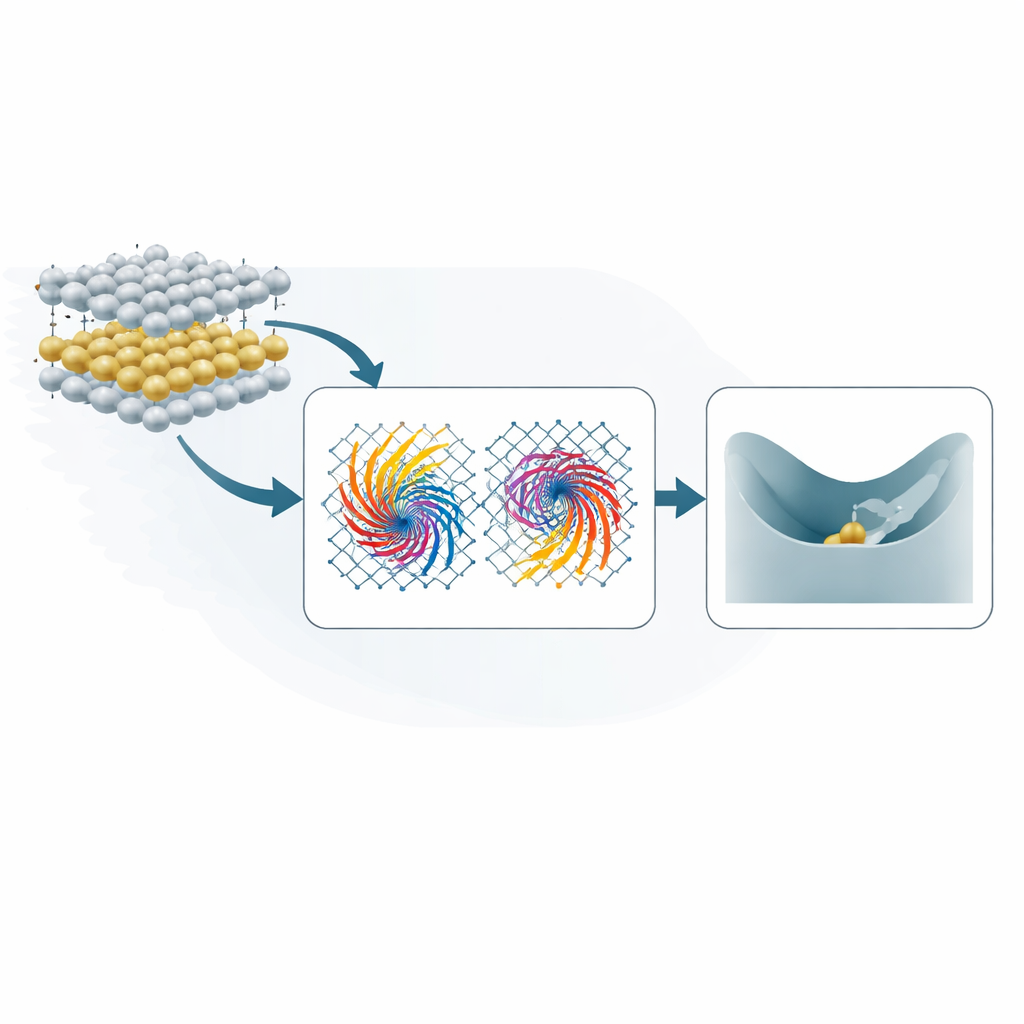
Magnetic Whirlpools in Ultra-Thin Metals
Skyrmions and antiskyrmions are nanoscale spin patterns in which the tiny magnetic moments of atoms twist to form swirling textures. They have attracted attention because they can be moved with very small electrical currents and can act as individual information bits. Traditionally, scientists believed that a special interaction linked to heavy elements and broken mirror symmetry—the Dzyaloshinskii–Moriya interaction—was essential to stabilize these textures. More recently, another ingredient has come into focus: higher-order exchange interactions, in which not just pairs, but groups of three or four spins, interact together. These many-spin couplings naturally arise in real materials and can favor complex magnetic patterns.
How Extra Spin Couplings Shape Stability
The authors build a detailed computer model of spins on atomic lattices in two well-studied ultrathin film systems: palladium/iron on iridium and on rhodium. Their model includes the usual pairwise couplings, the Dzyaloshinskii–Moriya interaction, and all relevant fourth-order exchange terms that link four spins at a time. Using a technique called harmonic transition-state theory, they trace out the most likely paths by which an isolated skyrmion or antiskyrmion disappears into a uniformly magnetized state. Along each path they calculate both the height of the energy barrier that must be crossed and the way the energy surface curves near the starting state and at the crucial “saddle point” where collapse occurs.
Energy Barriers, Entropy, and Lifetime
The lifetime of a magnetic whirl is governed by an Arrhenius-type law: the higher the barrier, the less frequently thermal motion can push the system over it. But there is another, often overlooked factor: entropy. It depends on how stiff or soft the energy landscape is around the initial state and the saddle point. When the researchers turn on higher-order exchange terms, they find a dual effect. First, a specific four-spin interaction raises the collapse barrier for both skyrmions and antiskyrmions by roughly 100 millielectronvolts in the iridium-based film, greatly increasing their resistance to thermal decay. Second, this interaction changes the curvature at the saddle point, making certain collective deformations of the spins softer. That increases the so-called pre-exponential factor in the lifetime formula and partly offsets the stabilizing effect of the larger barrier. Taking both ingredients into account, the net result is still a dramatic lifetime enhancement—skyrmions that would persist for about an hour below 30 kelvin without these couplings can survive at 50 kelvin or more when they are included.

Fine Tuning a Single Parameter
A striking outcome is how sensitively lifetimes respond to the strength of one particular four-spin, four-site term. Varying this parameter within a range expected for real transition-metal films changes the energy barrier almost linearly, but can swing the entropy-related prefactor over several orders of magnitude. For skyrmions, increasing this interaction by only half a millielectronvolt can lengthen predicted lifetimes at 40 kelvin from under an hour to nearly three weeks. Antiskyrmions show a similar trend but with generally shorter lifetimes because their barriers are lower. The study also shows that in models without the Dzyaloshinskii–Moriya interaction, the same higher-order terms alone can support metastable skyrmions and antiskyrmions with experimentally relevant lifetimes, even though their sizes and field dependence differ from the conventional case.
Why This Matters for Future Devices
For readers thinking about real-world applications, the message is that the fate of nanoscale magnetic bits depends not just on one famous interaction, but on a web of multi-spin couplings and entropy effects. By carefully engineering interfaces and material combinations to strengthen specific four-spin interactions, it should be possible to design skyrmions and antiskyrmions whose lifetimes are tailored for memory, logic, or neuromorphic devices—long enough to store information reliably, but not so long that they become impossible to write or erase. Perhaps most intriguingly, these findings open the door to skyrmion-based technologies in a broad class of layered magnets that lack the usual stabilizing interaction, suggesting new opportunities in two-dimensional materials and other systems where complex spin interactions naturally flourish.
Citation: Schrautzer, H., Goerzen, M.A., Beyer, B. et al. Impact of higher-order exchange on the lifetime of skyrmions and antiskyrmions. npj Comput Mater 12, 123 (2026). https://doi.org/10.1038/s41524-026-02034-9
Keywords: magnetic skyrmions, higher-order exchange, spintronics, topological magnetism, ultrathin films