Clear Sky Science · en
Hybrid magnetic skyrmions with near-zero Hall angle and electrical switchability in a 2D multiferroic
Whirling Patterns for Future Electronics
Inside certain magnetic materials, tiny whirlpools of magnetism called skyrmions can act like information bits, promising faster and more efficient memories and logic. Yet in most materials these whirlpools drift sideways when pushed by an electric current, threatening to crash into device edges and vanish. This paper explores a new two-dimensional material that hosts a special kind of skyrmion whose motion can be steered straight ahead and even controlled with electric fields and gentle stretching, pointing to low‑power, highly programmable electronics built from spinning atoms rather than moving charges alone.
A Flat Material with Built‑In Dual Personality
The researchers focus on a single atomic layer of a compound called TcIrGe2Se6. This ultrathin sheet is a “multiferroic,” meaning it combines both magnetism and an electric polarization that can be flipped up or down. In the crystal, different atoms form a hexagonal framework, with a pair of germanium atoms sticking slightly out of the plane. That small vertical shift breaks the symmetry of the lattice and creates an electric dipole that can be switched by an applied voltage. At the same time, the technetium atoms carry magnetic moments whose arrangement can form complex patterns. Using advanced quantum‑mechanical calculations, the authors confirm that this monolayer is structurally stable, ferromagnetic up to about 330 K (near room temperature), and has a modest energy barrier for flipping its electric polarization, all favorable traits for devices.
How Mixed Twists Give Hybrid Whirlpools
In most skyrmion‑hosting materials, a subtle interaction between neighboring spins called the Dzyaloshinskii–Moriya interaction twists spins in either a purely radial or purely tangential fashion, giving rise to two classic skyrmion types. TcIrGe2Se6 is different because its crystal symmetry allows both twist directions to coexist in the same plane. The authors show that the in‑plane twisting can be decomposed into components that are parallel and perpendicular to the bonds between magnetic atoms, and that both are sizable. This mixed twisting stabilizes “hybrid” skyrmions whose spins rotate in planes tilted between the two standard cases, giving an extra internal degree of freedom known as helicity. Crucially, flipping the electric polarization of the material reverses the sense of this twisting, so the swirling direction, or chirality, of the skyrmions can be switched purely by an electric field. 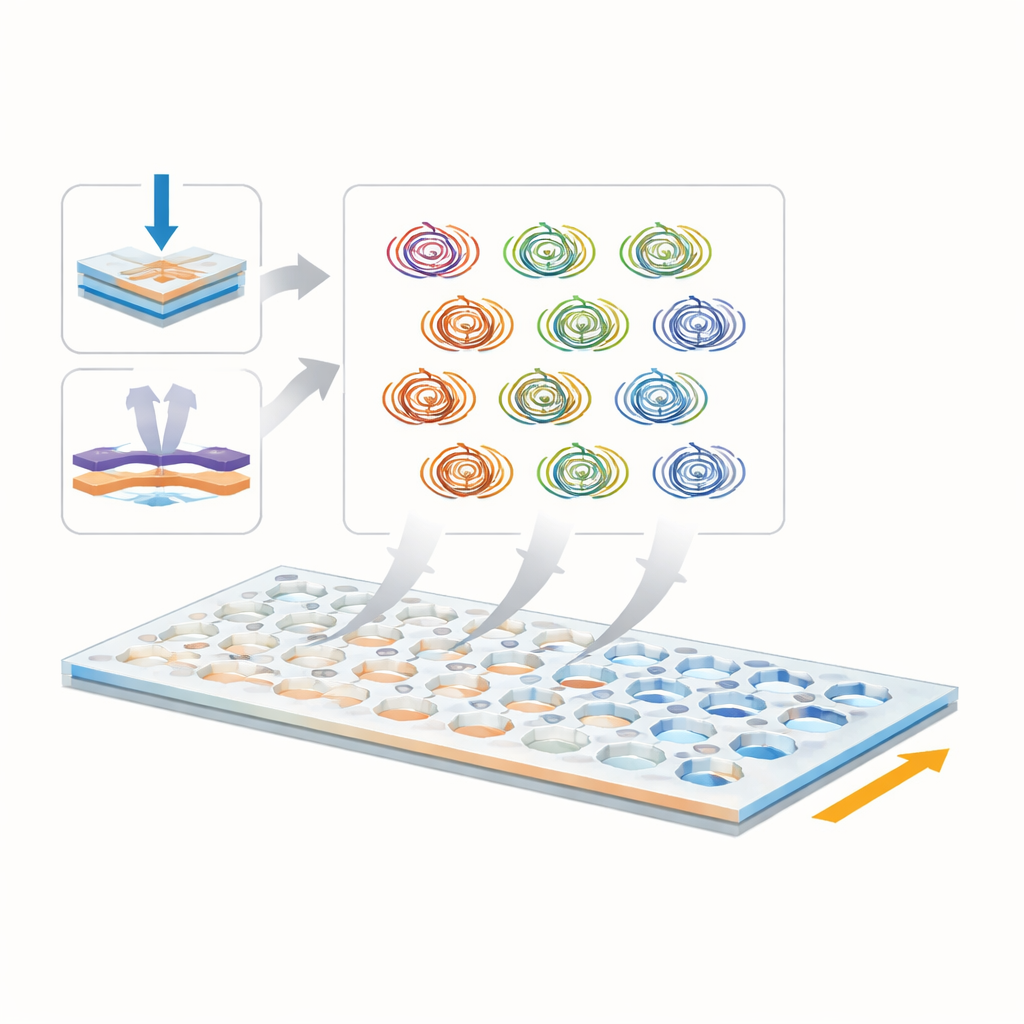
Keeping Skyrmions Stable and Moving Straight
To be useful in technology, these magnetic whirlpools must survive heat and magnetic fields, and move predictably under electric currents. Using large‑scale spin simulations, the team maps out how the skyrmion patterns evolve with temperature and external magnetic field. They find that hybrid skyrmions in TcIrGe2Se6 persist over wide ranges, including temperatures from near absolute zero up to around 280 K and magnetic fields up to about 17 tesla. The skyrmions can be very small, on the order of ten nanometers across, suitable for dense data storage. By analyzing their motion, the authors show that the special mixed twisting angles cause the sideways drift, known as the skyrmion Hall effect, to nearly vanish. In practice, when a current is applied, the hybrid skyrmions move almost exactly along the current direction, avoiding destructive collisions with device boundaries.
Electric and Mechanical Control Knobs
This two‑dimensional multiferroic offers several independent levers to tune the skyrmions. Reversing the electric polarization flips the skyrmion chirality and subtly alters their trajectory, enabling electrical “on‑the‑fly” routing and binary encoding. In addition, the authors explore how uniform stretching or compressing the sheet changes the magnetic interactions. Within a certain strain window, the mixed twisting remains strong and the skyrmion Hall angle stays close to zero, but the internal helicity shifts. Under stronger compressive strain, the system undergoes a topological makeover: skyrmions transform into elongated structures called bimerons, essentially vortex pairs living in the plane. These findings reveal that strain can serve as a mechanical dial to reconfigure the type and behavior of the topological textures without changing the material’s composition. 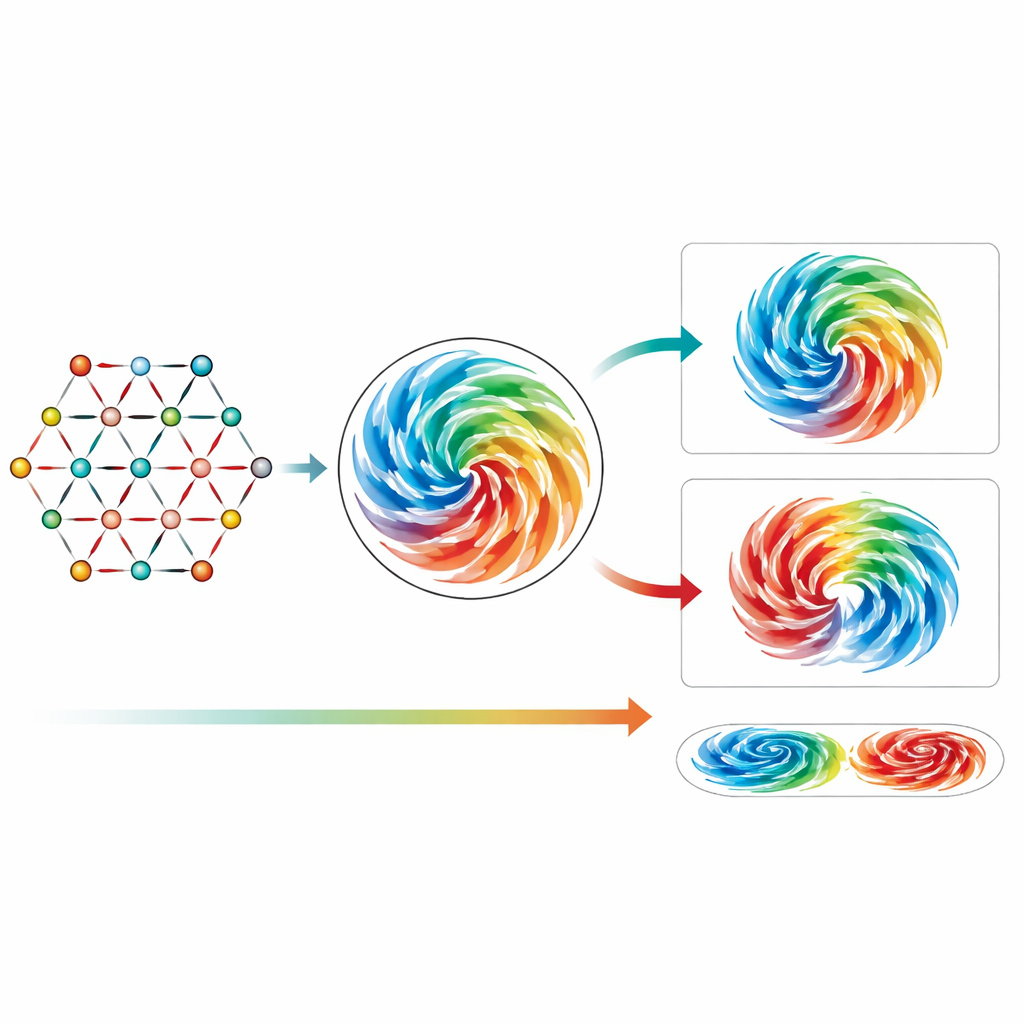
Why These Tiny Whirlpools Matter
In simple terms, this work identifies a single‑layer crystal where tiny magnetic whirlpools are not only robust and densely packable, but also can be pushed straight along a track and steered by both electric fields and gentle stretching. By combining magnetic order, switchable electric polarization, and flexible mechanics in one material, TcIrGe2Se6 emerges as a promising playground for future spin‑based electronics. Devices built on such controllable hybrid skyrmions could store and process information with far less energy than today’s charge‑based technologies, while exploiting the rich internal structure of these nanoscale whirlpools for new kinds of logic and memory schemes.
Citation: Li, X., Zhou, M., Wei, Y. et al. Hybrid magnetic skyrmions with near-zero Hall angle and electrical switchability in a 2D multiferroic. npj Comput Mater 12, 148 (2026). https://doi.org/10.1038/s41524-026-02030-z
Keywords: magnetic skyrmions, two-dimensional materials, multiferroics, spintronics, topological magnetism