Clear Sky Science · en
Discovery of a novel half metallic 2D Cr2Se3 monolayer with high Curie temperature from correlated antiferromagnetic 2D CrSe2
Why tiny magnetic sheets matter
Imagine computers that store information using the direction of an electron’s spin instead of its charge, making devices smaller and more efficient. For that future, engineers need stable, ultra-thin magnets that work at and above room temperature. This study uses computer simulations to show how a known two-dimensional material, chromium selenide, can be transformed into a new magnetic sheet called Cr2Se3 that behaves like a one-spin-only metal and keeps its magnetism even at very high temperatures. 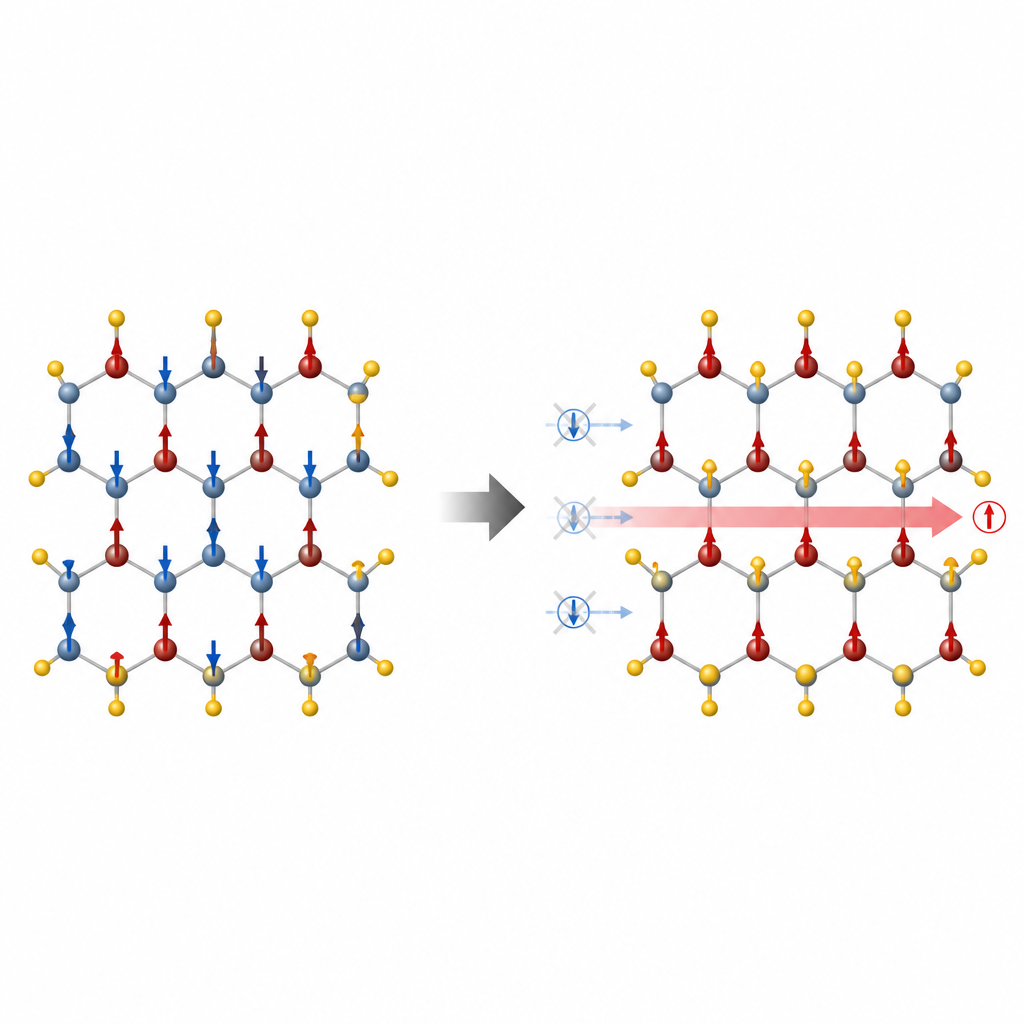
From known crystals to new magnetic behavior
The work starts from a monolayer of CrSe2, a sandwich of chromium and selenium atoms arranged in a honeycomb-like sheet only one atom thick. This sheet can take on two structural shapes, called 1H and 1T, which differ in how the atoms stack. The authors examine how electrons in these sheets arrange their spins and find that both shapes prefer an antiferromagnetic order, where neighboring spins point in opposite directions and cancel out overall magnetism. They use advanced electronic structure methods to test different interaction strengths among chromium’s d electrons and show that the 1T arrangement becomes the more stable form when electron–electron interactions are treated properly.
How electron crowding shapes magnetism
To understand why the 1T sheet is favored, the authors break down the material’s total energy into parts that track how filled the chromium d orbitals are and how strongly spins and orbitals line up. In the 1T case, three low-energy electron levels around each chromium atom each keep a distinct shape, which encourages electrons to stay more localized and makes spin ordering more effective. This boosts antiferromagnetic interactions and nudges the 1T arrangement to be more stable than the 1H one. Simulations of heat-driven spin motion show that the antiferromagnetic order in the 1T sheet lasts up to about 310 kelvin, slightly above typical room temperature, while the 1H sheet orders up to about 274 kelvin.
Turning antiferromagnets into strong ferromagnets
The central step of the study is to deliberately remove some selenium atoms from CrSe2 in a regular pattern, creating so-called line defects that leave behind a chromium-richer sheet with the overall formula Cr2Se3. Depending on whether the starting sheet was 1H or 1T, this restructuring produces two related forms, called H and T phases of Cr2Se3. Both are found to be structurally stable on their own and when placed on a hexagonal boron nitride support, a common non-reactive substrate used in experiments. Unlike the original CrSe2, these new Cr2Se3 sheets are ferromagnetic: their spins align in the same direction, giving a net magnetic moment. More strikingly, they are half metallic, meaning that electrons of one spin type can move freely, while those of the opposite spin see a large energy gap. 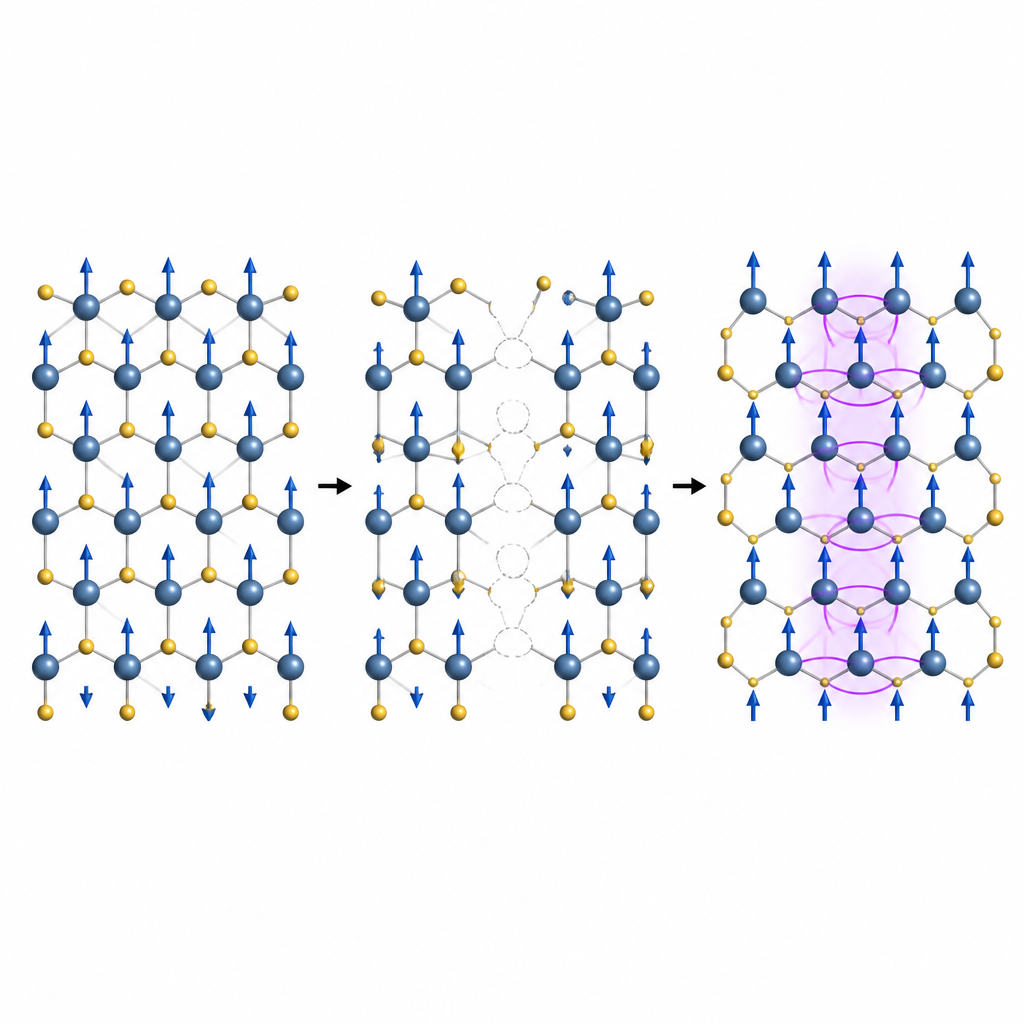
Why the new sheets stay magnetic when hot
The simulations reveal that in Cr2Se3 the low-energy electron levels on chromium lie very close together, leaving some of them only partially filled. This arrangement allows electrons to hop between filled and empty states in a way that strongly favors ferromagnetic alignment. In the H phase, the electron bands near the Fermi level are quite spread out, giving many mobile carriers that support magnetism through an itinerant, or Stoner-like, process. In the T phase, the magnetism is more localized and better described by a Heisenberg model, but it can be pushed toward itinerant behavior by gently stretching the sheet. In both cases, Monte Carlo simulations based on the calculated exchange strengths predict Curie temperatures of roughly 547 kelvin for the H phase and 606 kelvin for the T phase, well above room temperature.
What this means for future spin-based devices
In plain terms, the authors show that by carefully removing rows of atoms from a nonmagnetic or antiferromagnetic two-dimensional crystal, it is possible to create a new single-layer material that conducts only one spin type and remains strongly magnetic at temperatures far above those in everyday electronics. The predicted Cr2Se3 sheets combine high thermal stability, compatibility with common insulating supports, and spin-selective conduction, making them attractive building blocks for ultra-thin memory, logic, and sensing elements that use spin rather than charge to encode information.
Citation: Badawy, K., Zheng, L. & Singh, N. Discovery of a novel half metallic 2D Cr2Se3 monolayer with high Curie temperature from correlated antiferromagnetic 2D CrSe2. npj Comput Mater 12, 177 (2026). https://doi.org/10.1038/s41524-026-02029-6
Keywords: 2D magnets, chromium selenide, half-metal, spintronics, Curie temperature