Clear Sky Science · en
Extraction of the self energy and Eliashberg function from angle resolved photoemission spectroscopy using the xARPES code
Peeking Inside Quantum Materials
Many of today’s most intriguing materials—superconductors, ultra-clean metals, and atomically thin crystals—owe their unusual behavior to how electrons interact with tiny vibrations of the atomic lattice called phonons. Experiments can now take detailed “snapshots” of electrons in these materials, but turning those pictures into a clear, quantitative story about interactions has remained tricky and somewhat subjective. This paper introduces xARPES, a new open-source software tool that turns raw experimental data into a consistent, automated description of how strongly electrons couple to phonons and other scattering channels, helping scientists better understand and compare complex quantum materials.
How We Take Pictures of Electrons
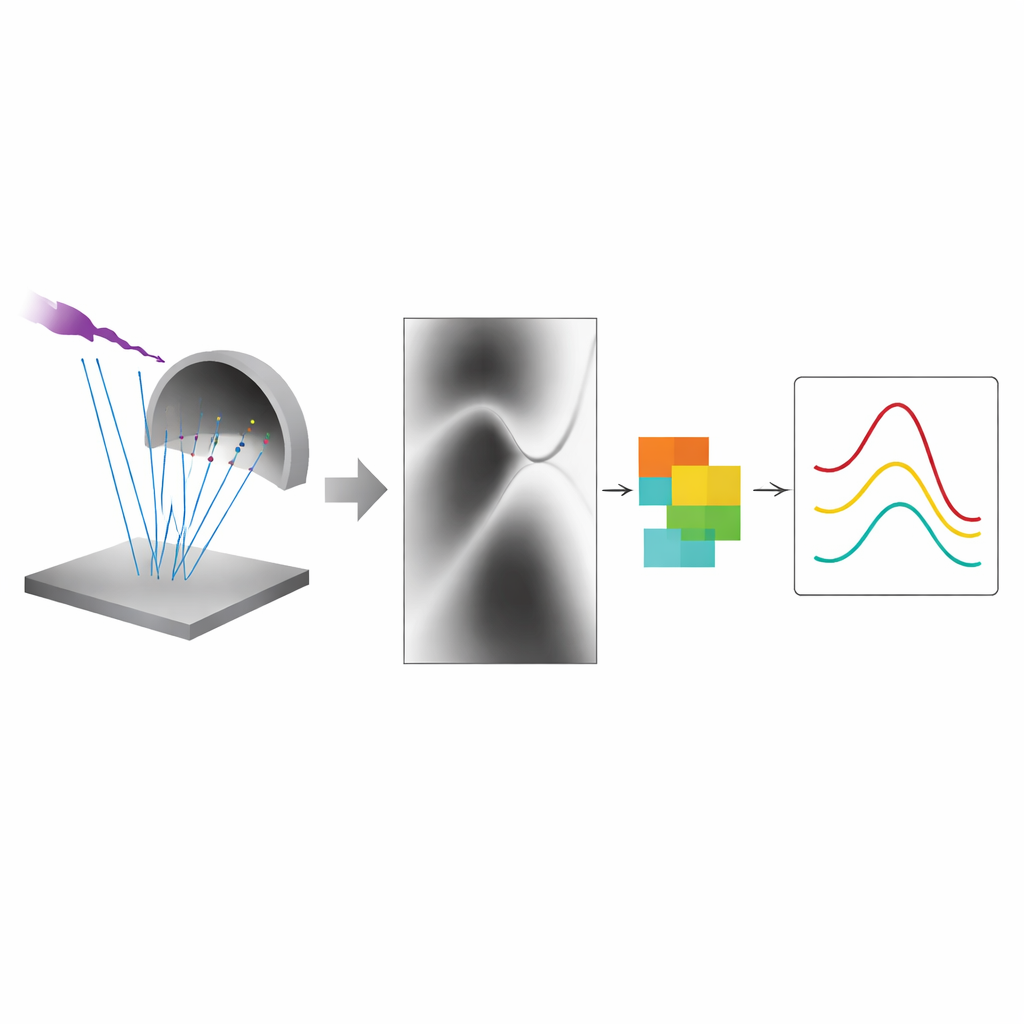
The work centers on angle-resolved photoemission spectroscopy (ARPES), a technique where energetic photons hit a material and eject electrons. By measuring the direction and energy of those electrons, researchers reconstruct how electrons originally moved inside the solid. The outcome is a band map: intensity patterns showing electronic energy as a function of momentum. Subtle bends and “kinks” in these bands reveal where electrons interact with phonons and other excitations. However, the bands are often curved, the signals are broadened by the instrument, and the data contain noise, making it difficult to reliably turn these visual features into quantitative measures of interaction strength and characteristic phonon energies.
From Raw Bands to Interaction Fingerprints
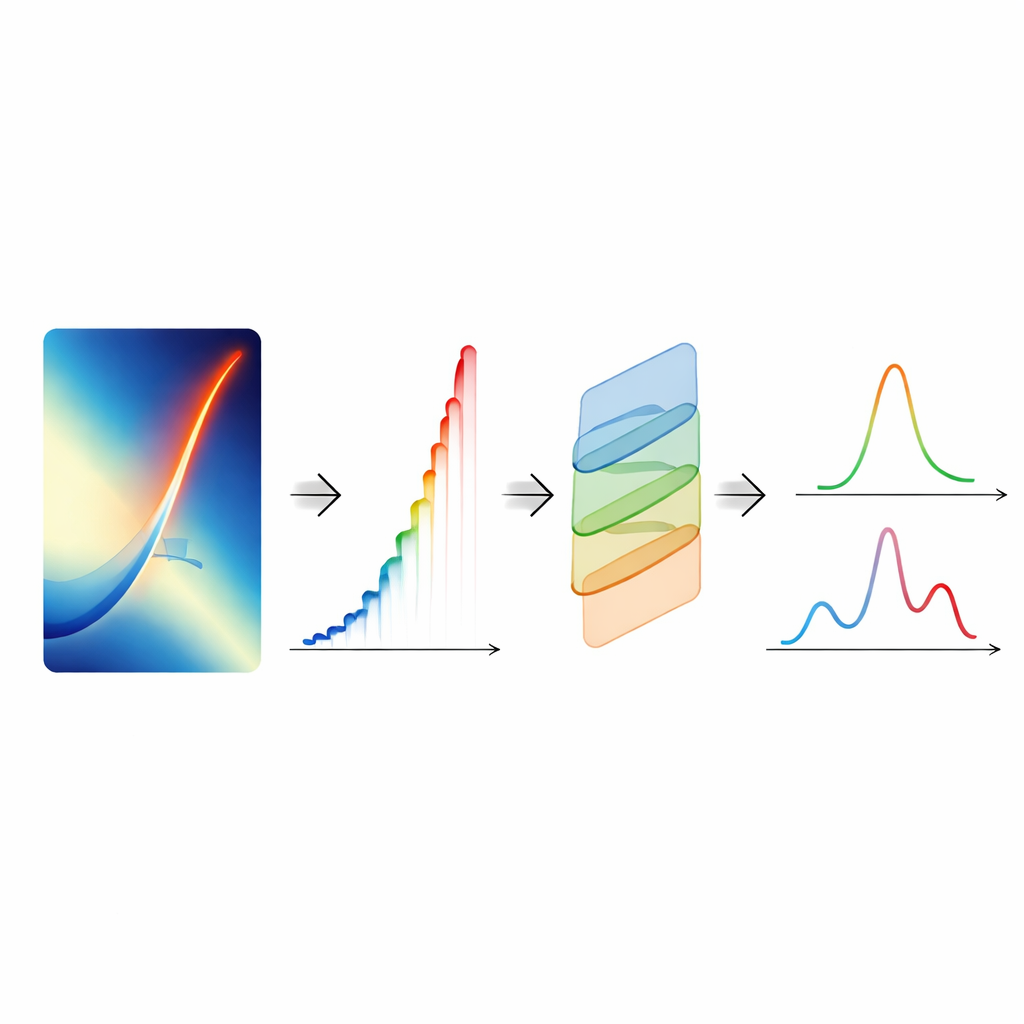
To tackle this, xARPES builds a fully specified model of the measured intensity. First, it describes the underlying, non-interacting electronic band as a polynomial (linear or parabolic in this work), rather than assuming it is perfectly straight. Then it introduces the electron self-energy, a complex function whose real part shifts the band and whose imaginary part broadens it, encoding finite lifetimes. By fitting slices of the data taken at fixed energy—so-called momentum-distribution curves—xARPES extracts how the apparent band position and width change with energy, and from these it deduces the self-energy for that branch of the band. Crucially, the method can include realistic, angle-dependent matrix elements that account for how strongly different states are seen in the experiment, avoiding large biases when the signal is suppressed or enhanced in certain directions.
Turning Kinks into Phonon Spectra
The next step is to separate the different physical processes that contribute to the self-energy. In metals where electron–phonon coupling dominates near the Fermi level, the key quantity is the Eliashberg function. This function tells how strongly electrons couple to phonons at each vibrational energy and directly determines observable properties such as effective mass and, in many cases, superconducting transition temperatures. Extracting it is mathematically an inverse problem: one must reconstruct a positive spectrum from limited and noisy self-energy data. xARPES extends the maximum-entropy method with Bayesian inference to solve this carefully. It uses prior information—such as the requirement that the Eliashberg function must be non-negative and confined to a finite energy range—while automatically optimizing nuisance parameters like band curvature, impurity scattering strength, and electron–electron contributions, rather than leaving them to manual tuning.
Testing the Method on Models and Real Materials
The authors first validate xARPES using artificial data generated from a known band and a chosen Eliashberg function. They add realistic noise and instrumental broadening, then ask whether the code can work backward to reconstruct the original interactions. When the energy resolution is good and the data are sampled densely, the recovered self-energy and Eliashberg function closely match the true input, and the accuracy improves systematically as the data quality increases. They also show that older, widely used approaches that fit simple Lorentzian line shapes to curved bands introduce growing errors at higher binding energies. Applying xARPES to real measurements, the authors analyze a two-dimensional electron liquid at the surface of SrTiO₃, identifying phonon modes associated with specific lattice vibrations and demonstrating that including realistic photoemission matrix elements can change the inferred interaction strengths by more than a factor of two.
Revealing Subtle Symmetries in Graphene
As a second showcase, the authors study lithium-doped graphene, where electrons in the “Dirac cones” interact strongly with in-plane phonon modes. Here, the bands are nearly linear, and xARPES uses its linear-dispersion mode to extract the self-energy separately for two symmetry-related momentum cuts. The resulting Eliashberg functions from the left and right sides of the cone almost perfectly overlap, revealing a high degree of internal consistency and suggesting that the underlying coupling is the same in both directions, as expected from symmetry. This kind of quantitative comparison, made possible by the automated and statistically grounded framework, points to doped graphene as an excellent benchmark system for testing theories of electron–phonon interactions.
Why This Matters for Future Materials
For non-specialists, the key outcome is that xARPES turns what used to be a partly manual, subjective procedure into a reproducible, probabilistic pipeline. Given a high-quality ARPES data set, the code provides best estimates—and uncertainties—for how strongly electrons scatter from phonons, impurities, and other electrons, and reconstructs the phonon spectrum that most likely explains observed band kinks. Because it is open-source and explicitly designed to connect with first-principles electronic-structure calculations, xARPES offers a shared standard by which experimentalists and theorists can compare results. This should accelerate the design and assessment of novel quantum materials, from more efficient conductors to potential high-temperature superconductors.
Citation: van Waas, T.P., Berthod, C., Berges, J. et al. Extraction of the self energy and Eliashberg function from angle resolved photoemission spectroscopy using the xARPES code. npj Comput Mater 12, 172 (2026). https://doi.org/10.1038/s41524-026-02026-9
Keywords: angle-resolved photoemission, electron-phonon coupling, Eliashberg function, self-energy extraction, xARPES software