Clear Sky Science · en
Integrated thermodynamic modeling of composition and strain tunable ferroelectricity in Wurtzite Zn1-xMgxO
Smarter Materials for Cooler, Faster Computers
Modern computers waste a surprising amount of energy just shuttling data back and forth between memory and processors. Ferroelectric materials—crystals that can remember an electrical state even when power is off—offer a path to smaller, faster, and more efficient memory. This paper explores a promising ferroelectric made from zinc oxide and magnesium, and shows how carefully tweaking its recipe and stretching it as a thin film could unlock powerful new devices for future low-energy computing.
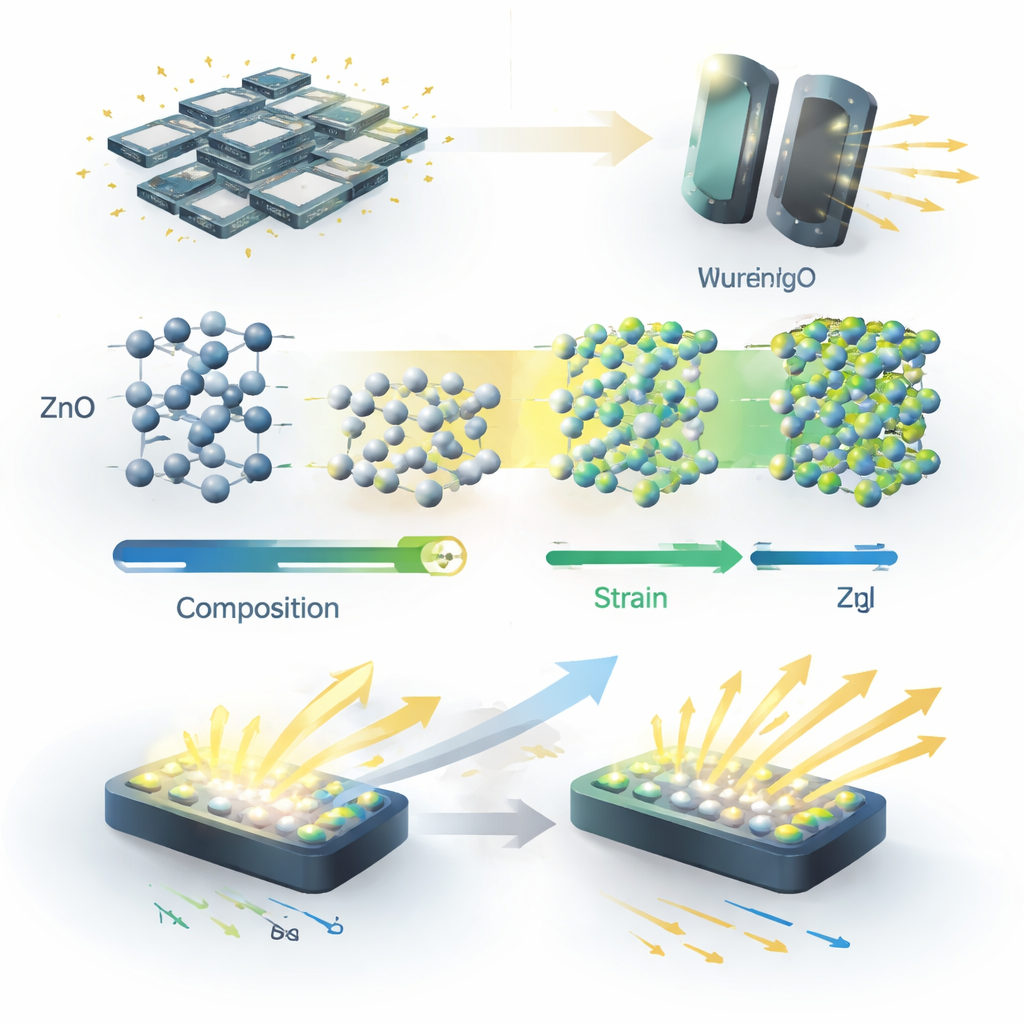
A New Spin on a Familiar Crystal
For decades, electronics have relied on complex ferroelectric compounds that work well but are hard to manufacture alongside mainstream semiconductor chips and often lose their special properties when shrunk down. Recently, simpler materials once thought unsuitable have surprised researchers. By subtly changing their structure—through chemical additives or mechanical strain—these modest oxides can suddenly behave like robust ferroelectrics. One such candidate is zinc oxide, a well-known material in transparent electronics, which takes on new life when some of its zinc atoms are replaced by magnesium to form Zn1‑xMgxO.
Why Mixing Magnesium Is Tricky
At the atomic level, this material can adopt two main crystal arrangements: a polar “wurtzite” form that can host ferroelectricity, and a non-polar “rocksalt” form that cannot. The authors first use a thermodynamic modeling approach, known as CALPHAD, to map out which crystal structure is favored at different temperatures and compositions. Under true equilibrium conditions, only a very small amount of magnesium can dissolve into the wurtzite structure before the system prefers to break into a mixture of wurtzite and rocksalt. This is at odds with experiments, which routinely report single-phase wurtzite films with much higher magnesium content. To reconcile this, the authors focus on a special boundary—the so‑called T0 line—where the energies of pure wurtzite and pure rocksalt cross. This line serves as a practical upper limit for how much magnesium can be locked into a metastable wurtzite state during fast, non-equilibrium film growth.
Peering Inside with Quantum Calculations
Next, the researchers perform detailed quantum-mechanical (DFT) calculations across the full range from pure zinc oxide to pure magnesium oxide, always in the wurtzite arrangement. These calculations reveal how the crystal’s shape, stiffness, electric polarization, and electromechanical coupling change as magnesium content increases. As more magnesium is added, the crystal squashes along one direction, its built-in polarization steadily weakens, and most elastic constants soften, though resistance to certain shearing motions actually grows. The team distills these rich data into simple mathematical expressions, then feeds them into a phenomenological Landau‑Devonshire model—a compact formula that connects polarization, strain, and energy. This unified description shows that wurtzite Zn–Mg–O remains polar across the entire meaningful composition range, and quantifies how much energy separates it from a closely related non-polar structure.
Stretching Thin Films to Tune Their Behavior
The most technologically relevant form of this material is an ultra-thin film grown on a rigid substrate. In that setting, the substrate forces the film to stretch or compress in-plane, a condition known as epitaxial strain. By combining their thermodynamic and Landau‑Devonshire tools, the authors examine how this strain alters both which phase is stable and how strong the ferroelectric response is. They find that in thin films, strong in‑plane stretching can stabilize magnesium-rich wurtzite that would otherwise collapse into rocksalt, effectively widening the usable composition window. At the same time, compressive strain tends to boost polarization, while tensile strain reduces it but significantly enhances the material’s ability to store electrical energy and to convert between mechanical and electrical signals. Near a strain‑driven transition to a non-polar state, these dielectric and piezoelectric responses become especially large, offering a powerful knob for device design.
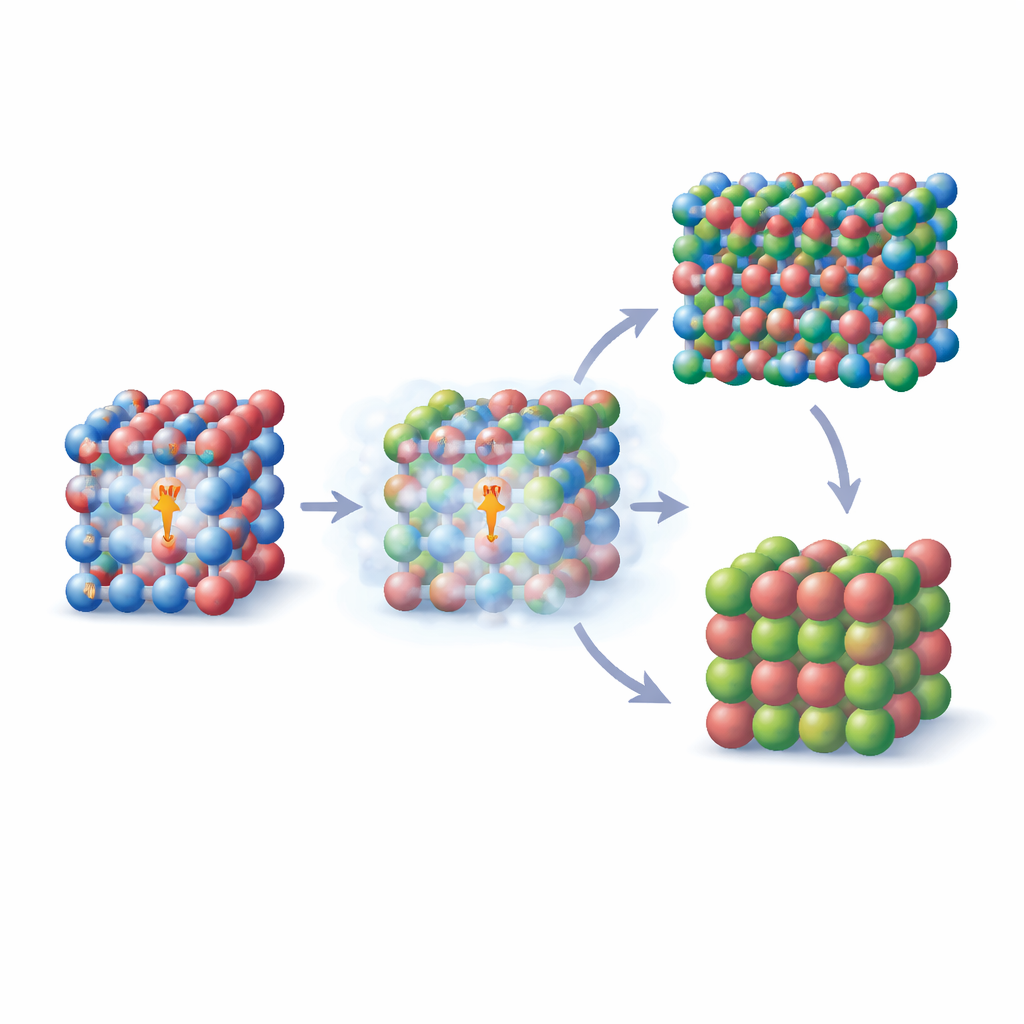
Guiding the Search for Better Memory Materials
In plain terms, this work delivers a roadmap for engineering a promising ferroelectric oxide by adjusting two dials: how much magnesium is mixed into zinc oxide, and how much the film is stretched or compressed on a substrate. The combined modeling framework not only explains why experiments can stabilize magnesium-rich ferroelectric films far beyond equilibrium limits, but also predicts where the best trade‑off between stability, polarization, and electromechanical response is likely to be found. Because the same strategy can be applied to other wurtzite oxides and nitrides, it offers a general toolkit for designing the next generation of energy‑efficient memories, sensors, and nano‑devices without relying solely on trial‑and‑error in the lab.
Citation: Chak, K.H.S., Bhattarai, B., Meng, A.C. et al. Integrated thermodynamic modeling of composition and strain tunable ferroelectricity in Wurtzite Zn1-xMgxO. npj Comput Mater 12, 154 (2026). https://doi.org/10.1038/s41524-026-02021-0
Keywords: ferroelectric materials, zinc magnesium oxide, epitaxial strain, thermodynamic modeling, energy-efficient memory