Clear Sky Science · en
Boundary sensitivity in finite-sized artificial spin ice explored via AI-assisted genetic algorithms
Magnetic puzzles made of tiny bar magnets
Imagine a tabletop made of thousands of tiny bar magnets, each one able to flip only left or right. These magnets jostle and compete, creating beautiful but hard‑to‑predict patterns. Such “artificial spin ice” systems are more than curiosities: they are test beds for future computing devices, data storage, and exotic magnetic materials. This paper shows how a new blend of artificial intelligence and evolutionary search can untangle one of their toughest riddles: what overall pattern do the magnets prefer when the array is finite and has edges?
Why edges matter in magnetic tilings
In an ideal, infinite sheet of artificial kagome spin ice — a pattern built from corner‑sharing triangles — the magnets settle into a well‑ordered repeating state that theory has mapped out. But in any real device the lattice is cut into a finite shape with boundaries. These edges subtly favor some local magnet arrangements over others, and long‑range magnetic forces then spread those preferences inward. Because there are astronomically many ways for the magnets to point, traditional methods like simulated annealing often get stuck in “good but not best” patterns. The challenge is to find the genuine lowest‑energy arrangement, or ground state, for specific shapes and boundary types.
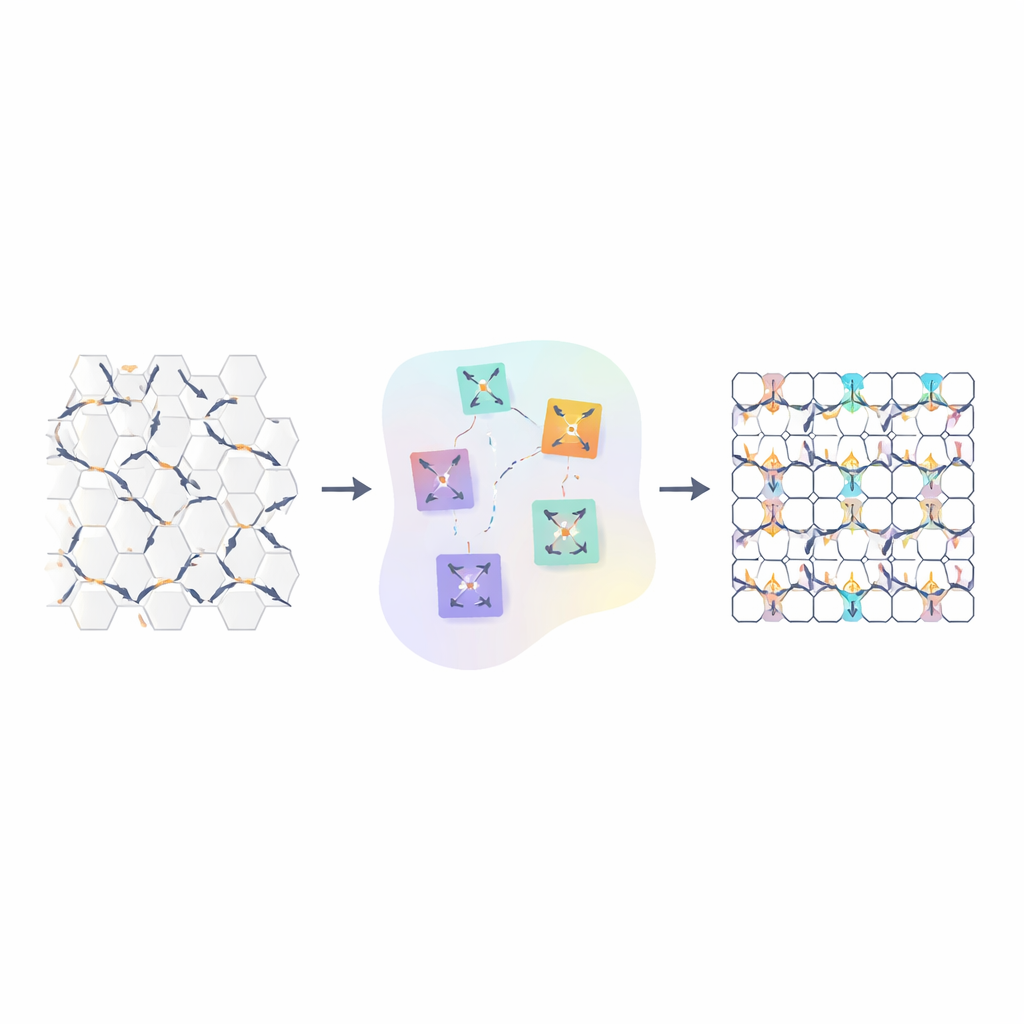
An AI and evolution loop for exploring possibilities
The authors build a “virtuous cycle” that pairs a deep‑learning model called a variational autoencoder with a genetic algorithm, both guided by physics. First, computer simulations generate tens of thousands of reasonably low‑energy magnetic patterns. The autoencoder learns to compress each detailed pattern into a compact numerical fingerprint and then reconstruct it. The genetic algorithm then works not on the raw magnets, but in this compressed space: it mixes and mutates the fingerprints, decodes them back into full magnetic patterns, and keeps those with lower energy. The very best candidates are fed back to retrain the autoencoder, sharpening its focus on the truly interesting region of possibilities. Repeating this loop allows the search to escape local traps that defeated standard approaches.
What the ground states reveal about edges
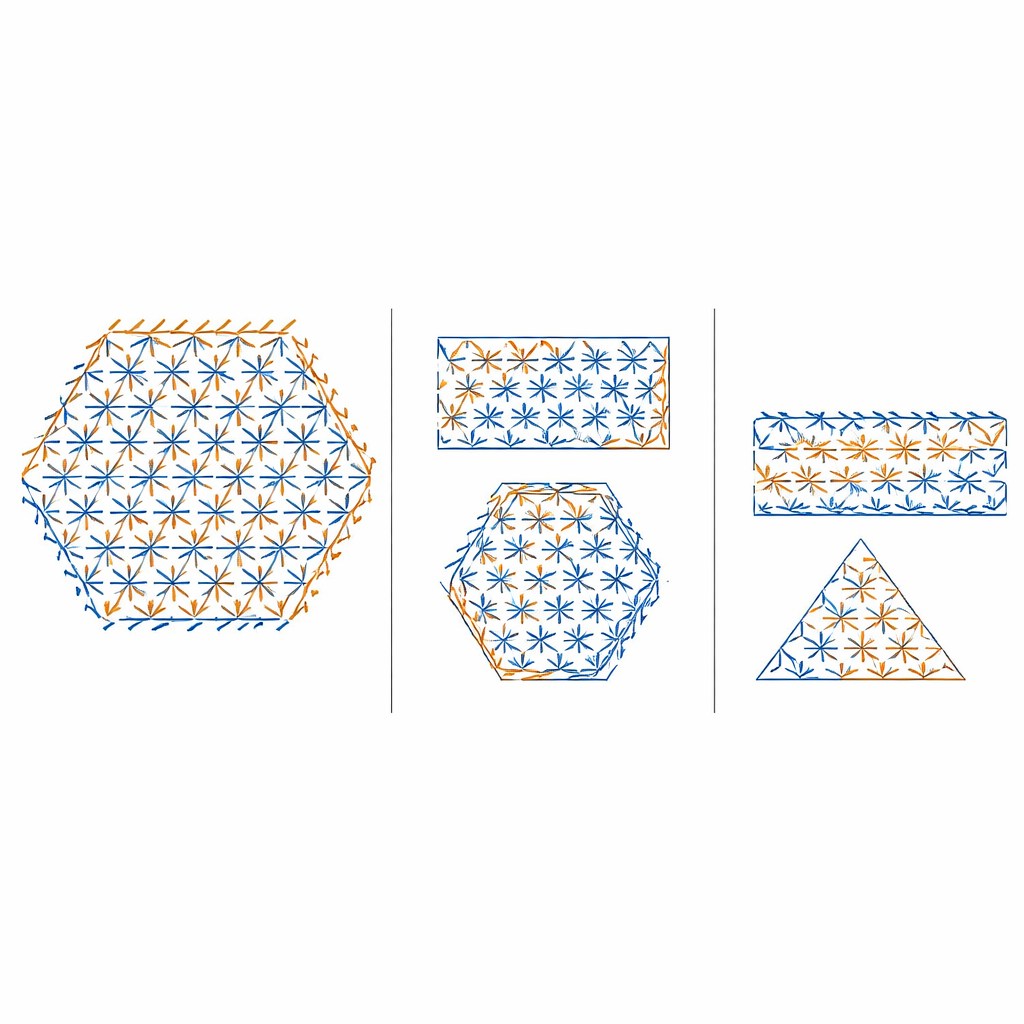
Using this pipeline on large kagome arrays, the team recovers the known bulk ground state in the interior while carefully tracking how the edges behave. For common “zigzag” boundaries, they find that edge disturbances fade within roughly two hexagon layers, so the interior quickly regains the ideal repeating order. Other edge shapes, called “armchair” terminations, behave more delicately: small changes in the overall shape or in whether certain edge spins are pinned can flip the preferred edge pattern while leaving the interior almost unchanged. By comparing many geometries — rectangles, hexagons, triangles, and pinned variants — the study shows that one can steer the net magnetic moment along the boundary simply by tailoring the outline of the array, without applying any external magnetic field.
New phases under extreme confinement
When the kagome array is squeezed into a very long, narrow strip with zigzag edges on top and bottom, something more dramatic happens. The usual interior order no longer wins. Instead, the AI‑assisted search uncovers a new “quasi‑ferromagnetic” phase: most magnets line up along one horizontal direction, giving the whole strip a strong net magnetization. This comes at the cost of creating domain walls — narrow regions where the preferred pattern is interrupted — but in extreme confinement the gain from having strongly aligned edges outweighs the penalty of those internal defects. Calculations of average magnetization and energy per magnet show that this ferromagnet‑like order becomes stable as the strip gets longer.
Implications for designing future magnetic materials
Viewed in simple terms, this work shows that the “personality” of a frustrated magnetic material is set not just by the magnets themselves, but also by how you cut its edges and how tightly you confine it. Some boundary shapes are robust and predictable; others act like tunable knobs for steering magnetic patterns and overall moments. The AI‑driven search pipeline developed here provides a general recipe for discovering such edge‑controlled states in many‑body systems that are otherwise too complex to explore exhaustively. That makes it a promising tool for engineering custom magnetic textures and, more broadly, for finding hidden states in other intricate physical systems.
Citation: Moon, T.J., Park, S.M., Yoon, H.G. et al. Boundary sensitivity in finite-sized artificial spin ice explored via AI-assisted genetic algorithms. npj Comput Mater 12, 138 (2026). https://doi.org/10.1038/s41524-026-02016-x
Keywords: artificial spin ice, kagome lattice, magnetic metamaterials, machine learning in physics, genetic algorithms