Clear Sky Science · en
Accurate screening of functional materials with machine-learning potential and transfer-learned regressions: Heusler alloy benchmark
Why faster materials discovery matters
Modern technologies, from electric cars to data centers, rely on specialized materials whose internal structure is tuned for a very specific job. One important class, known as Heusler alloys, can act as powerful, lightweight magnets for use in sensors, memory devices, and spintronics. But finding the rare compositions with the right combination of stability and magnetic behavior has been painfully slow, because each candidate normally requires heavy quantum‑mechanical calculations. This paper shows how advanced machine‑learning models can take over most of that work, sifting through hundreds of thousands of possibilities and spotlighting the few most promising materials far more quickly than before.
Searching a vast landscape of alloys
The authors focus on a large and structurally rich family of materials called Heusler compounds, made by combining metallic and main‑group elements in a regular crystal pattern. Earlier computer‑driven searches using quantum calculations had already combed through simpler, three‑element versions and found that only about half a percent met strict demands for both stability and strong magnetic directionality. In this study, the team greatly widens the search to more complex four‑element mixtures and to versions built entirely from transition metals, creating more than 230,000 distinct chemical recipes to examine. Exploring such an enormous design space with conventional methods alone would be computationally overwhelming.
Machine learning as a stand‑in for heavy calculations
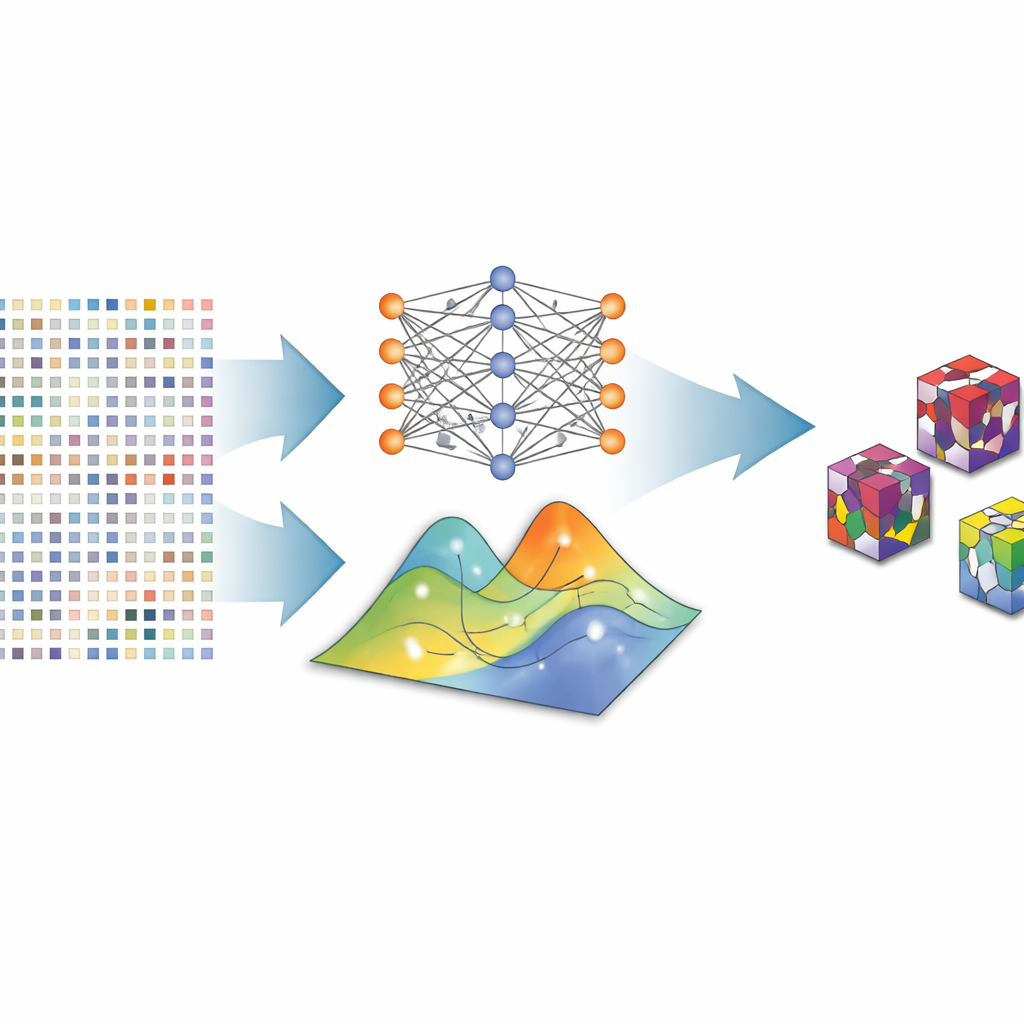
To tame this complexity, the researchers build a “high‑throughput” workflow in which machine‑learning models mimic the steps that quantum calculations would usually perform. One model type, called a universal interatomic potential, learns the energy of a crystal from many known examples and can quickly relax an initial guess into its most stable shape. Another set of models, called regressors, then take these relaxed structures and predict key properties: whether atoms vibrate stably, whether the material is magnetic, how hot it can get before losing magnetism, and how strongly its magnetization prefers to point along a particular direction. By chaining these models together, the authors can screen each candidate material in a fraction of a second instead of hours.
Borrowing knowledge through transfer learning
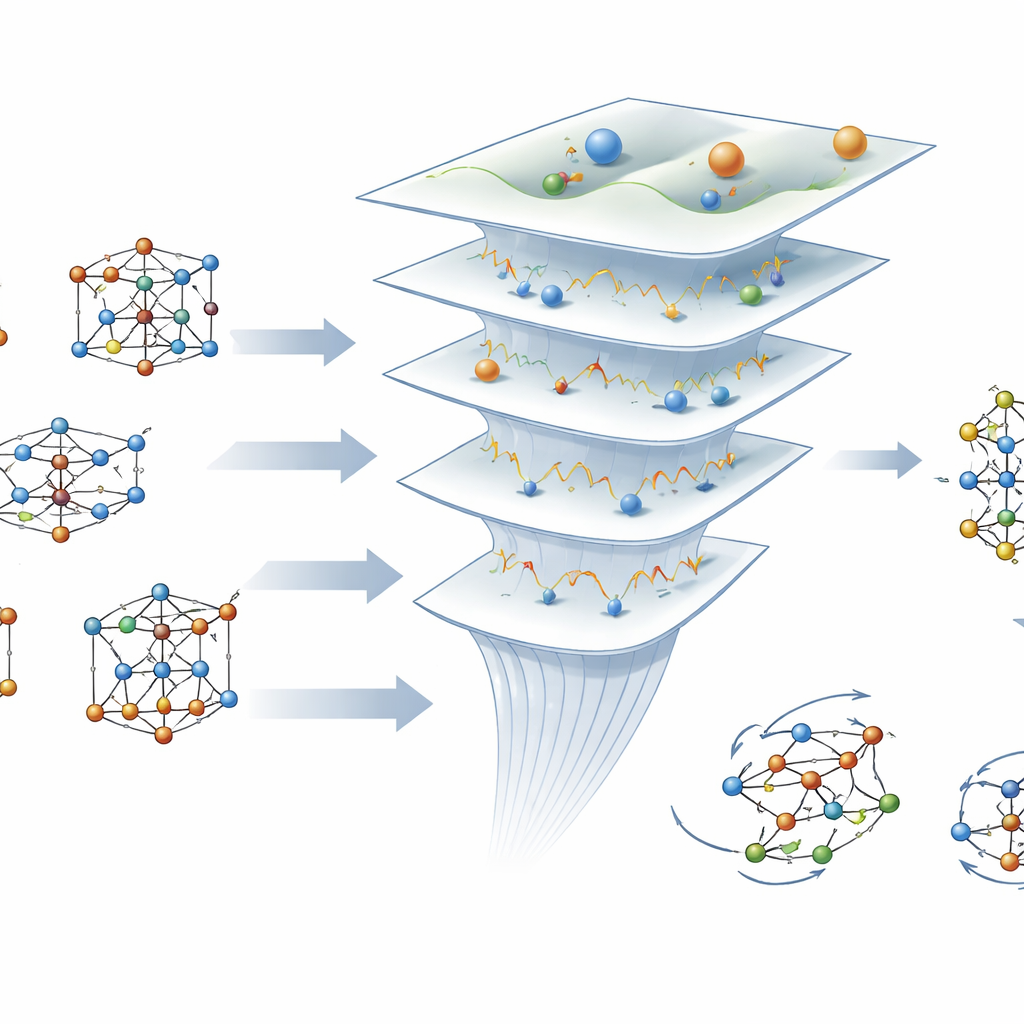
A central innovation is how the property‑prediction models are trained. Rather than starting from scratch on a relatively small Heusler dataset, the authors begin with a powerful potential that was previously trained on tens of millions of atomic environments spanning much of the periodic table. They “freeze” the early layers of this model, which already encode general rules about how atoms interact, and only retrain the final layers to output magnetic and vibrational properties. This transfer‑learning strategy both improves accuracy and helps the models handle alloys containing elements or combinations they never saw during training. Tests in which entire groups of elements were withheld during training show that this borrowed knowledge substantially boosts performance on unfamiliar chemistry.
Finding rare magnetic gems and checking them carefully
Running the full machine‑learning pipeline on all candidates, the team identifies 334 four‑element Heusler alloys and 924 all‑metal Heuslers that appear thermodynamically stable and possess strong magnetic anisotropy along with robust magnetic order and vibrational stability. To verify that the shortcut is trustworthy, they then perform full quantum‑mechanical calculations on every selected candidate. For most screening criteria, between about 80 and 99 percent of the machine‑chosen materials pass the more exacting tests, demonstrating that the models are not only fast but also highly precise. The study also compares several rival machine‑learning potentials and older graph‑based models, finding that the newest smooth, expressive potential combined with transfer‑learned regressors delivers by far the best balance of speed and reliability.
Speeding up discovery well beyond magnets
Beyond the specific list of new Heusler magnets uncovered here, the work’s broader message is that machine‑learning models can now stand in for costly quantum calculations across much of a standard screening pipeline. The authors estimate that a purely quantum‑based survey of the same chemical space would require orders of magnitude more computing time than their hybrid approach, even before any experimental work begins. By treating the machine‑learning models as drop‑in replacements for structure relaxation and property evaluation, and refining them as new high‑quality data arrive, researchers can explore far larger design spaces for magnets, thermoelectrics, batteries, and other functional materials. In practical terms, this means that the rare, best‑in‑class materials needed for future technologies can be found sooner and at far lower computational cost.
Citation: Xiao, E., Tadano, T. Accurate screening of functional materials with machine-learning potential and transfer-learned regressions: Heusler alloy benchmark. npj Comput Mater 12, 133 (2026). https://doi.org/10.1038/s41524-026-02013-0
Keywords: machine learning interatomic potentials, Heusler alloys, high-throughput screening, magnetic anisotropy, materials discovery