Clear Sky Science · en
Ultra-fast design and application of non-heat-treatable integrated die casting aluminum alloys
Why Faster Metal Design Matters for Cars
Modern electric cars increasingly rely on large single-piece metal parts that are lighter, cheaper to make, and easier to assemble. But creating new aluminum recipes tough enough to survive crashes and everyday use has traditionally taken many years of trial and error. This paper shows how a team compressed that cycle into just five months by combining computer learning with focused experiments to create a new aluminum alloy for giant die-cast car floor sections—no extra heat treatment required.
From Dozens of Parts to One Giant Casting
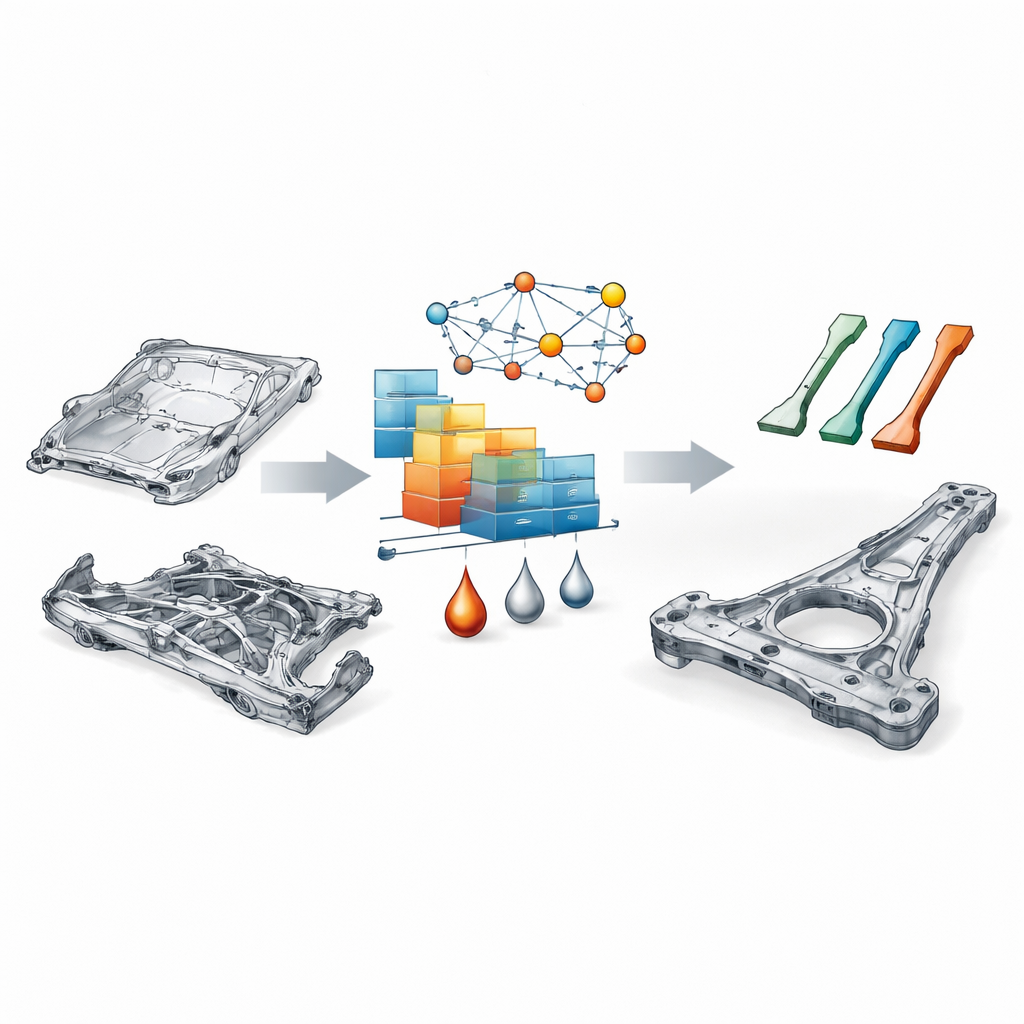
Automakers are shifting from welding together many small pieces to squeezing molten aluminum into huge molds that form entire rear floor structures in one shot. This saves weight and production time, but it also creates long, twisting flow paths where the metal cools unevenly and can form tiny voids. As a result, the material must be strong, stretchy, and easy to cast straight from the mold, without later heating steps that add cost and can warp the part. Existing commercial aluminum casting alloys either flow well but are too weak, or are strong but brittle, leaving a gap for better materials.
Teaching a Computer to Choose a Better Recipe
The researchers focused on aluminum–silicon alloys, the workhorses of high-pressure die casting. They assembled a data set of 80 known alloys from past studies, each with measured strength and stretchiness, and with carefully recorded amounts of eight elements such as silicon, magnesium, copper, manganese, and titanium. Because these elements interact in complex ways, it is very hard for human intuition alone to find the sweet spot. The team trained several types of machine-learning models to connect composition with three key properties: how much load the metal can take before it breaks, when it begins to permanently deform, and how far it can stretch.
Searching Millions of Possibilities, Then Testing a Few
An artificial neural network turned out to be the most accurate, so the team used it as the engine of a multi-step search. They generated ten million virtual alloy recipes within realistic composition ranges and asked the model to predict their performance. Only alloys that cleared demanding property targets for strength and elongation were kept, then a screening method was applied to pick those that balanced strength and flexibility rather than excelling at just one. From this narrowed group, the researchers chose a few promising candidates to melt and cast into simple test plates, measured their real properties, and then fed the results back into the model for further training. After only three such loops, the design converged on a standout composition.
What Makes the New Alloy Work
The final alloy delivered impressive numbers straight from the mold: high tensile and yield strength paired with more than 12 percent elongation, surpassing previous non-heat-treatable die-cast alloys. Microscopic examinations revealed a fine, uniform structure with helpful strengthening particles formed from magnesium and copper, and with silicon present in a rounded, fibrous form that avoids sharp crack-starting features. Small additions of manganese, titanium, and strontium helped control unwanted iron-rich particles and refine the overall grain structure, supporting both strength and ductility. This matched what the computer model had learned: the best performance arises not from a single magic ingredient, but from a carefully tuned blend.
Proving It in Long, Thin Castings and Real Car Floors
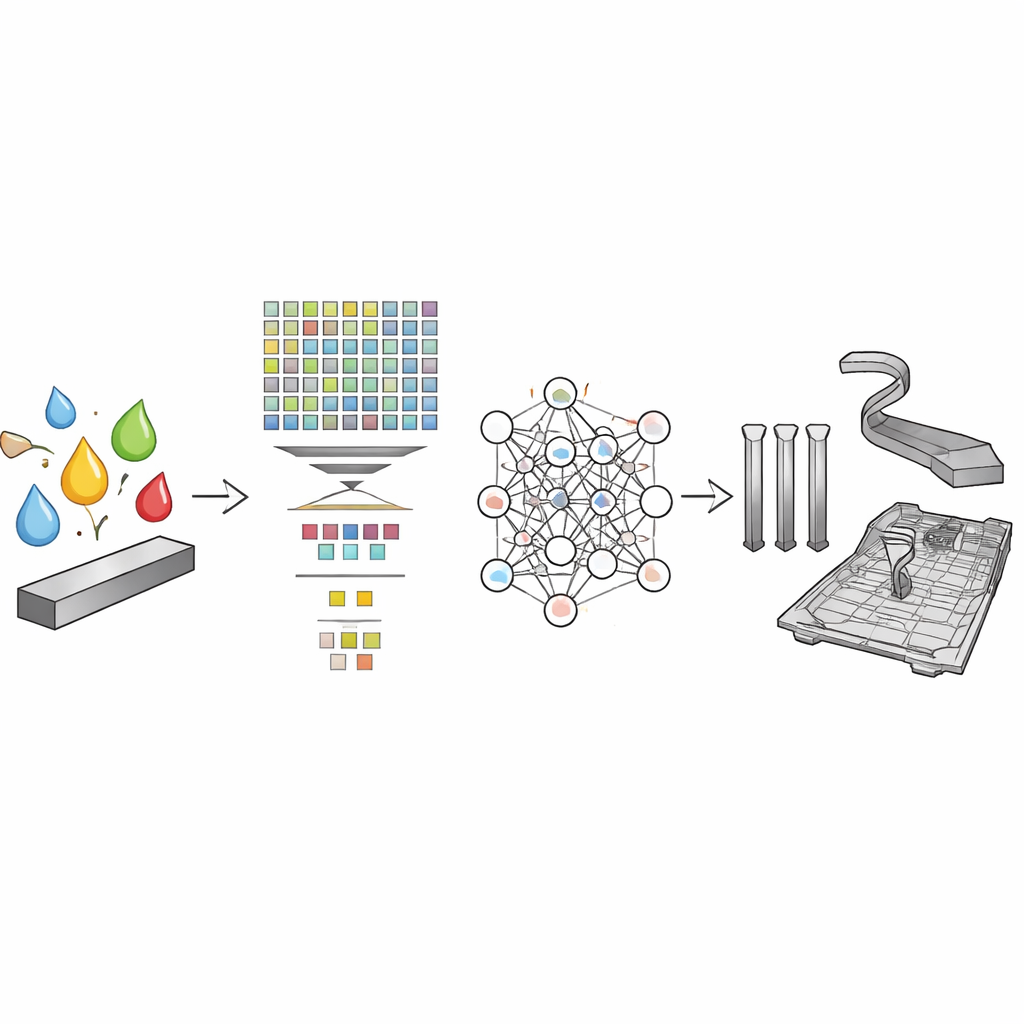
To see whether the alloy would behave well in realistic conditions, the team cast a long, thin, S-shaped test piece where the metal had to travel up to 3.5 meters, mimicking the extreme flow distances in large car parts. They cut samples along the length and found that, although some strength and stretchiness declined as small pores accumulated farther from the gate, the properties stayed above strict industrial thresholds for more than two meters—better than comparable alloys reported in the literature. Finally, the alloy was used to cast a full-size rear floor for a new energy vehicle. Samples taken from different regions of the part all met or exceeded the strength and ductility targets set by the car maker, even in areas with the longest filling distances.
What This Means for Future Materials
The study shows that an iterative loop of data, machine learning, and targeted experiments can turn the long, uncertain search for new metal recipes into a fast, directed process. In only a few months, the researchers went from computer-designed compositions to a validated alloy working in a complex, full-scale automotive component, without relying on extra heat-treatment steps. For non-specialists, the key message is that smarter use of data can unlock lighter, safer, and more efficient vehicles more quickly, and that the same approach can be applied to many other structural metals beyond aluminum.
Citation: Yang, D., Min, J., Yi, W. et al. Ultra-fast design and application of non-heat-treatable integrated die casting aluminum alloys. npj Comput Mater 12, 140 (2026). https://doi.org/10.1038/s41524-026-02010-3
Keywords: die casting aluminum, machine learning materials, automotive lightweighting, alloy design, integrated casting