Clear Sky Science · en
Metastable twin boundary mediating superelasticity and ferroelasticity in monolayer group IV monochalcogenides
Why ultra-thin flexible materials matter
Imagine an electronic skin that can be stretched again and again without tearing, or tiny sensors that bend and snap back perfectly every time. Many metals can do this thanks to a property called superelasticity, but classic semiconductors and ceramics are usually too stiff and brittle. This study shows that several ultra-thin, single-atom-thick crystals made from common semiconductor ingredients can behave in a surprisingly rubberlike way, revealing a new route to truly flexible electronic and optical devices.
A sheet only atoms thick that springs back
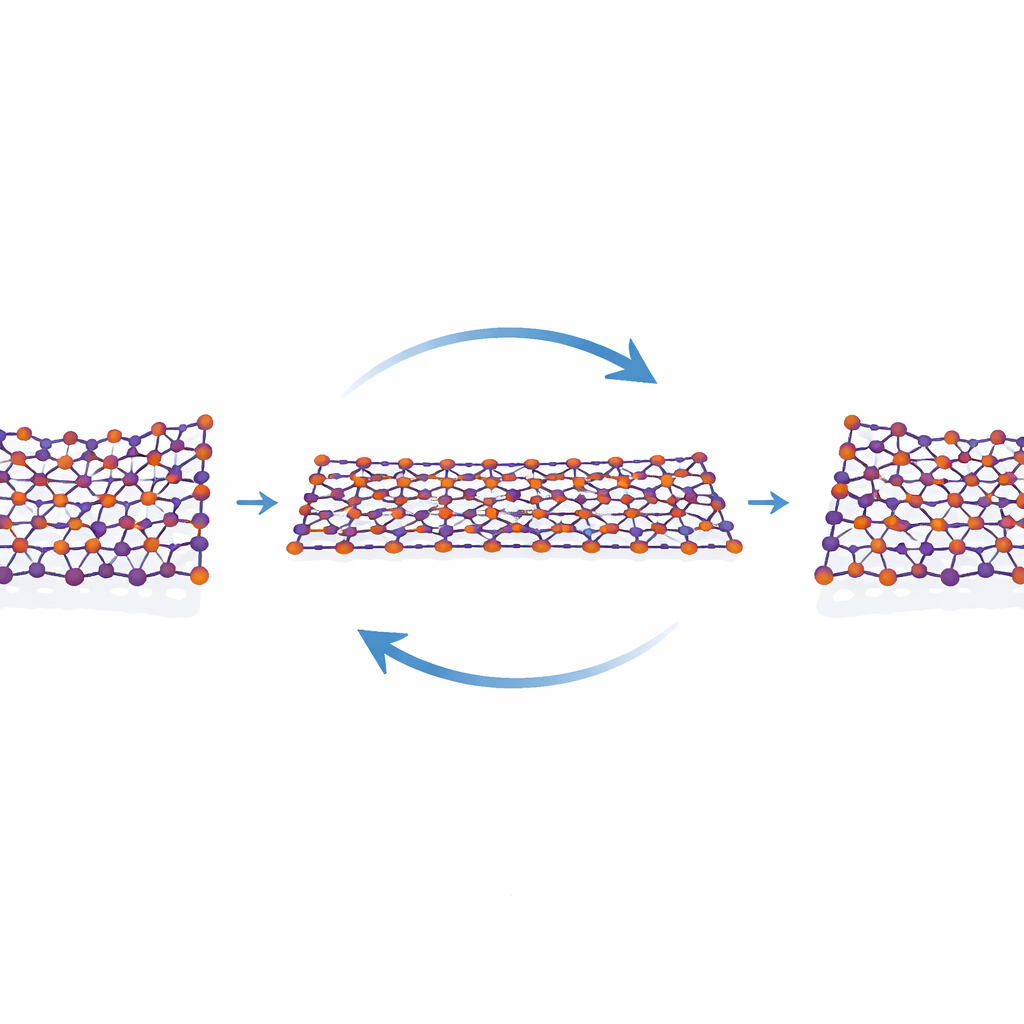
The researchers focus on monolayer GeSe, a crystal just one atom thick that belongs to a family known as group IV monochalcogenides. These materials already attract attention for their unusual electrical and optical behavior. Using powerful quantum-mechanical simulations, the team stretches a virtual sheet of GeSe along one in-plane direction, called the zigzag direction. Instead of simply stretching its bonds until they break, the sheet undergoes a subtle internal rearrangement: pairs of germanium and selenium atoms rotate by about 90 degrees, allowing the layer to change shape and then fully recover when the stretching is released. This kind of repeatable, reversible shape change is the hallmark of superelasticity.
Tiny atomic rotations act like a domino chain
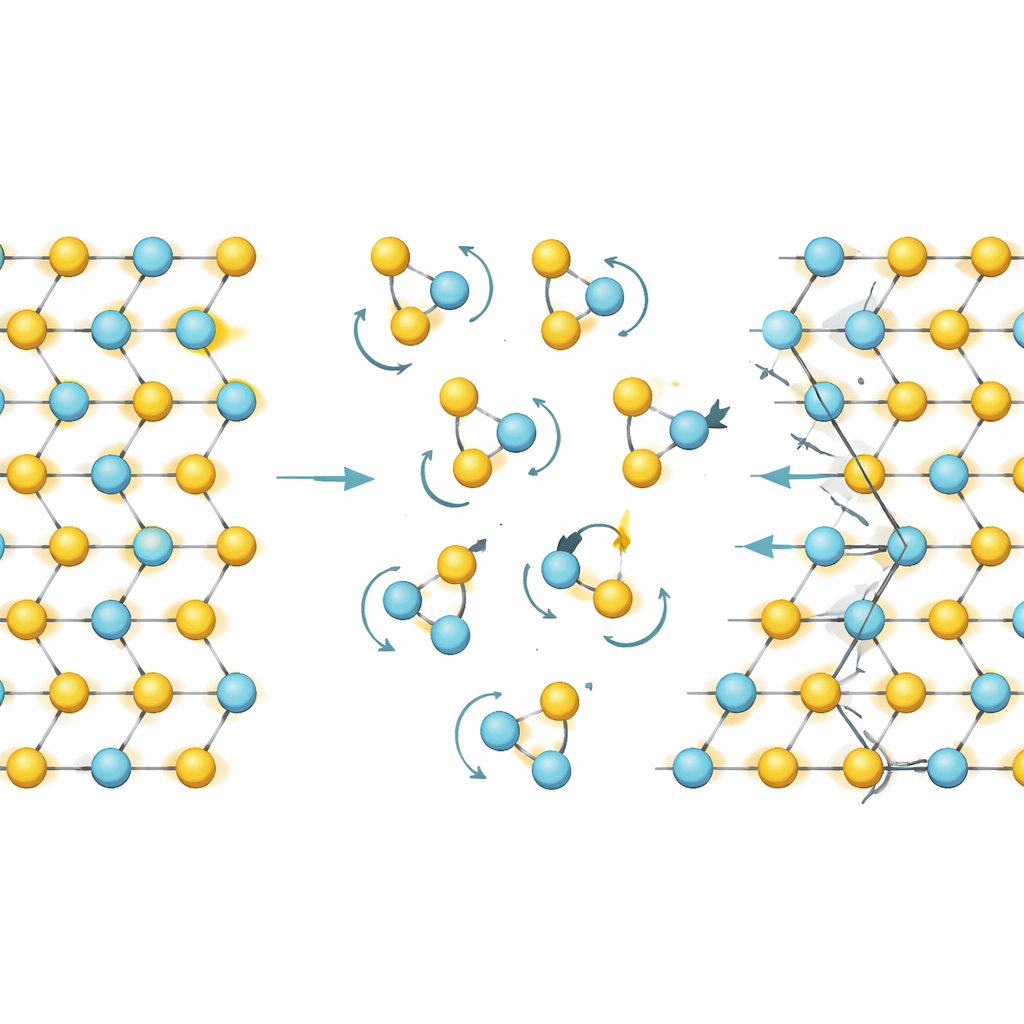
At the heart of this behavior is how electrons are shared between atoms. In GeSe, some bonds behave in a “resonant” way, meaning the bonding electrons are spread out rather than locked between just two atoms. When the sheet is pulled, one particular pattern of vibration softens, making it easier for certain atom pairs to twist. A single rotated pair disturbs the surrounding electron cloud along preferred directions in the crystal. This disturbance nudges neighboring pairs to rotate too, setting off a domino-like sequence of 90-degree rotations that sweeps across the sheet. The result is the formation of a twin domain: a region where the crystal pattern is mirrored relative to the unrotated matrix.
A movable boundary that makes the sheet recover
The line that separates the original and rotated regions is called a twin boundary. The simulations show that this boundary is not just a geometric detail—it controls whether the shape change is truly reversible. Under tension, the energy barrier for forming and moving this boundary drops, so the rotated domain grows and the boundary marches forward. When the strain is removed, the boundary retreats as the energy landscape reverses, shrinking the rotated region until the material returns to its starting state. Stress–strain curves from atomistic simulations reveal a characteristic plateau during this process, closely resembling the response of bulk shape-memory alloys, but now in a single atomic layer.
Sorting superelastic and ferroelastic behaviors
Building on the GeSe case, the authors examine related monolayer materials such as GeS, SnS, SnSe, Bi, and Sb. They compute how easily each layer can form twin domains under stretching or compression and how the energies of the matrix, boundary, and domain compare. GeS and SnS are predicted to be superelastic like GeSe, with twin boundaries that favor reversible motion. In contrast, SnSe, Bi, and Sb tend to show ferroelasticity: they can switch between shapes, but the transformation is less easily reversed once the strain is removed. Under compression along a different in-plane direction (the armchair direction), several of these materials also display ferroelastic changes, suggesting that both pulling and pushing can be used to program their shapes.
What this means for future flexible devices
By demonstrating that superelasticity can exist in atomically thin semiconductors and clarifying how it differs from ordinary ferroelasticity, this work outlines a recipe for designing new flexible materials. In monolayer GeSe and its cousins, reversible motion of twin boundaries enables large, repeatable shape changes without permanent damage. Because these same crystals already offer ferroelectricity, unusual charge flow, and strong light–matter interactions, combining superelasticity with their electronic and optical traits could lead to bendable, stretchable devices that are both robust and multifunctional, from reconfigurable circuits to responsive optoelectronic components.
Citation: Wang, C., Han, K., Ma, B. et al. Metastable twin boundary mediating superelasticity and ferroelasticity in monolayer group IV monochalcogenides. npj Comput Mater 12, 131 (2026). https://doi.org/10.1038/s41524-026-02006-z
Keywords: 2D superelasticity, twin boundaries, flexible electronics, monolayer GeSe, ferroelastic materials