Clear Sky Science · en
Coexistence of magnetism and ferroelectricity in the 2D inorganic molecular crystal SbI3•(S7N)3
Building Tiny Layers with Big Potential
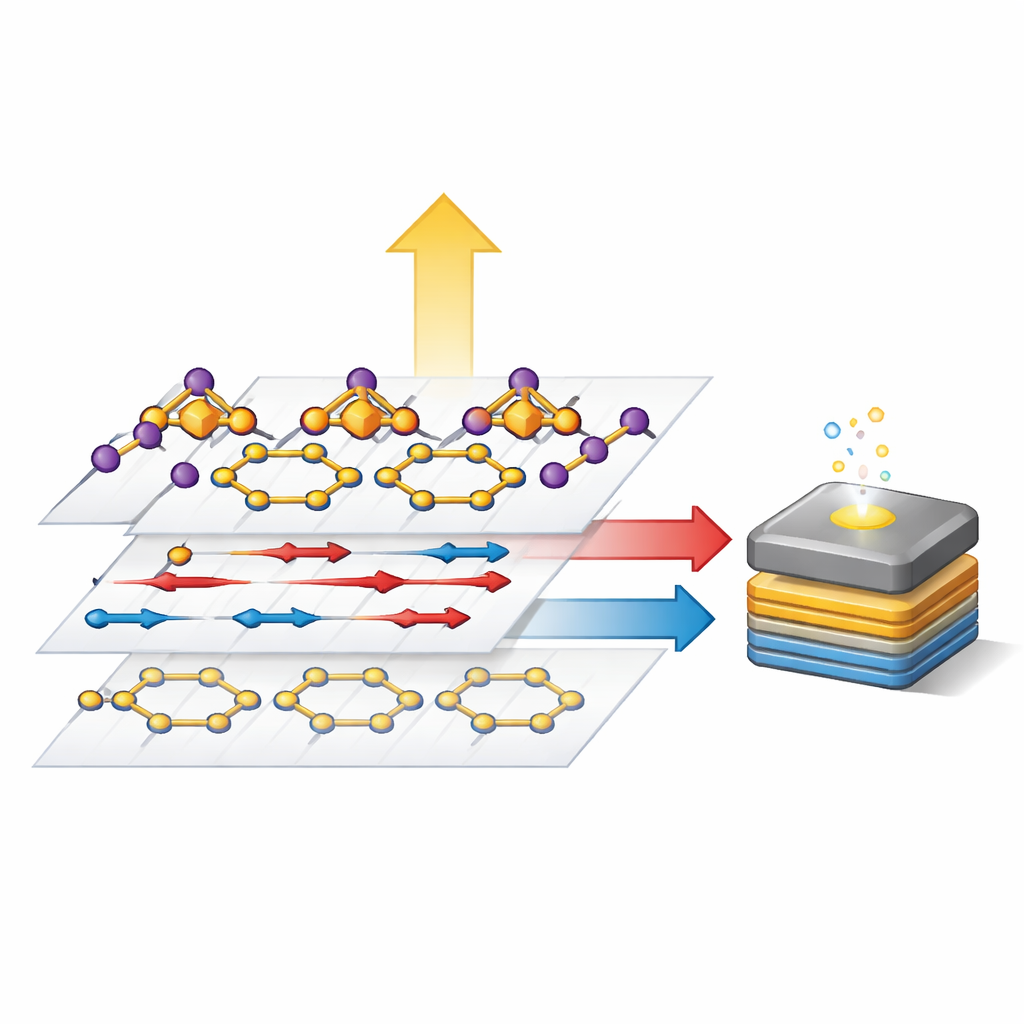
Imagine a material as thin as a single sheet of molecules that can both remember an electric signal and respond like a tiny magnet. Such "two-in-one" behavior is highly sought after for future low‑power memory and sensing technologies. This paper reports a theoretical design for just such a material: an ultrathin crystal made from two kinds of inorganic molecules, carefully chosen and arranged so that electricity and magnetism are tightly coupled and can be steered by an external electric field.
A New Kind of Lego for Flat Materials
The work focuses on two-dimensional inorganic molecular crystals, a young family of materials built from discrete molecules that snap together gently, more like Lego bricks than welded metal. Because the pieces are held by relatively weak forces, researchers can mix and match different molecular units to tune properties with unusual precision. Building on recent experiments that produced related compounds, the authors propose replacing non‑magnetic sulfur rings (S8) in a known material with rings that contain both sulfur and nitrogen (S7N), combined with pyramidal SbI3 molecules. Computer simulations show that this new sheet, called SbI3·(S7N)3, should be structurally stable and within reach of existing growth techniques.
Hidden Patterns of Spins and Charges
At the heart of the design is the way electrons arrange themselves in the S7N rings. The nitrogen atom and its two neighboring sulfurs share electrons in such a way that this three‑atom unit behaves like a tiny magnet, with a net magnetic moment. When many such units are linked across the sheet they form a so‑called kagome‑like network, a triangular mesh known to host unusual electronic states. The calculations reveal that these magnetic units do not all point in the same direction. Instead, their spins form a noncollinear pattern within the plane—a kind of antiferromagnetic state where neighboring moments are arranged in a Y‑shaped configuration, cancelling each other overall while still producing rich internal structure.
Built‑In Electric Imbalance
The same molecular building blocks also carry electric dipoles—separations of positive and negative charge that act like tiny arrows of polarization. In the SbI3 molecules, lone pairs of electrons on the antimony atom push bonds into an asymmetric shape, creating a strong dipole pointing out of the plane. The S7N rings, distorted by the presence of nitrogen, also acquire both out‑of‑plane and in‑plane dipoles. When all molecules are assembled into the crystal, their out‑of‑plane contributions add up, giving the whole sheet a built‑in vertical polarization. However, the in‑plane dipoles of the S7N rings are arranged in a threefold symmetric pattern that makes them cancel each other, so there is no net sideways polarization in the ground state.
Switching with an Electric Field
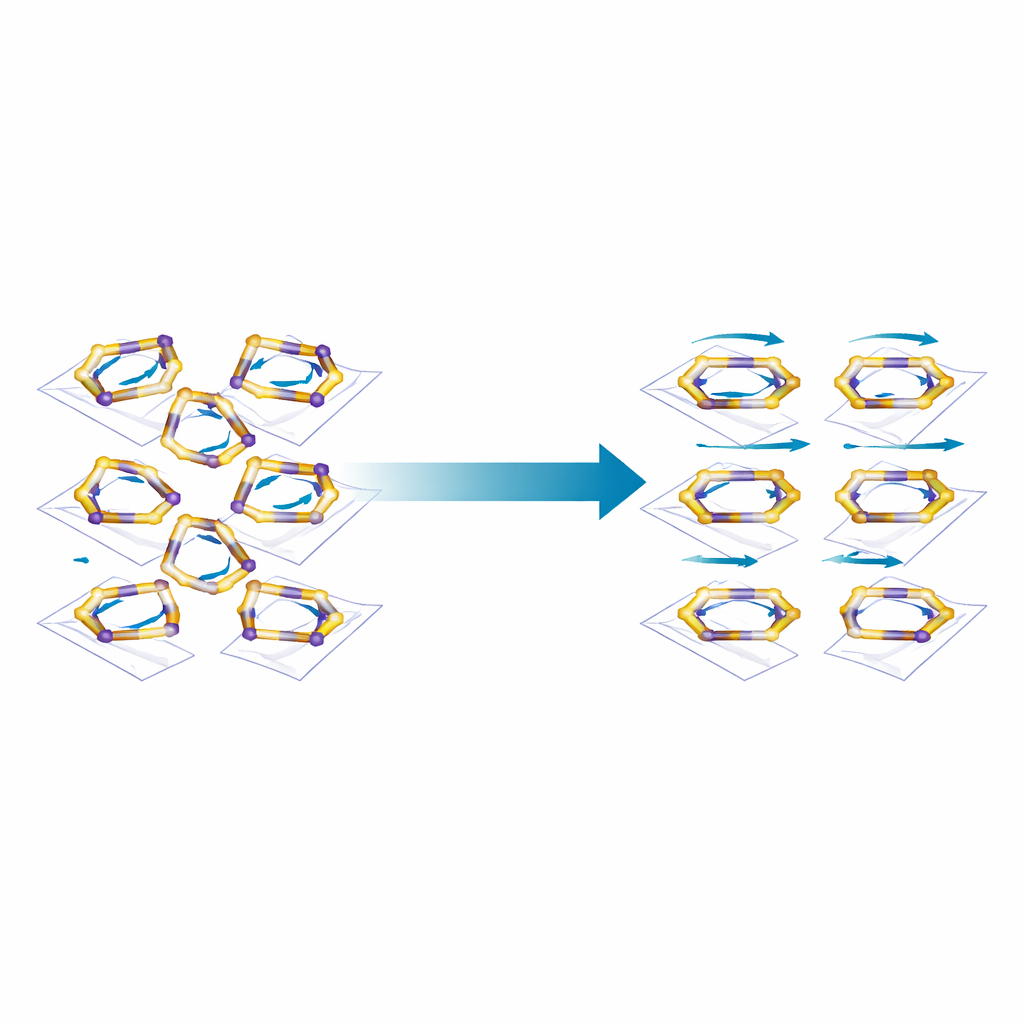
Because the molecules are coupled only weakly, they can rotate relatively easily inside the crystal. The authors show that an electric field applied within the plane can act like a hand on many tiny compass needles, gradually rotating the S7N rings until their in‑plane dipoles all line up with the field. This collective reorientation creates a strong sideways ferroelectric polarization that can point in either of two opposite directions, separated by a modest energy barrier accessible at room temperature. Crucially, the same motion rotates the magnetic moments tied to each ring, transforming the original antiferromagnetic pattern into a ferromagnetic one where all spins align. In other words, an electric field can simultaneously switch both the electric and magnetic order of the material.
Why This Matters for Future Devices
By carefully choosing and arranging molecular building blocks, this study predicts a single ultrathin crystal that is both ferroelectric and magnetic, with the two orders directly linked. In SbI3·(S7N)3, flipping the electric polarization by an in‑plane field also flips the magnetic state, offering a compact route to electrically controlled magnetic memory or multifunctional sensors. Although the work is based on first‑principles calculations rather than experiments, it outlines a realistic target for synthesis and a broader design strategy: use the modular "Lego" nature of two‑dimensional inorganic molecular crystals to engineer coupled quantum behaviors in atomically thin materials.
Citation: Xing, J., Zhao, Y., Sun, L. et al. Coexistence of magnetism and ferroelectricity in the 2D inorganic molecular crystal SbI3•(S7N)3. npj Comput Mater 12, 139 (2026). https://doi.org/10.1038/s41524-026-02004-1
Keywords: two-dimensional materials, multiferroics, ferroelectric switching, magnetoelectric coupling, inorganic molecular crystals