Clear Sky Science · en
An accurate DFT-1/2 approach for shallow defect states: efficient calculation of donor binding energies in silicon
Why tiny tweaks in silicon matter
Every computer chip and solar cell depends on carefully added impurities, or “dopants,” that control how easily electricity flows. For some cutting-edge technologies – from ultra‑efficient transistors to donor‑based quantum bits – we need to know exactly how tightly an extra electron is bound to a dopant atom inside a semiconductor crystal. This paper introduces a faster and more practical way to calculate that binding energy with high accuracy, especially for dopants in silicon, the backbone of modern electronics.
Atoms that donate extra electrons
In pure silicon, atoms share electrons in neat, repeating bonds, and the material conducts poorly at room temperature. Add a tiny amount of a group‑V element such as phosphorus, arsenic, antimony, or bismuth, and each dopant brings one extra electron. That extra electron does not fly freely; instead, it sits in a hydrogen‑like cloud loosely bound to the dopant and to the surrounding silicon. The strength of this bond – the donor binding energy – sets how easily the electron can be freed to carry current or participate in quantum operations. Measuring these energies in the lab is well established, but predicting them reliably from first‑principles calculations has proved difficult and expensive.
Why standard calculations fall short
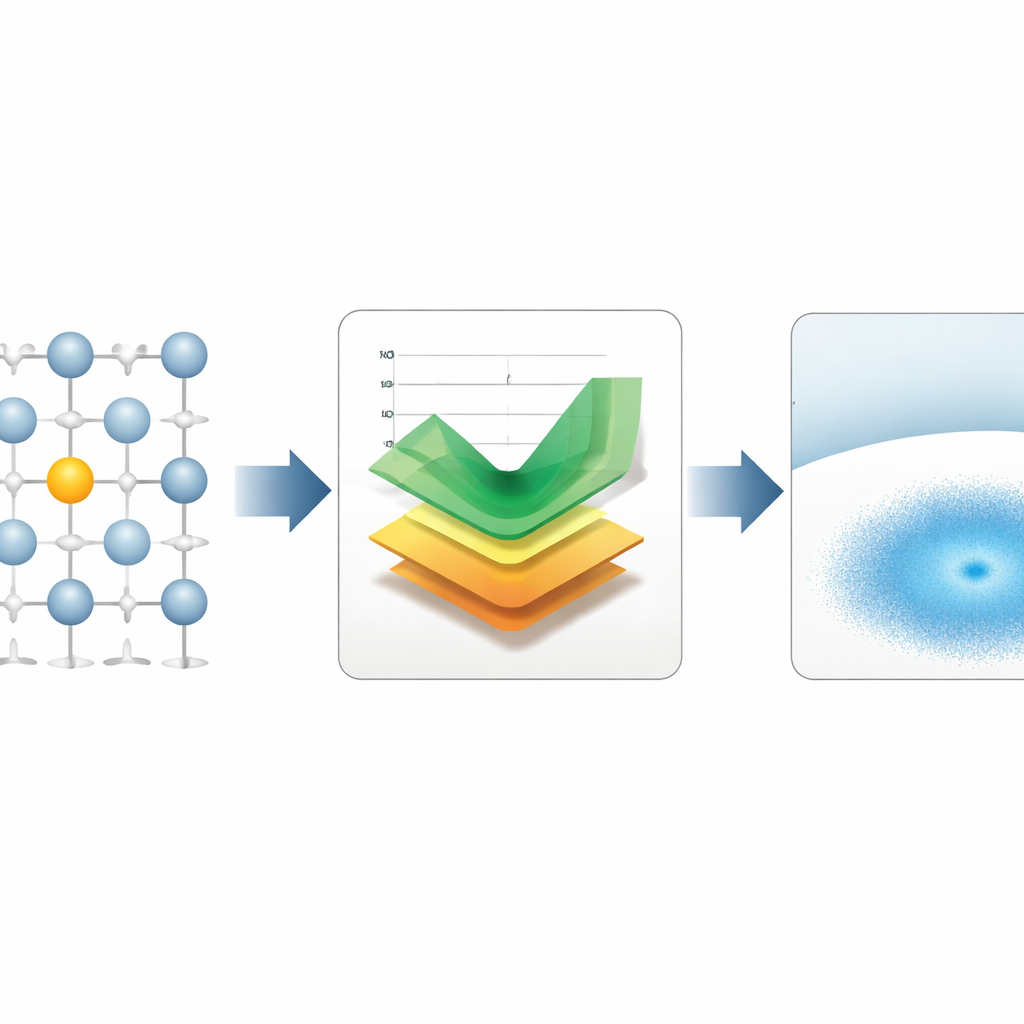
Computer models based on density functional theory (DFT) are the workhorse of materials design, but they tend to underestimate how strongly electrons are localized and to misplace the edges of the energy bands in semiconductors. For shallow donors, whose electron clouds extend over many tens of atoms, this means DFT usually predicts binding energies that are much too small. More advanced methods, such as hybrid functionals and GW calculations, can fix these issues but at a massive computational cost, especially when large simulation boxes with thousands of atoms are needed to capture the extended donor state. Earlier “tandem” approaches had to mix different levels of theory in different cell sizes and then stitch the results together, making the workflow complex and system‑dependent.
A simple correction with a big payoff
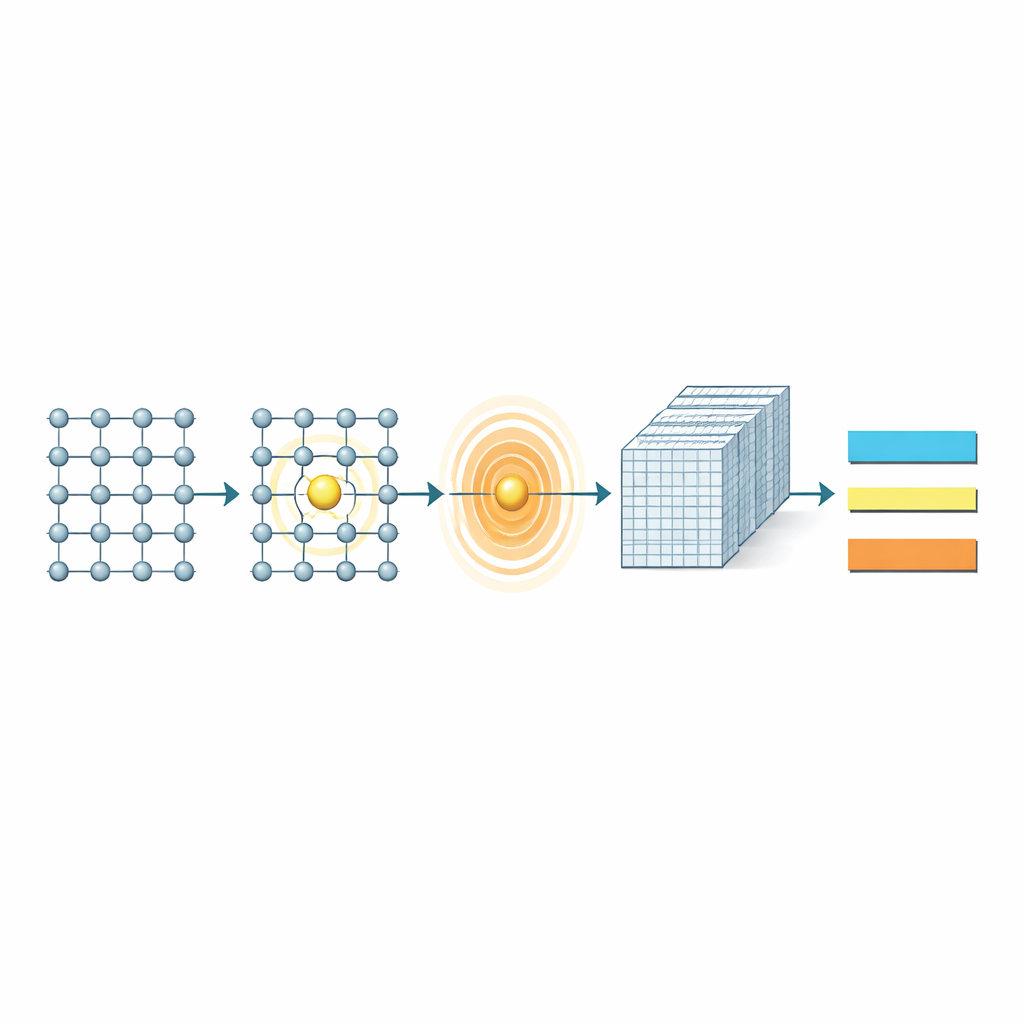
The authors build on a technique called DFT‑1/2, which adds an approximate self‑energy correction directly into standard DFT. In practical terms, they slightly modify the effective potential of selected atoms by conceptually removing half an electron from particular atomic orbitals. First, they apply this correction to bulk silicon so that the calculated band gap matches experiment much better and provides a reliable reference for the conduction band. Next, they examine the electronic character of the donor state and find that, for all group‑V dopants, it is dominated by the s‑orbital of the dopant atom. They then apply a tailored half‑electron correction to that orbital and fine‑tune a single cutoff radius to maximize the separation between the donor level and the nearest empty conduction state. Importantly, this optimized correction remains valid when the simulation box is enlarged, so it can be reused in supercells containing up to thousands of atoms.
How well the method works
With this two‑step correction – first to the host silicon, then to the donor itself – the method produces donor binding energies that closely match experimental values. For arsenic in silicon, the predicted energy differs from experiment by only 0.3 millielectronvolts, essentially perfect agreement and comparable to far more expensive hybrid calculations. For antimony and phosphorus, the errors are about 5 and 8 millielectronvolts, respectively, a major improvement over uncorrected DFT. For bismuth, a very heavy dopant, the authors also include spin‑orbit coupling, a relativistic effect that slightly reshapes energy levels. This reduces the calculated binding energy to within roughly 5 millielectronvolts of experiment and highlights physics that earlier, more demanding methods had neglected. To show the approach is not limited to silicon, they successfully apply the same workflow to a hydrogen donor in zinc oxide, again reproducing measured binding energies within a few millielectronvolts.
A practical tool for designing future chips
For non‑specialists, the key message is that the authors have created a recipe that keeps the low cost and simplicity of standard DFT calculations while reaching the accuracy of much heavier methods. By systematically correcting both the overall band structure of the host material and the local environment around the dopant, their DFT‑1/2 protocol delivers reliable donor binding energies in very large simulation cells. This makes it a powerful and general tool for studying dopants that control everyday electronics and emerging quantum devices, helping engineers design materials where individual impurities behave exactly as intended.
Citation: Claes, J., Partoens, B., Lamoen, D. et al. An accurate DFT-1/2 approach for shallow defect states: efficient calculation of donor binding energies in silicon. npj Comput Mater 12, 153 (2026). https://doi.org/10.1038/s41524-026-02003-2
Keywords: shallow donors, silicon dopants, density functional theory, quantum materials, semiconductor defects