Clear Sky Science · en
Dielectric properties of disordered crystalline materials: a computational case study on hexagonal ice
Why the way ice responds to electricity matters
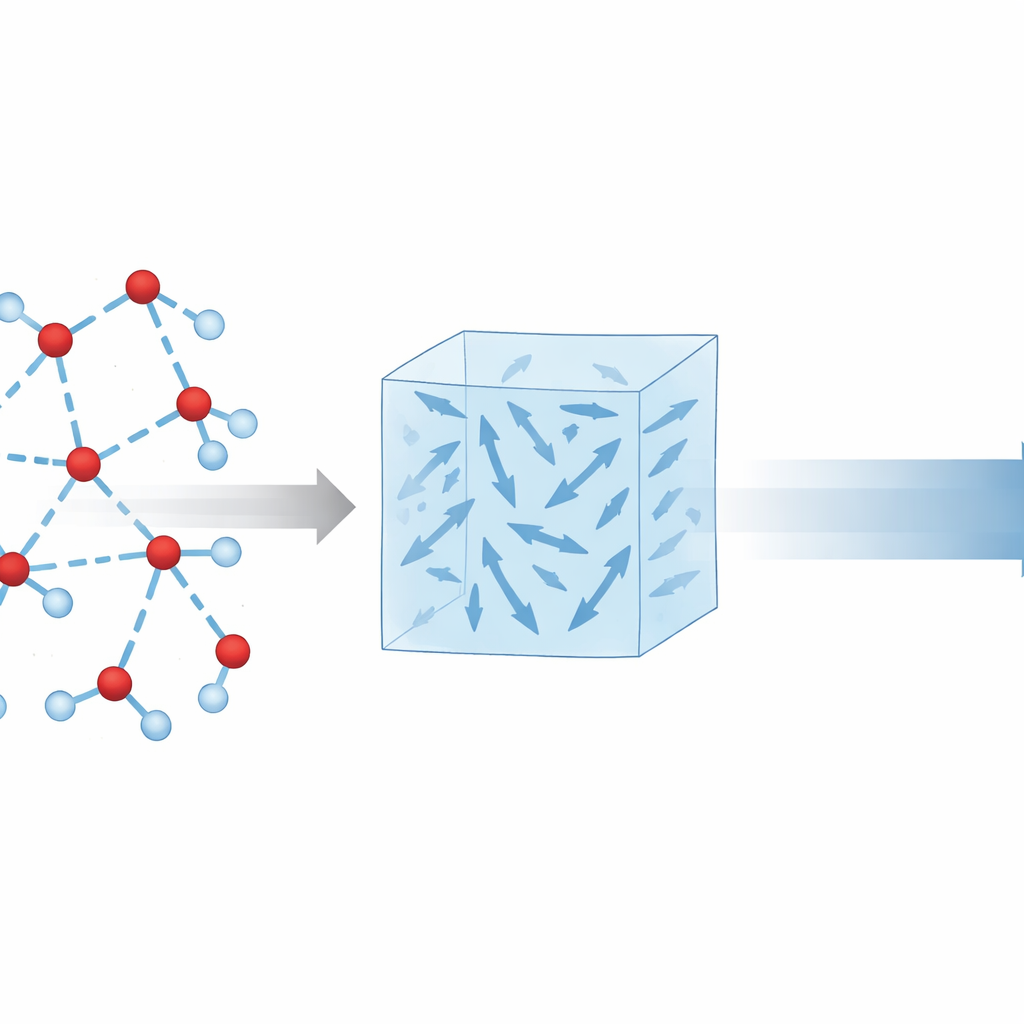
Ice may look simple and familiar, but on the inside it behaves in surprisingly complex ways when exposed to electric fields. The ease with which electrical polarization can form inside a material — described by its dielectric properties — affects everything from how radio waves travel through snow and ice sheets to how energy is stored in advanced materials. This study takes a fresh computational look at the most common form of ice on Earth, hexagonal ice, and shows how the subtle disorder in the way water molecules line up can be turned into a powerful, general method for predicting dielectric behavior in many kinds of crystals.
Hidden disorder inside an ordered crystal
Hexagonal ice is a crystal, meaning its oxygen atoms sit on a well-defined lattice. Yet each water molecule can point in several allowed directions, as long as it follows simple local rules about how many hydrogen bonds it donates and accepts. This built-in “proton disorder” creates a huge number of possible arrangements and gives ice a large capacity for electrical polarization. For decades, experiments have disagreed about whether ice responds differently to electric fields along different crystal directions, suggesting anything from almost no directional difference to nearly twenty percent. Standard computer models of water have also struggled to reproduce the measured dielectric constant of ice, pointing to gaps in our understanding of how local molecular orientations add up to a macroscopic response.
Turning the ice network into a map of arrows
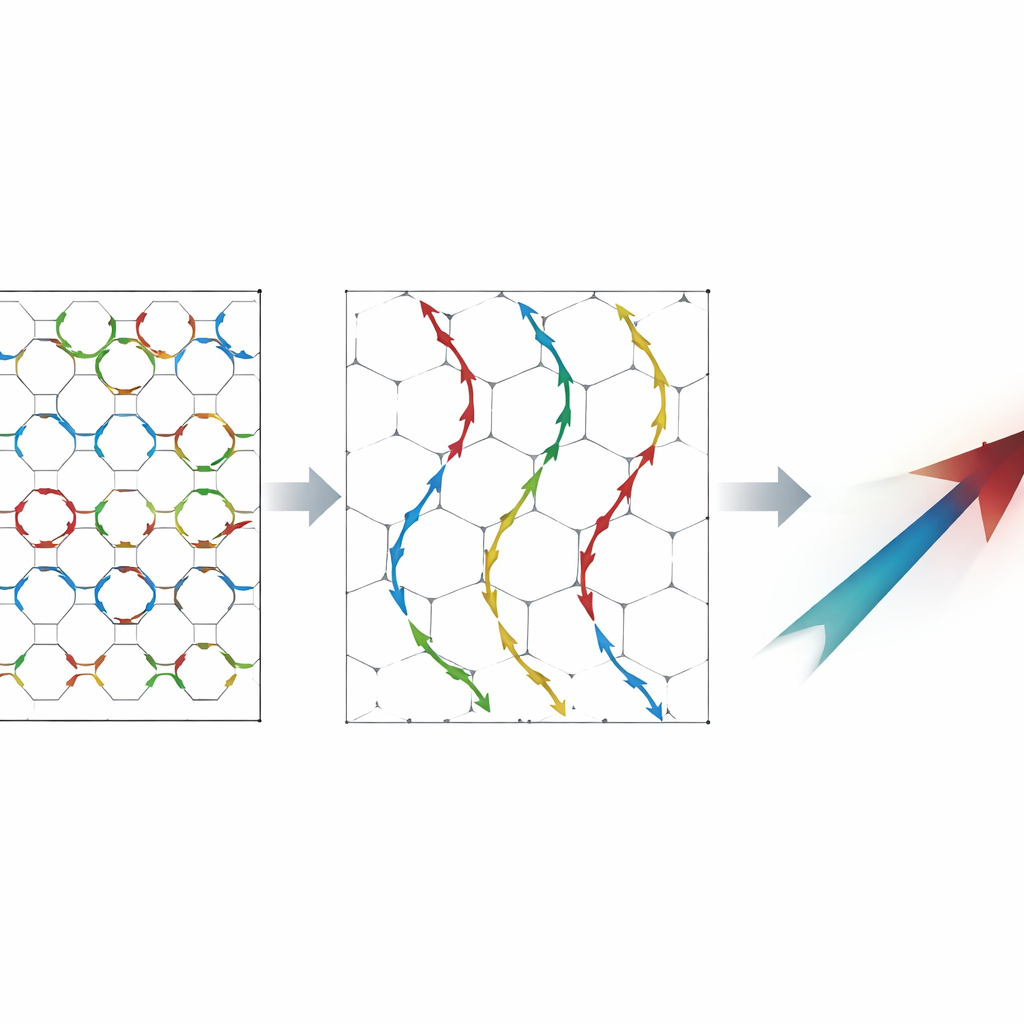
The authors tackle this problem by viewing the hydrogen-bond network of ice as a mathematical graph. Each oxygen atom becomes a node, and each hydrogen bond becomes a directed link pointing from the donor to the acceptor molecule. In this picture, most bonds belong to closed loops that do not contribute to an overall polarization, while a smaller number of long chains thread through the periodic crystal. A key quantity, called the polarization index, simply counts how many directed bonds effectively traverse the simulation box in each crystal direction. By construction, only these percolating chains contribute to the index, making it a compact descriptor of long-range orientational asymmetry without tracking every atom in detail.
From microscopic arrows to bulk electrical response
Using advanced interaction models — a polarizable force field and a neural-network potential trained on quantum calculations — the researchers optimized hundreds of thousands of disordered ice configurations. They showed that the total dipole moment of each configuration is almost perfectly proportional to the polarization index along each crystal axis. This allowed them to define an effective dipole strength per hydrogen bond and to separate purely geometric factors of the hexagonal lattice from the statistics of the disordered network. They then examined how the polarization index fluctuates across many random arrangements and found that its distribution is essentially Gaussian and nearly direction-independent once simple geometric scaling is applied. Combining the effective bond dipole with the variance of these index fluctuations yields a new model — the Polarization Index-Based Effective Dipole (PIBED) framework — that predicts the dielectric constant without needing full three-dimensional calculations for very large cells.
Pinning down a tiny directional difference
The PIBED approach reproduces the standard fluctuation-based dielectric calculations almost exactly for moderate system sizes, but with much better statistical stability. This extra robustness is crucial for resolving the tiny directional difference in the dielectric response of hexagonal ice. When the authors used PIBED to separate responses parallel and perpendicular to the main crystal axis, they found a dielectric anisotropy of about one percent — small, but consistent across system sizes and methods. Additional simulations that include thermal motion and quantum vibrations of the nuclei show that temperature and quantum effects slightly reduce the overall dielectric constant, but do not introduce extra directional bias. The final predicted value at typical cold conditions is modestly lower than the static, perfectly frozen estimate, in line with expectations from experiment.
What this means for ice and other complex materials
For a non-specialist, the key message is that a seemingly messy problem — how countless hydrogen bonds fluctuate in a crystal — can be reduced to a simple, countable index of how often certain chains traverse the material. This topological view lets scientists predict the dielectric behavior of very large, disordered crystals quickly and reliably. In hexagonal ice, it resolves a long-standing debate by showing that any directional difference in dielectric response is real but very small. More broadly, the same framework could be adapted to other materials where a mostly ordered lattice hosts a disordered subnetwork, such as ferroelectric perovskites and solid proton conductors. In these systems, turning local rules and network connectivity into effective dipoles may provide a powerful new route to designing materials with tailored electrical properties.
Citation: Tohidi Nafe, Z., Madarász, Á. Dielectric properties of disordered crystalline materials: a computational case study on hexagonal ice. npj Comput Mater 12, 126 (2026). https://doi.org/10.1038/s41524-026-01998-y
Keywords: dielectric properties of ice, hydrogen bond networks, proton disorder, computational materials science, polarization index model