Clear Sky Science · en
Domain features-informed two-step machine learning: accelerating the search for superlubric heterostructures
Why sliding without friction matters
From hard drives and electric cars to tiny medical sensors, modern technology depends on moving parts that rub against each other. That rubbing—friction—wastes energy and wears out components. Scientists dream of “superlubricity,” a state where surfaces glide with almost no resistance, like air-hockey pucks at the atomic scale. This article explores how researchers used advanced computer simulations and machine learning to rapidly discover new combinations of ultra-thin materials that can all but eliminate friction.
Atomically thin building blocks
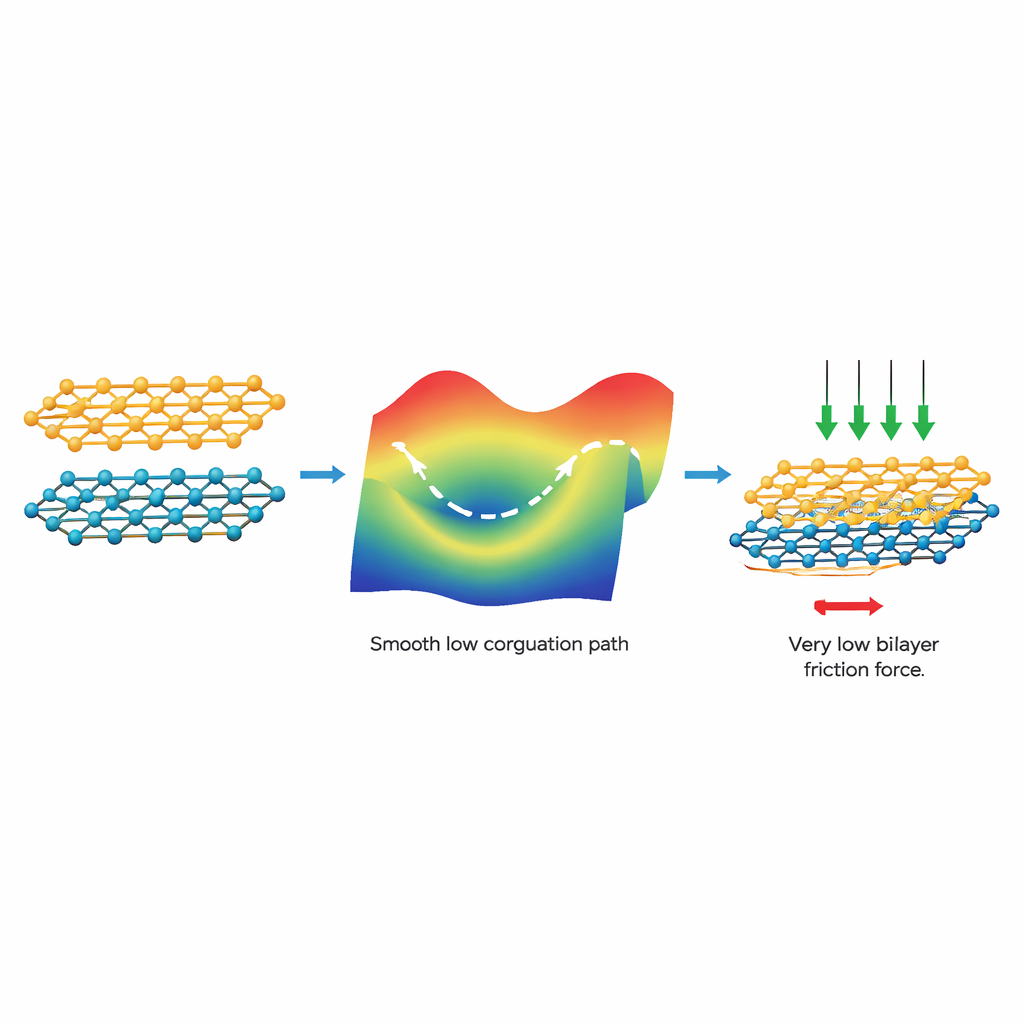
The study focuses on two-dimensional materials—crystal sheets only a few atoms thick. Well-known examples include graphene and a family called transition metal dichalcogenides (TMDs), such as molybdenum disulfide (MoS₂) and tungsten disulfide (WS₂). These materials are already prized as solid lubricants because their layers can easily slide over one another. When two different sheets are stacked to form a “heterostructure,” their atomic patterns may not line up perfectly. This misalignment, known as incommensurate contact, can drastically reduce friction and create structural superlubricity, where the resistance to motion approaches zero.
The problem of too many possibilities
Designing such slick interfaces is not as simple as mixing any two sheets together. The authors considered 66 different monolayers built from various metals (like Mo, W, V, Ni) and chalcogen atoms (like S, Se, Te), plus so‑called Janus sheets that differ from top to bottom. In principle, hundreds of distinct pairings are possible, each with many ways the two layers can align. Accurately simulating the sliding energy—how the total energy changes as one sheet moves across the other—usually requires demanding quantum mechanical calculations. Doing this for every possible pair would take an impractical amount of computing time.
Teaching algorithms what really matters
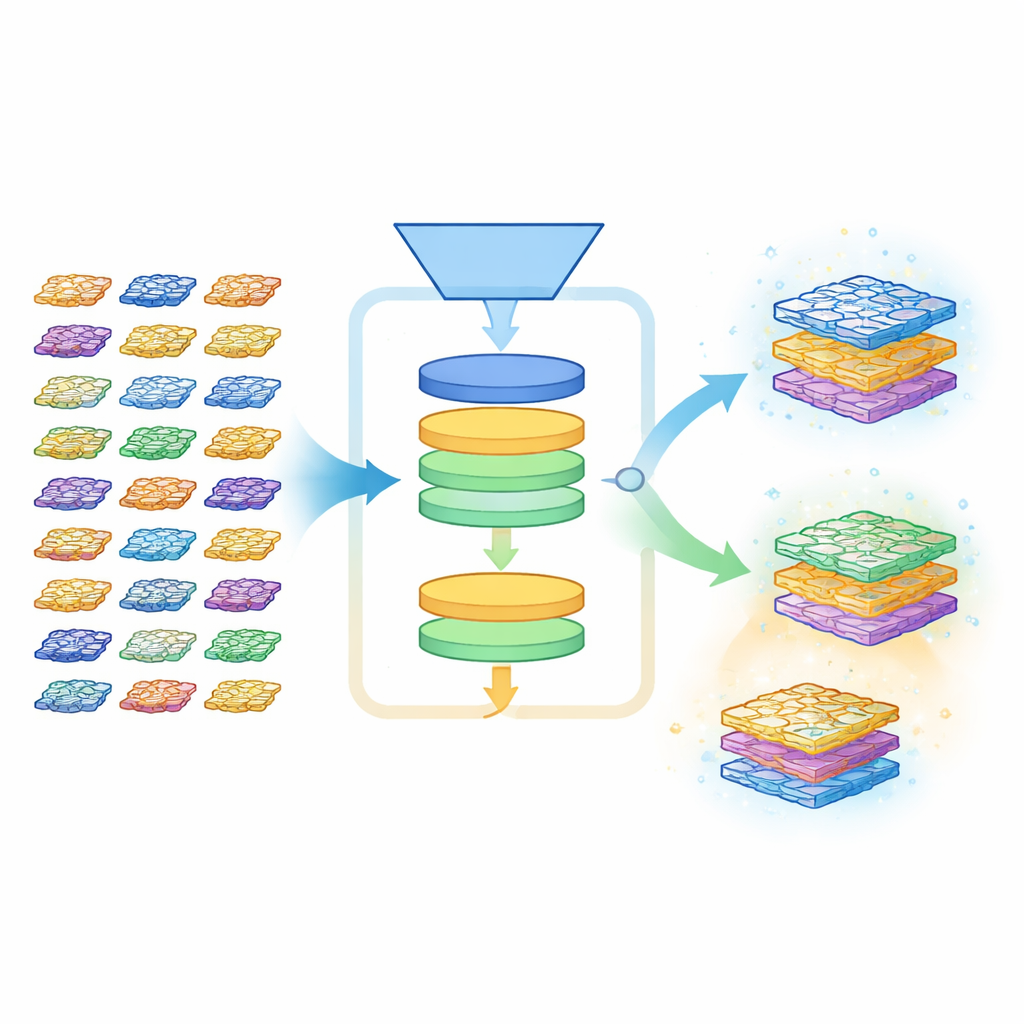
To tackle this, the team designed a two-step machine learning strategy. First, they built a small but carefully chosen “training set” of 78 heterostructures and computed key physical quantities with high-precision methods. These include how strongly the layers stick together, how stiff they are, and how electrons shift at the interface. Instead of trying to predict friction directly from raw geometry, they trained several machine learning models to connect simple structural descriptors—such as bond lengths, atom sizes, and layer spacing—to these more informative “domain features” that are known to influence friction. These models act as fast surrogates, allowing the computer to estimate difficult properties for many candidate materials without repeating costly calculations.
Letting the computer hunt for the slipperiest pairs
In the second step, the authors combined their surrogate models with a search strategy called Bayesian optimization. This method continually proposes new candidate heterostructures that are most likely to show low sliding energy, updates its beliefs based on fresh high-accuracy calculations, and then searches again. By iterating this loop only a few times, the system efficiently zoomed in on the most promising superlubric combinations among more than 400 possibilities. Crucially, the surrogate models cut the computational cost by nearly a month of supercomputer time while keeping prediction errors at a manageable level.
New superlubric pairs and real-world tests
The search revealed three especially promising pairs: MoS₂/WS₂, MoS₂/VS₂, and NiS₂/NbSSe. Detailed simulations showed that their sliding energy landscapes are remarkably smooth, with energy ripples far smaller than those in classic low-friction systems like graphene on graphene or graphene on hexagonal boron nitride. Molecular dynamics simulations suggested friction coefficients well below 0.001 for MoS₂/WS₂ and MoS₂/VS₂ under nanoscale loads, the hallmark of superlubricity. The team then fabricated MoS₂/WS₂ and MoS₂/VS₂ coatings using 3D‑printed, point-contact ceramic structures that mimic many tiny microscopic sliders. In friction tests at normal laboratory scales, MoS₂/WS₂ reduced friction by up to about a third compared with a benchmark MoS₂/MoSe₂ coating already known to slide extremely well.
What this means for future machines
Put simply, the study shows that teaching computers the “physics language” of friction—how structure relates to stiffness, adhesion, and electronic charge—allows them to explore vast design spaces far faster than brute force calculation. The two-step approach not only uncovered new superlubric material pairs, but also confirmed their performance through both atomistic simulations and real tribology experiments. As this strategy is extended and refined, it could accelerate the discovery of low-friction coatings for everything from spacecraft mechanisms and precision instruments to micromachines, helping future devices run cooler, last longer, and waste far less energy.
Citation: Chen, L., Huang, Y., Zhang, H. et al. Domain features-informed two-step machine learning: accelerating the search for superlubric heterostructures. npj Comput Mater 12, 147 (2026). https://doi.org/10.1038/s41524-026-01996-0
Keywords: superlubricity, 2D materials, heterostructures, machine learning, solid lubrication