Clear Sky Science · en
Deep learning generative model for conditional crystal structure prediction of sodium amide
Why this study matters for future clean energy
Storing hydrogen safely and compactly is vital for clean energy technologies, from fuel-cell vehicles to grid storage. One material that helps other compounds release hydrogen more easily is sodium amide, a simple salt made of sodium and nitrogen–hydrogen groups. Yet scientists have not fully understood how its atomic structure changes when squeezed at very high pressures—conditions that can reveal new, useful forms of matter. This paper combines cutting-edge X-ray experiments with a deep-learning model to uncover a long-mysterious high-pressure form of sodium amide, offering a new path for solving similarly complex crystal structures.
From helpful salt to high-pressure puzzle
Sodium amide does not store enormous amounts of hydrogen on its own, but it plays a powerful supporting role in mixtures with other metal hydrides, helping them release hydrogen at lower temperatures and with better efficiency. At normal conditions, its crystal structure—how the atoms arrange in a repeating pattern—is well known. Earlier high-pressure measurements had shown that as pressure increases, sodium amide passes through several distinct phases, labeled alpha, beta, and gamma, but the detailed atomic arrangement of the high-pressure phases remained unclear. Conventional computer methods tried to predict these structures but disagreed with precise X-ray diffraction measurements, revealing that something was missing in our modeling of this ionic material under compression.
Limits of traditional search and the need for smarter tools
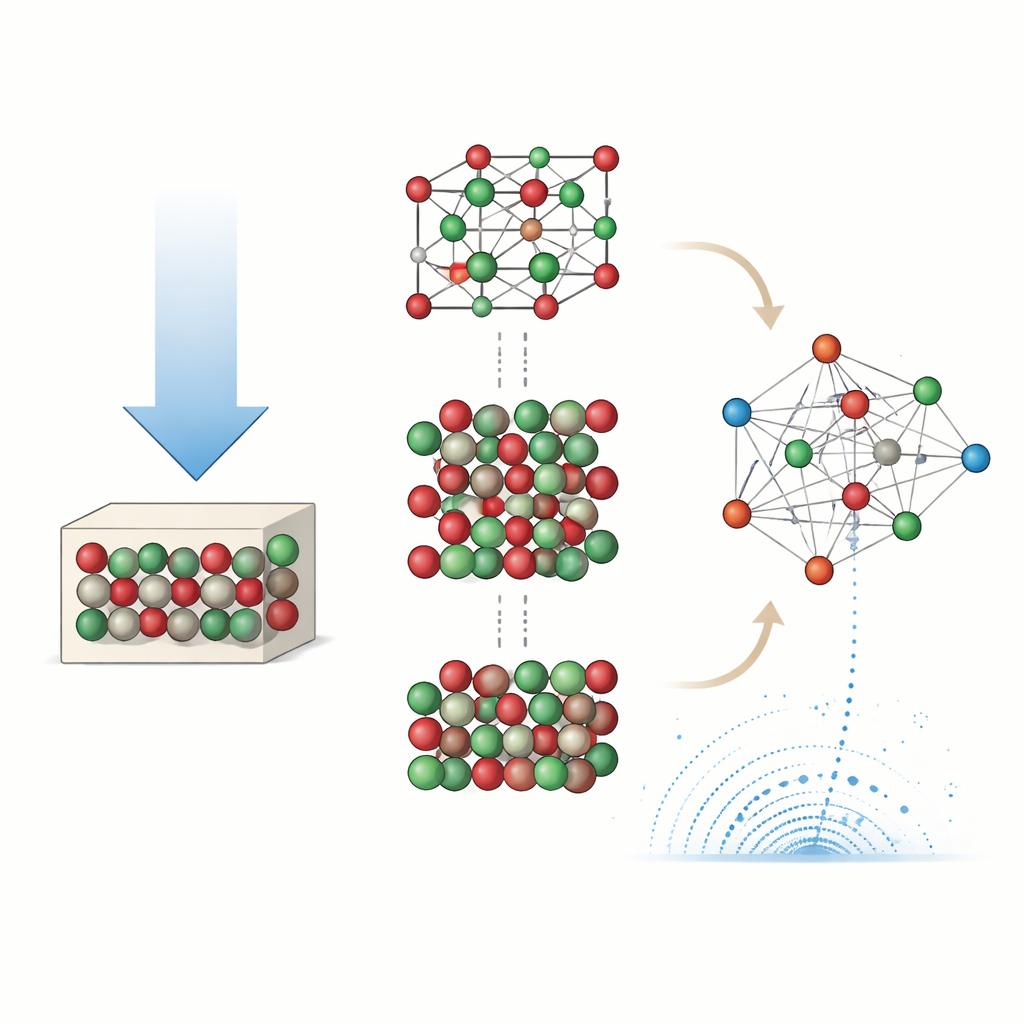
Standard crystal-structure prediction techniques, such as evolutionary algorithms and random structure searches, work by exploring many possible atomic arrangements and selecting those with the lowest calculated energy. For sodium amide at high pressure, these methods proposed several candidate structures and phase transitions. However, when the researchers compared simulated X-ray patterns from those candidates with experimental data, the matches were poor. The underlying challenge is that sodium amide has strong long-range electric interactions, directional bonding to hydrogen, and a relatively large number of atoms per repeating unit. This creates an extremely rugged energy landscape where the truly relevant structures may not be the very lowest in energy and can easily be missed by brute-force searching.
A guided generative model that learns the landscape
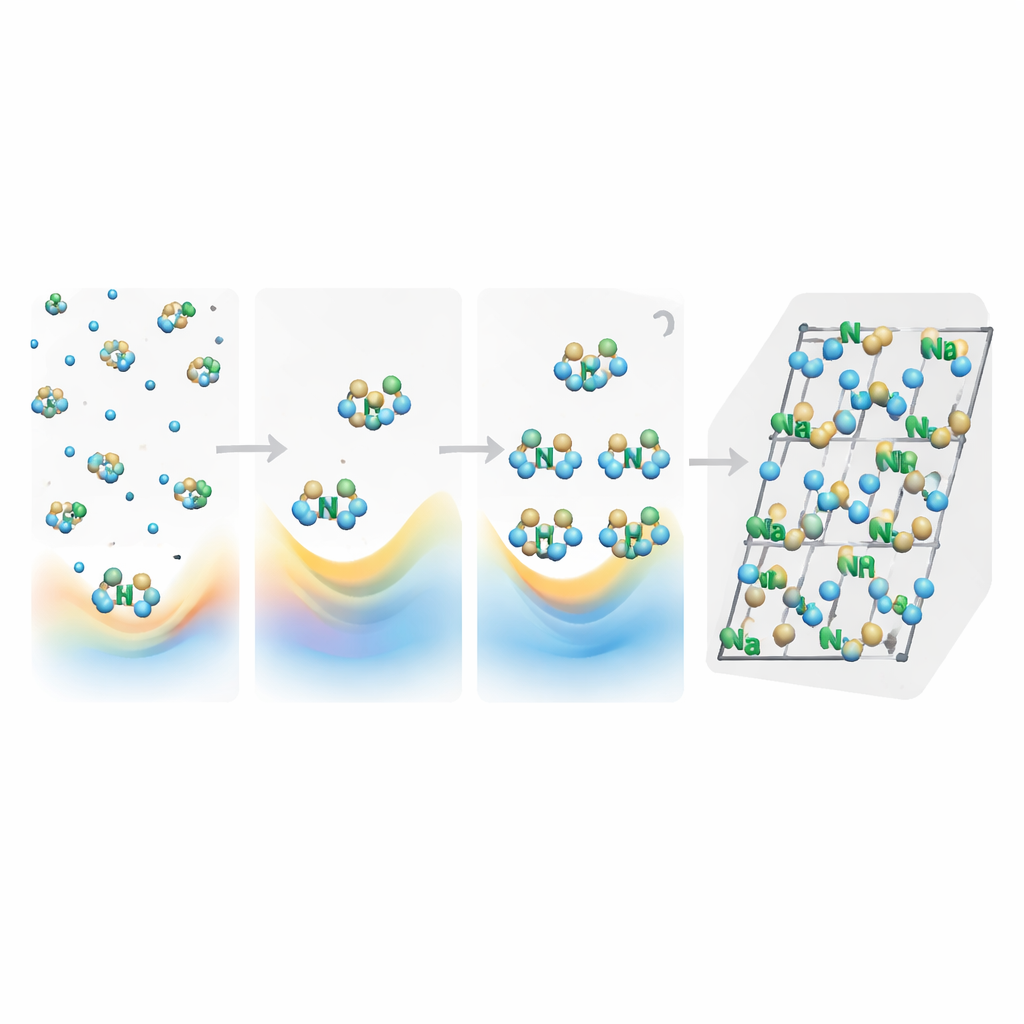
To overcome these hurdles, the authors developed a deep-learning generative framework tailored to sodium amide. They first built a custom dataset of a thousand plausible sodium amide structures, all with the same large unit cell and consistent chemical makeup, generated by a conventional random search and refined by quantum-mechanical calculations. Each structure was broken into two parts: the overall cell shape, taken from experiment, and a compact description of the smallest set of symmetry-unique molecular units inside that cell. A diffusion-based neural network then learned how to gradually turn random noise in this compact space into realistic arrangements, while a second neural network estimated the energy of each candidate and gently nudged the generation process toward low-energy regions. Afterward, the model expanded the compact description back into a full crystal using symmetry operations and filtered out any candidates with unphysical atom-atom distances or incorrect symmetry.
Cracking the hidden high-pressure phase
Armed with this model, the team focused on pressure ranges where experiments showed new phases. They used lattice parameters and likely symmetry types, extracted from X-ray data, as conditions for the generator, ensuring that only physically relevant structures were explored. Out of hundreds of generated candidates, four emerged as especially stable at high pressures, each belonging to a different symmetry family. When these were rigorously compared against synchrotron X-ray diffraction patterns collected around 10 gigapascals, one structure—belonging to a symmetry class called P21/c with 64 atoms in its repeating unit—stood out with an excellent match. This structure was then identified as the long-sought gamma phase of sodium amide, stable from about 2.5 up to at least 14 gigapascals.
How charge shifts help lock in the new phase
Beyond identifying the structure, the researchers examined how the distribution of electric charge and the distances between sodium atoms evolve as pressure rises. They found that in the gamma phase, electrons shift so that the nitrogen–hydrogen groups become more negatively charged while sodium atoms become more positive, enhancing the ionic attraction between them. At the same time, sodium atoms move closer together, and the lattice becomes more densely packed. Together, these changes help explain why the gamma phase is particularly robust under compression and may influence how sodium amide behaves when mixed with other hydrogen-bearing compounds in real devices.
A blueprint for solving other complex crystals
In plain terms, this work shows that a smart, experiment-guided generative model can succeed where traditional trial-and-error methods fail. By weaving experimental hints, symmetry rules, and energy calculations into a single learning pipeline, the authors were able to reveal the detailed atomic structure of a high-pressure phase that had eluded researchers for years. The approach should be transferable to other ionic and hydrogen-rich materials—such as related metal amides—that are important for hydrogen storage and high-pressure science, opening a more efficient route to understanding and designing new functional solids.
Citation: Guan, R., Liu, A. & Song, Y. Deep learning generative model for conditional crystal structure prediction of sodium amide. npj Comput Mater 12, 136 (2026). https://doi.org/10.1038/s41524-026-01994-2
Keywords: hydrogen storage, sodium amide, high-pressure phases, crystal structure prediction, deep learning materials