Clear Sky Science · en
AMaRaNTA: automated first-principles exchange parameters in 2D magnets
Why tiny magnetic sheets matter
Imagine electronics where information is carried not by electric charges but by the direction of tiny atomic magnets. Two-dimensional magnetic materials—crystals only an atom or two thick—are prime candidates for such ultra-compact, low-energy devices. But to design and control them, scientists must first understand how strongly neighboring atoms interact magnetically and which directions their spins prefer. This paper introduces AMaRaNTA, a new computational tool that automates these demanding calculations, making it far easier to explore and engineer the “magnetic genome” of 2D materials.
Thin magnets with rich behavior
Over the past decade, experiments have shown that some crystals remain magnetic even when peeled down to a single layer. These atomically thin magnets display far more than simple north–south alignment: they can host swirling patterns, spirals, and exotic textures such as skyrmions—tiny whirlpools of spins that behave like particles. In principle, thermal motion should destroy long-range magnetism in two dimensions, but real materials escape this fate because their spins are not perfectly free to point in any direction: subtle anisotropies and competing interactions stabilize order. Capturing these effects requires precise numerical values for several types of magnetic couplings, which are notoriously hard to obtain reliably from first-principles quantum calculations.
Turning complex quantum math into practical numbers
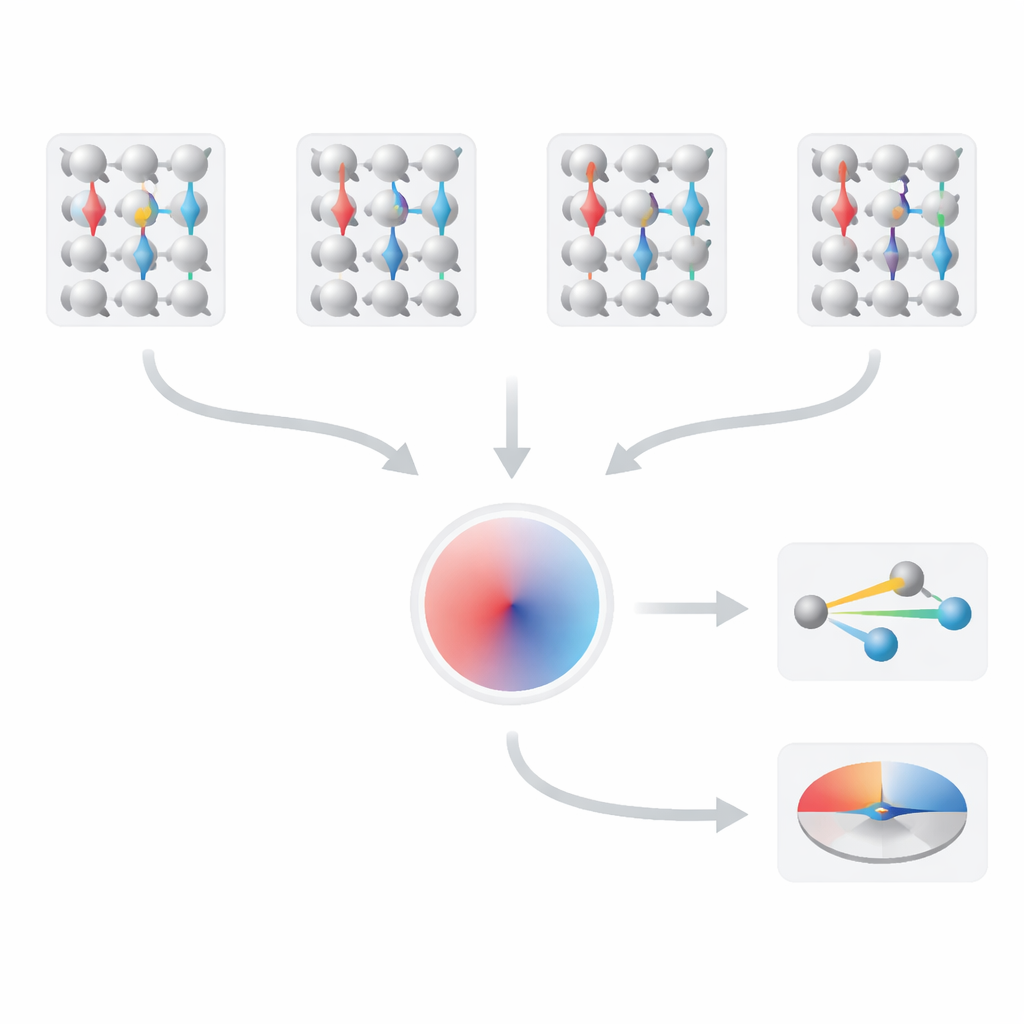
Most theoretical studies use density functional theory, a quantum mechanical workhorse for solids, and then “map” the resulting total energies onto simplified models of spins on a lattice. Traditional mapping approaches demand many hand-crafted simulations and often treat key effects—especially direction-dependent interactions—only approximately. AMaRaNTA streamlines a more rigorous strategy called the four-state method. In this scheme, the researchers choose a pair of magnetic atoms and compute the total energy for four carefully arranged spin orientations. By cleverly combining these four energies, they can isolate a single parameter that tells how strongly those two spins interact, and whether they prefer to align, anti-align, or cant at an angle. Repeating this for different directions and neighbors reveals not just the overall strength, but the full directional character of the coupling.
An automated factory for magnetic parameters
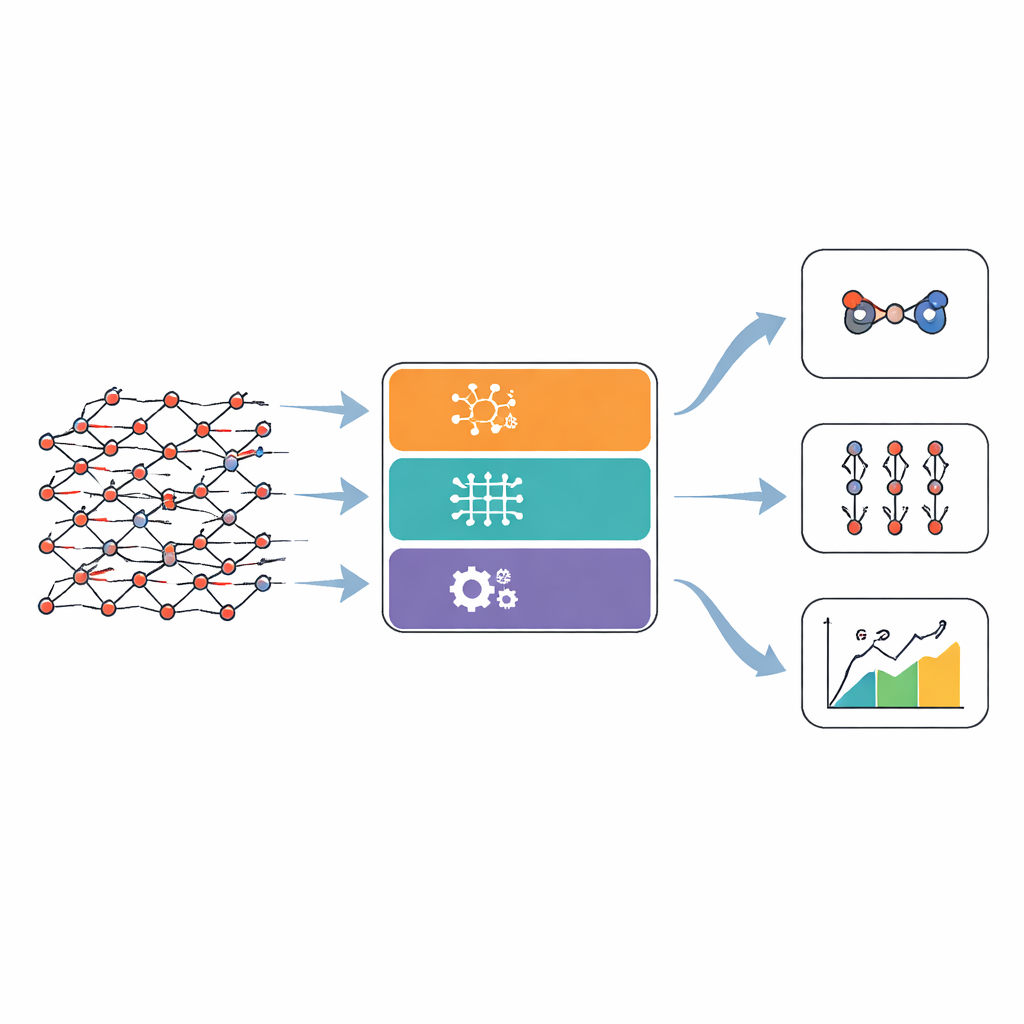
AMaRaNTA wraps this four-state protocol into an automated workflow built on the AiiDA platform, which manages large families of calculations and records their provenance. Starting from a structural file of any 2D magnetic crystal, the code first identifies representative pairs of magnetic atoms at nearest, second-nearest, and third-nearest distances and constructs supercells large enough to avoid spurious interactions with periodic copies. It then performs an initial quantum calculation to estimate the size of each atomic moment and launches dozens of follow-up simulations where selected spins are constrained along different directions. From these, AMaRaNTA extracts a complete tensor describing the nearest-neighbor interaction, simpler scalar couplings for more distant neighbors, and a term capturing how each spin prefers to tilt out of the plane or stay within it. All inputs, outputs, and derived parameters are stored in a uniform, user-friendly format, ready for further analysis or for feeding into spin-dynamics simulations.
What the screening of real materials reveals
To demonstrate its power, the authors applied AMaRaNTA to 29 insulating 2D magnets drawn from a public materials database. They found clear trends in how magnetic interactions vary across this family. Some compounds are governed almost entirely by nearest-neighbor coupling, pointing to relatively simple ferromagnetic or antiferromagnetic ground states. Others, such as nickel phosphorous trichalcogenides, show unusually strong interactions between more distant neighbors, helping to explain experimentally observed zigzag patterns of spins. A third group displays several competing couplings of similar magnitude—a recipe for magnetic frustration, where no arrangement satisfies all neighbors at once and more complex non-collinear patterns can emerge. The tool also quantifies directional effects: in some crystals, bond-dependent couplings and Dzyaloshinskii–Moriya interactions (which favor twisting spins) reach a sizable fraction of the main exchange, hinting at the possibility of stabilizing skyrmions and related topological textures.
A stepping stone toward designed spin technology
By delivering a consistent, automated way to extract the minimal set of magnetic parameters that govern 2D magnets, AMaRaNTA turns what was once a laborious, expert-only task into a scalable workflow. The study confirms known behavior in benchmark materials and uncovers promising, previously unreported patterns of interaction in others, paving the way for targeted searches of thin crystals with desired magnetic textures or switching properties. Looking ahead, the framework can be extended to more complex models, additional interaction ranges, and tighter coupling to simulation tools that predict temperature-dependent behavior or device performance. For non-specialists, the key message is that we are moving toward a future where the intricate dance of spins in atomically thin sheets can be predicted and tuned on demand, accelerating the design of next-generation spintronic and quantum devices.
Citation: Orlando, F., Droghetti, A., Varrassi, L. et al. AMaRaNTA: automated first-principles exchange parameters in 2D magnets. npj Comput Mater 12, 146 (2026). https://doi.org/10.1038/s41524-026-01968-4
Keywords: two-dimensional magnets, magnetic exchange interactions, first-principles calculations, spintronics, computational materials discovery