Clear Sky Science · en
Machine-learning guided search for phonon-mediated superconductivity in boron and carbon compounds
Why new superconductors matter
Superconductors, materials that carry electricity with zero resistance, could transform power grids, medical imaging, quantum computers, and high-speed trains. Yet most known superconductors only work at very low temperatures, making them costly to use. This study explores whether smart computer models and machine learning can speed up the hunt for better superconductors made from common light elements like boron and carbon, potentially bringing practical high-performance materials closer to everyday technology.
Searching smart instead of searching blind
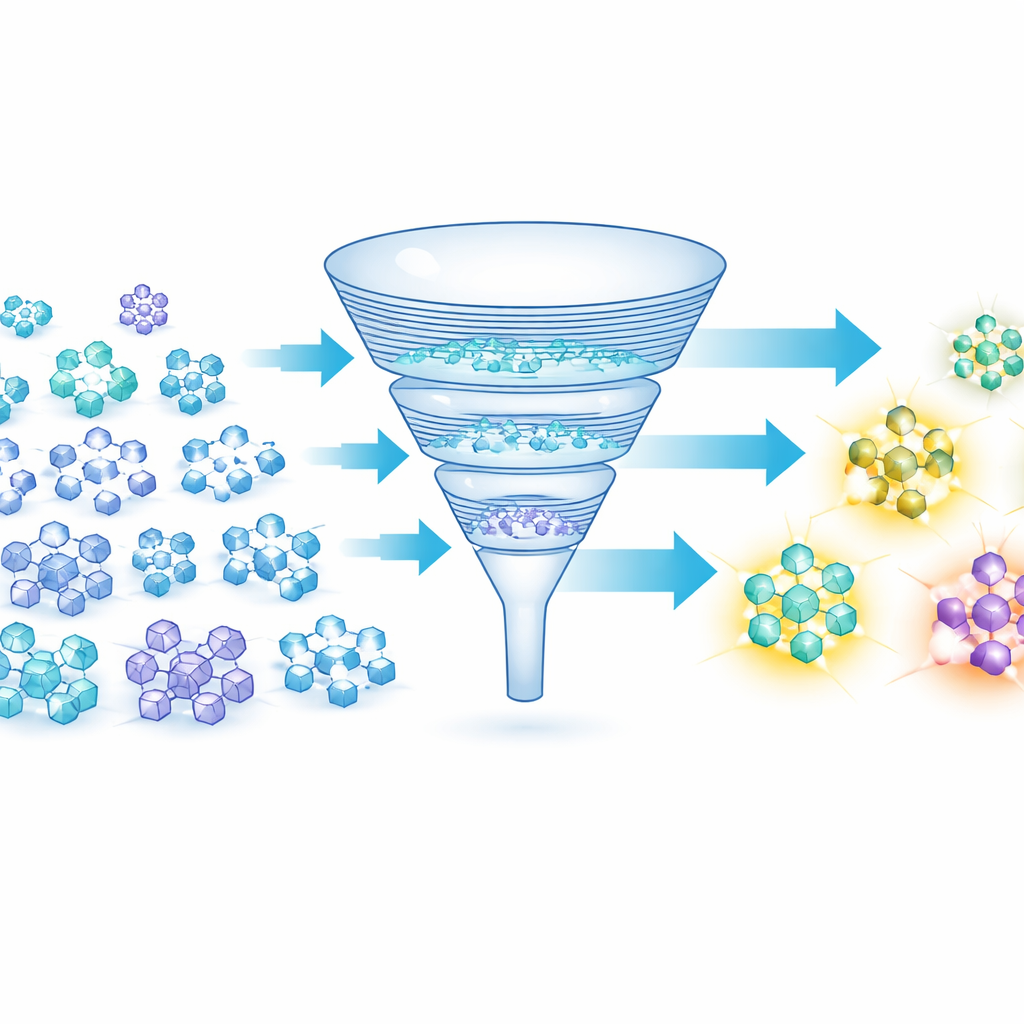
The authors focus on a particular class called phonon-mediated superconductors, where vibrations of the crystal lattice (phonons) help electrons pair up and move without resistance. Light atoms such as boron and carbon naturally vibrate at high frequencies, which can favor higher superconducting temperatures. Instead of testing materials one by one in the lab, the team starts from a large digital library of more than a thousand boron- and carbon-containing compounds drawn from the Materials Project database. They apply filters to select metallic, nonmagnetic, and energetically reasonable candidates with manageable crystal sizes, narrowing the pool to about 700 materials that could, in principle, support this type of superconductivity.
Heavy-duty calculations to teach the machine
To estimate whether each candidate might become a superconductor, the researchers use a quantum-mechanical method called density functional perturbation theory. This lets them calculate how strongly electrons interact with lattice vibrations and predict a critical temperature at which superconductivity would appear. However, these calculations are time-consuming and tricky: they require careful sampling of the crystal’s momentum space and often reveal dynamical instabilities, where some vibrational modes are “imaginary,” indicating the structure would prefer to distort. The team develops a practical test to check whether their temperature predictions are numerically reliable and refines their sampling until the results converge for over 400 compounds. They also devise ways—using pressure, gentle distortions, or increased electronic smearing—to stabilize unstable vibrational modes so that they can still estimate their superconducting behavior rather than discarding them.
Teaching neural networks to spot superconductors
Once they have a large, reasonably accurate computed dataset, the authors train two graph-based neural networks, CGCNN and ALIGNN, to learn the link between crystal structure and superconducting properties. These models treat the crystal as a network of atoms and bonds, and then adjust internal parameters to reproduce the calculated strength of electron–phonon coupling and transition temperature. The workflow is iterative: an initial model is trained on a subset of compounds, used to predict which unexplored materials look most promising or most clearly non-superconducting, and those candidates are then fed back into the expensive quantum calculations. With each loop, the training set grows and the machine-learning models become more reliable. A key twist in this work is that the authors deliberately include compounds that are dynamically unstable at first but can be stabilized, broadening the variety of patterns the models see.
Soft vibrations as a hidden opportunity
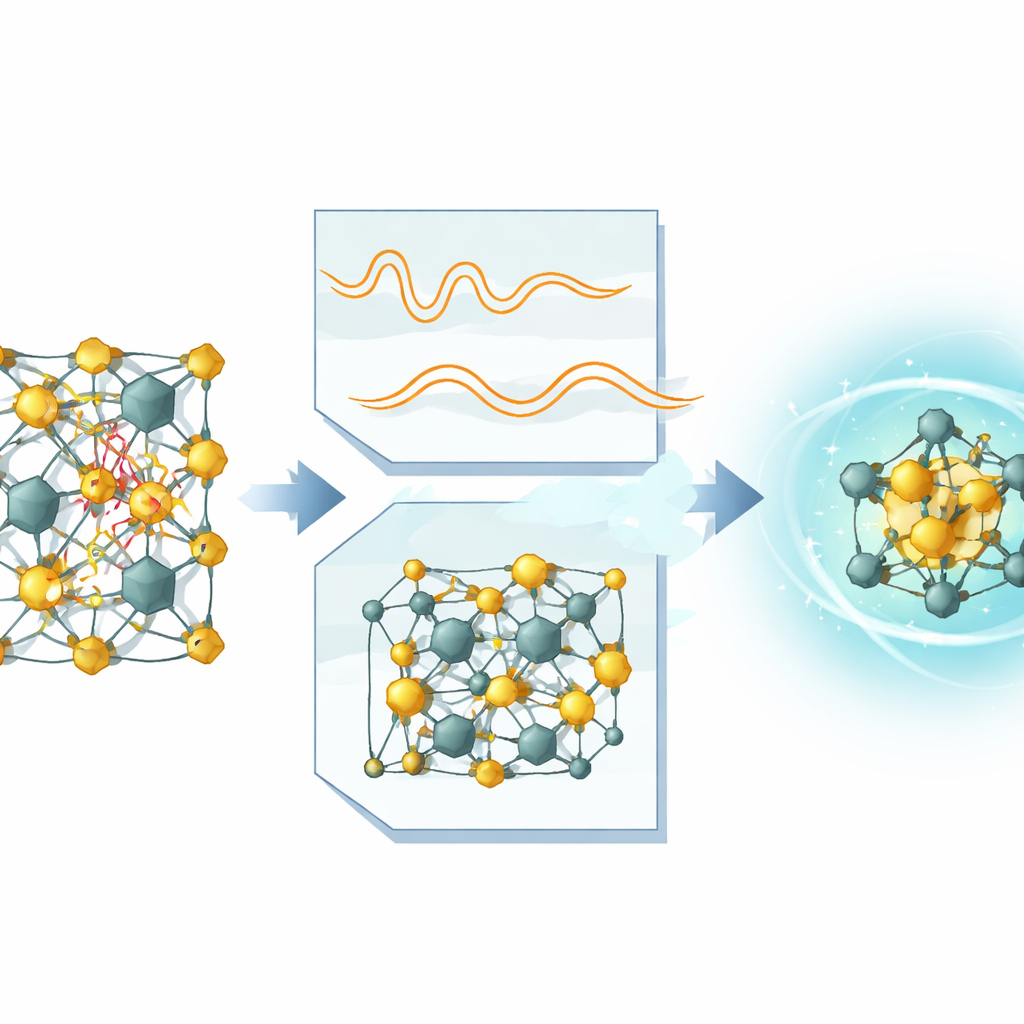
By stabilizing and analyzing compounds with initially imaginary phonon modes, the study reveals that these soft vibrations can actually boost superconductivity once tamed. Several such compounds, including a calcium boron nitride (Ca5B3N6) and various molybdenum, tantalum, and ruthenium borides and carbides, are predicted to have relatively high critical temperatures, some rivaling or surpassing the well-known MgB2, at least in theory. The work shows that ignoring dynamically unstable systems would have missed about one fifth of the dataset and several of the most promising candidates. When these challenging cases are included, the ALIGNN model, which explicitly encodes bond angles as well as bond lengths, clearly outperforms CGCNN, underscoring how subtle geometric features matter for capturing soft vibrational behavior.
What this means for future materials
For non-specialists, the main message is that the combination of detailed quantum calculations and tailored machine-learning models can now scan complex chemical spaces far more efficiently than experiments alone. The study not only identifies specific boron- and carbon-rich compounds—such as TaNbC2, Nb3B3C, Y2B3C2, Ca5B3N6, and a family of Ru-based materials—as promising superconductors, it also establishes a reusable strategy: do not throw away “unstable” candidates too quickly, because their soft vibrations may hold the key to stronger superconductivity once stabilized. While these predictions still need experimental confirmation and more refined theoretical checks, they map out a more targeted and informed route toward discovering practical superconductors for future technologies.
Citation: Nepal, N.K., Wang, LL. Machine-learning guided search for phonon-mediated superconductivity in boron and carbon compounds. npj Comput Mater 12, 152 (2026). https://doi.org/10.1038/s41524-026-01962-w
Keywords: superconductivity, machine learning, boron and carbon compounds, electron phonon coupling, materials discovery