Clear Sky Science · en
Universal giant spin Hall effect in moiré metal
Why twisting sheets of atoms matters
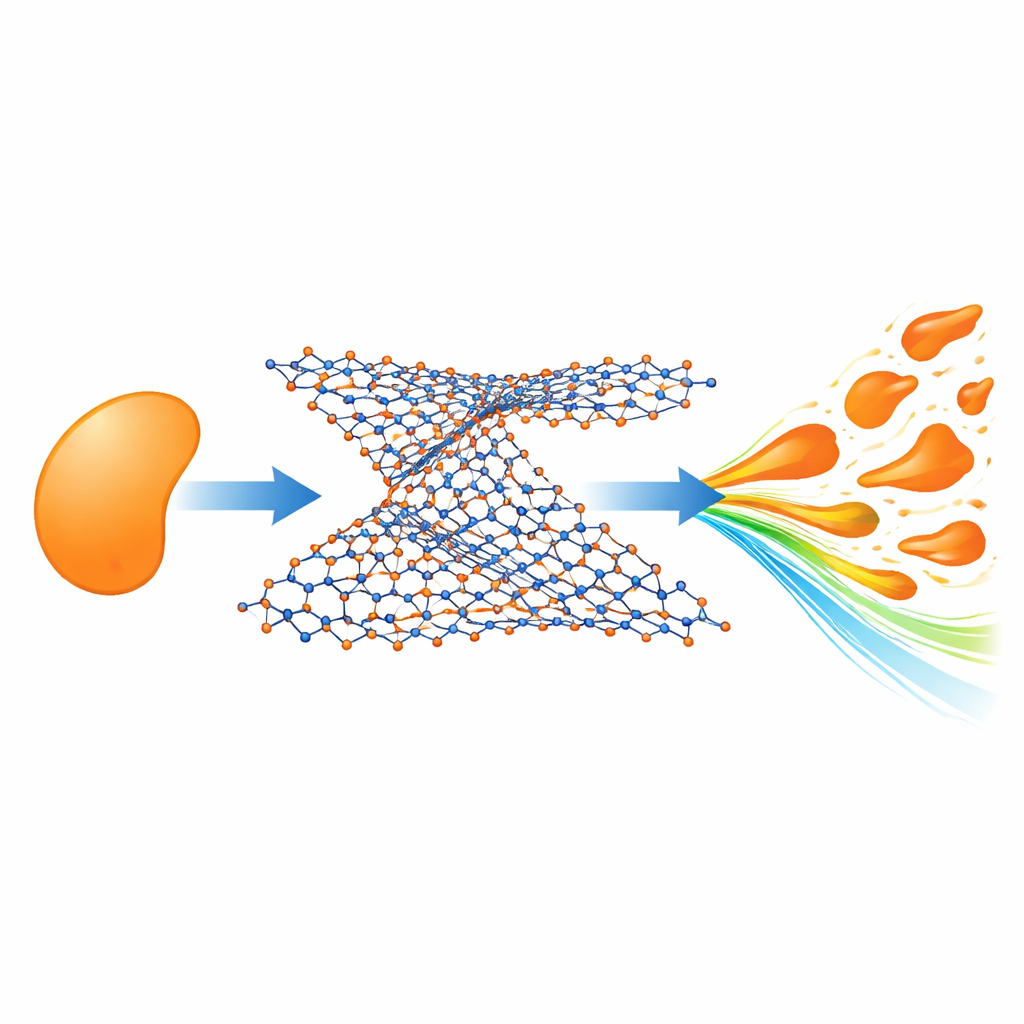
Modern electronics mostly relies on moving electric charge, but every electron also carries a tiny magnetic compass called spin. Devices that control spin instead of, or in addition to, charge could be faster and more energy‑efficient. This paper shows that by gently twisting two ultra‑thin crystals to create a moiré pattern—much like overlapping two window screens—scientists can dramatically boost how well a material converts ordinary electric current into spin current, a property known as the spin Hall effect. The authors reveal that this boost is not limited to exotic, delicate states but can be even stronger in ordinary metallic conditions that are easier to realize in the lab.
From flat bands to powerful spin currents
Earlier work on moiré materials focused on semiconductors where electrons occupy narrow, nearly flat energy bands. These flat bands can host striking quantum phases, and experiments in twisted tungsten diselenide (WSe2) and molybdenum telluride (MoTe2) have already demonstrated unusually large spin currents in lightly doped samples. In this regime, the spin Hall conductivity—how effectively an electric field drives a transverse spin flow—takes on quantized values set by the number of special “Chern” bands near the Fermi level. As the twist angle between the layers in twisted MoTe2 is reduced, the number of such bands grows and the quantized spin Hall response steps up from 4 to 10 in natural quantum units.
When metals do even better than exotic insulators
The authors then ask what happens when the system is pushed far away from the flat‑band regime, into heavily doped metallic states where many bands overlap. Intuitively, one might expect the tidy, quantized behavior to disappear and the spin Hall effect to weaken. Instead, large‑scale quantum simulations accelerated on graphics processing units reveal the opposite: in twisted MoTe2, the spin Hall conductivity in the metallic regime can reach about 17 of those same quantum units—roughly three times larger than the best quantized values. Here, the twist‑generated moiré potential reshapes the large Fermi surface, breaking it into pieces and causing many band crossings and inversions. These rearrangements concentrate the “Berry curvature,” a geometric property of the electronic states that acts like a magnetic field in momentum space and directly drives spin Hall currents.
Moiré metals set a new record
Building on this insight, the study turns to materials that are metallic even before twisting: niobium disulfide (NbS2) and niobium diselenide (NbSe2). Because niobium has one fewer valence electron than molybdenum, the Fermi level in these compounds cuts through broad, overlapping bands that cover nearly half of the Brillouin zone. Twisting two such layers creates an intrinsic moiré metal with a dense web of avoided crossings. Calculations show that in twisted NbSe2 at a twist angle near 5°, the spin Hall conductivity reaches a three‑dimensional value of about −5200 (ħ/e) S/cm—roughly three times larger than the best bulk record previously observed in platinum. Crucially, this maximum lies right at the natural Fermi level, meaning it should be accessible without delicate tuning of the electron density.
Peering inside the momentum‑space engine
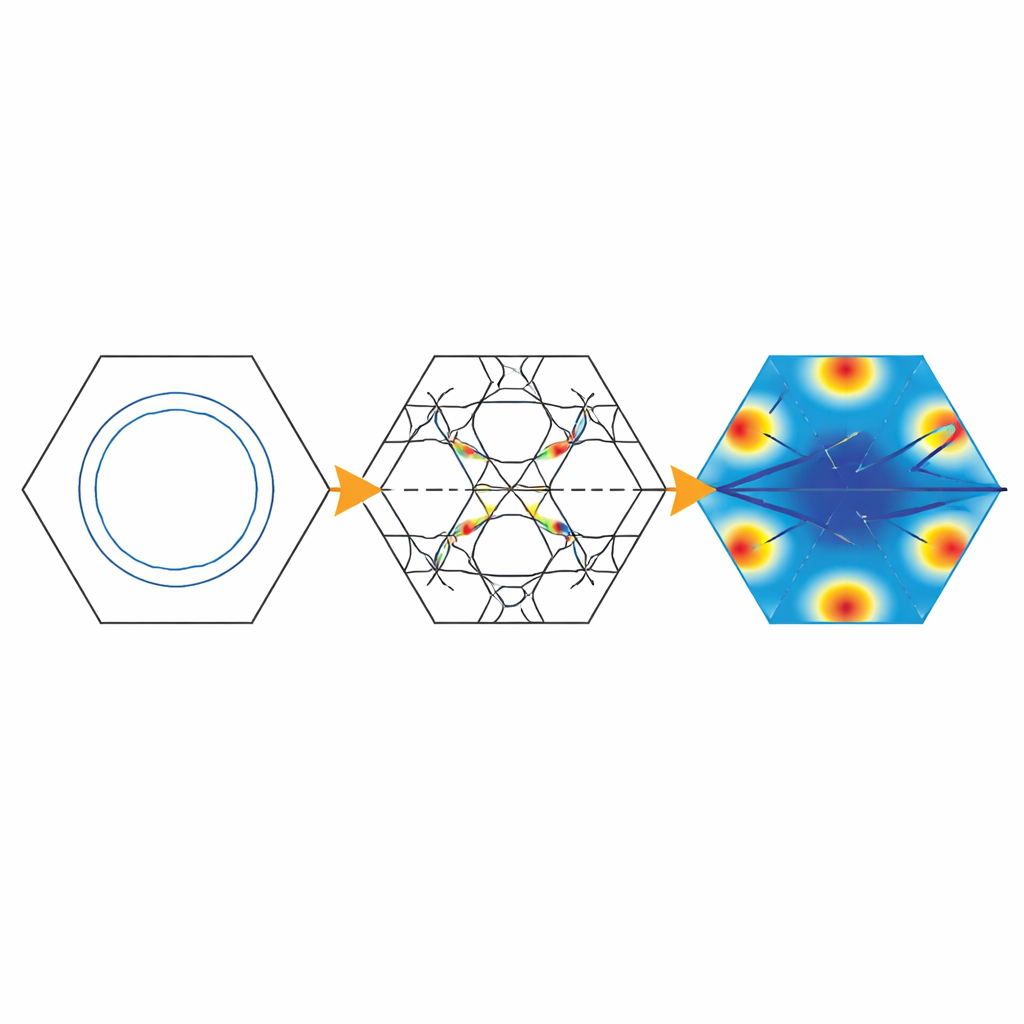
To understand where this enormous response comes from, the authors “unfold” the complicated moiré band structures back into the simpler momentum space of a single layer. In twisted MoTe2, they find that while the central Fermi‑surface pocket changes little, six surrounding pockets near the Brillouin‑zone edges are strongly modified by the moiré potential. These pockets develop gaps and inversions that appear as bright hotspots of Berry curvature and dominate the spin Hall signal. In twisted NbSe2, the Fermi surface is even larger, and both the central and outer pockets undergo multiple inversions, creating ring‑like and patch‑like Berry‑curvature patterns. The more area the Fermi surface covers, the more such hotspots form, and the stronger the resulting spin current.
What this means for future devices
Overall, the work shows that twisting two atomic layers is a powerful knob for engineering giant spin Hall effects, not only in fragile flat‑band phases but also in robust metallic regimes. By exploiting moiré‑induced reconstructions of the Fermi surface and the resulting geometric forces in momentum space, the authors identify moiré metals such as twisted NbSe2 as promising platforms for generating record‑breaking spin currents. For a layperson, the main takeaway is that carefully arranged patterns at the atomic scale can turn otherwise ordinary metals into superior sources of spin, opening new routes toward efficient, tunable spintronic technologies.
Citation: Mao, N., Xu, C., Bao, T. et al. Universal giant spin Hall effect in moiré metal. npj Comput Mater 12, 142 (2026). https://doi.org/10.1038/s41524-025-01887-w
Keywords: spin Hall effect, moiré materials, twisted bilayer MoTe2, moiré metals, spintronics