Clear Sky Science · en
Androgen receptor localisation and protein interactions provide insight into steroid mediated metabolic shifts in endocrine resistant breast cancer
Why this research matters
For many women with hormone-sensitive breast cancer, aromatase inhibitors are a mainstay of treatment after menopause. These drugs strip tumors of estrogen and can work well for years—yet many cancers eventually return. This study asks a crucial question: when estrogen is almost gone, do other hormones step in to fuel the cancer? By tracking where the androgen receptor sits inside breast cancer cells, and which proteins it teams up with, the researchers uncover how a surplus of male-type hormones can help tumors adapt their metabolism and outsmart therapy.
A new role for a familiar hormone switch
Most people think of androgens, such as testosterone and its relatives, as hormones that act on reproductive tissues. Here, scientists focused on their less familiar actions in breast tissue, especially after menopause when adrenal androgens remain relatively high while estrogen drops. They studied the androgen receptor (AR), a protein that normally moves into the nucleus of a cell to switch genes on or off. Instead of concentrating only on this classic nuclear role, the team examined AR in the cell’s fluid-filled cytoplasm. Using digital pathology on hundreds of tumor samples and an independent clinical trial, they found that high levels of AR in the cytoplasm strongly predicted poorer survival in a specific group: postmenopausal women with the more aggressive luminal B type of breast cancer. This pattern did not hold for younger women or for the generally slower-growing luminal A tumors.
Where the receptor sits shapes patient outcome
By carefully reanalyzing stained tumor tissues, the researchers showed that AR can be present in both the nucleus and cytoplasm, but the balance shifts with age and tumor subtype. In postmenopausal luminal B cancers, cytoplasmic AR was more common and linked to a lower presence of progesterone receptor, a marker often associated with better hormone responsiveness. In metastatic biopsies, cytoplasmic AR appeared mainly in particularly hard-to-treat lobular cancers carrying estrogen receptor mutations. Together, these observations suggest that when AR is active outside the nucleus, it may signal through rapid, non-genomic routes that help tumors survive endocrine therapy and become more aggressive.
Hormone overload and a turbocharged energy supply
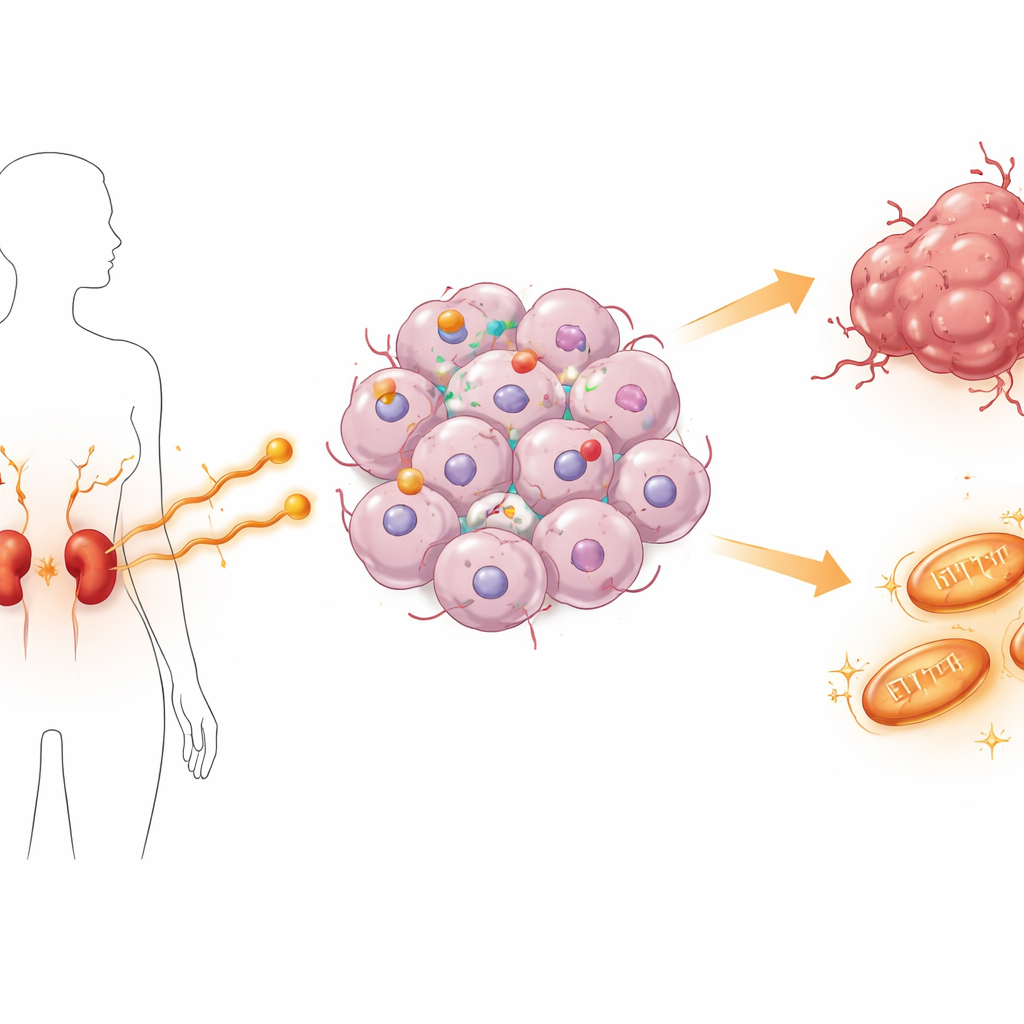
To probe how androgen excess changes cell behavior, the team used laboratory models of breast cancer that had either remained sensitive to aromatase inhibitors or evolved resistance. They exposed these cells to androstenedione, a key adrenal androgen abundant after menopause. In resistant cells, but not in sensitive ones, this hormone boosted AR levels, promoted its movement into both cytoplasm and nucleus, and rapidly triggered an internal signaling cascade involving ERK, a well-known growth pathway. At the same time, resistant cells developed unusually shaped mitochondria, increased mitochondrial mass and membrane potential, and showed higher oxygen consumption and glycolysis. In simple terms, their energy factories grew larger and more active, and the cells became more flexible in how they produced fuel—features that can support survival under treatment stress.

New protein partners that reshape cell behavior
Because proteins often work in teams, the researchers next asked which molecules physically associate with AR under androgen excess in resistant cells. Using a combination of immunoprecipitation and high-resolution mass spectrometry, they mapped an AR “interactome” and compared it between resistant and sensitive cell lines. In resistant cells exposed to androstenedione, AR partnered with specific proteins involved in stress responses, RNA handling, and metabolic control, including G3BP1, SLIRP, and IGFBP5. Follow-up imaging confirmed that AR and these partners came together near the nuclear membrane and within nuclear foci, especially under androgen treatment. G3BP1 is linked to stress granules and selective protein production, SLIRP can dampen or enhance nuclear receptor activity, and IGFBP5 influences growth factor signaling and cell movement. Their association with cytoplasmic AR points to a rewiring of both metabolism and gene regulation that favors survival in a low-estrogen, high-androgen environment.
What this means for women with breast cancer
This work suggests that in some postmenopausal breast cancers, especially luminal B tumors, an androgen-rich environment allows AR to operate outside its usual nuclear role, helping cells retool their energy systems and resist endocrine therapy. Measuring cytoplasmic AR with digital pathology could provide a new prognostic marker and help flag patients at higher risk of relapse who might benefit from different or additional treatments, such as carefully chosen AR-targeted drugs. More broadly, the findings tie together hormone balance, metabolism, and breast cancer behavior, hinting that chronic androgen excess—a feature shared with metabolic conditions like polycystic ovary syndrome—may quietly shape cancer risk and treatment response in women.
Citation: Bleach, R., Bozkurt, E., Xin, J. et al. Androgen receptor localisation and protein interactions provide insight into steroid mediated metabolic shifts in endocrine resistant breast cancer. npj Breast Cancer 12, 65 (2026). https://doi.org/10.1038/s41523-026-00924-1
Keywords: androgen receptor, endocrine resistance, luminal B breast cancer, cancer metabolism, postmenopausal hormones