Clear Sky Science · en
Probing biofilm development, stress response and heterogeneity—spectroscopic characterization of single and multi-species consortia
Life in Slimy River Coats
In many streams and rivers, bacteria do not drift alone in the water. Instead, they band together in slimy surface films that coat rocks, plants, and other underwater surfaces. These films, called biofilms, are miniature cities where microbes feed, grow, and shelter from harsh conditions. This study asks a timely question: how do such river biofilms respond when they are bathed in traces of human medicines, and can living together help some species cope better with this kind of stress?
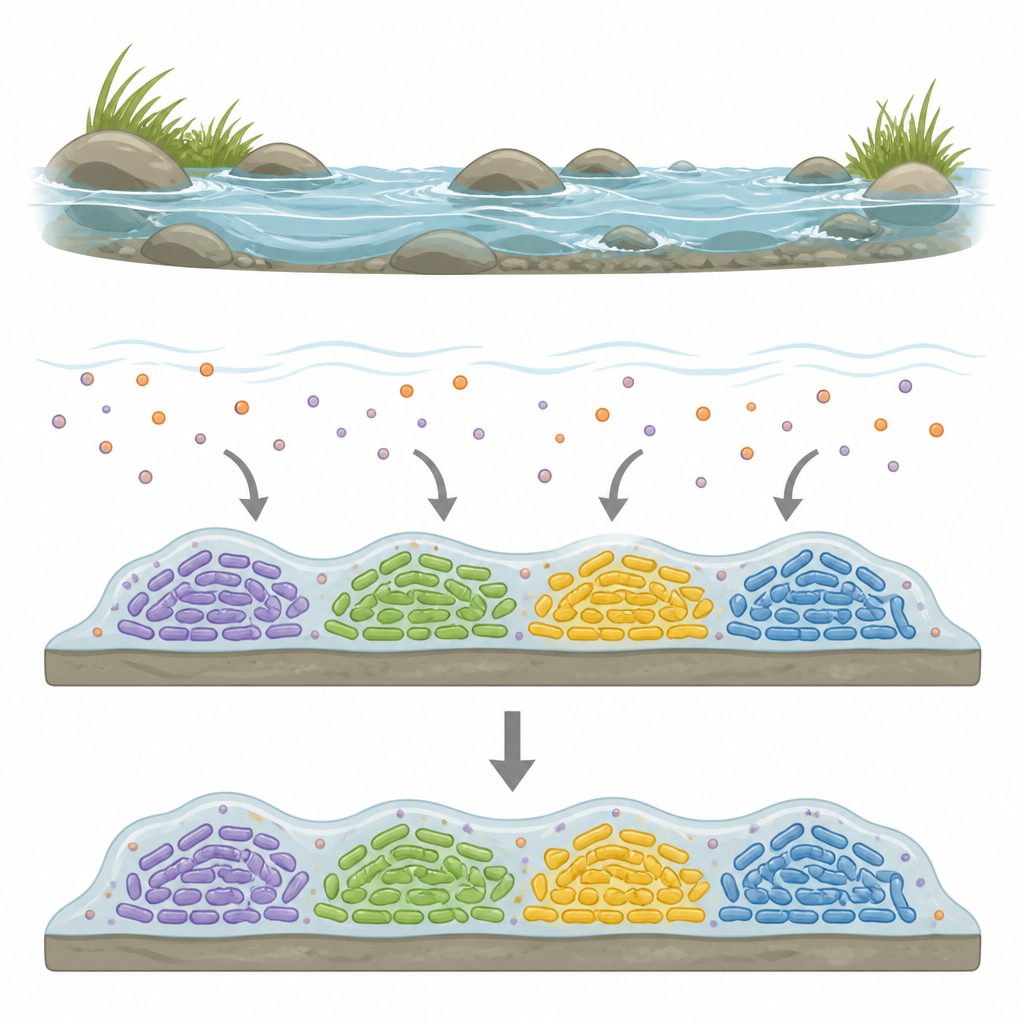
A Simple River Community in the Lab
To explore this, researchers built a carefully controlled model of a natural river biofilm. They isolated four bacterial strains from the same spot in a small Swedish stream and confirmed by genome analysis that all four normally live in freshwater environments. In the lab, they grew each strain alone and in mixtures, watching how fast they multiplied, how they moved, and how they built biofilms. Some species grew quickly and swam using long tails, while others produced thick, jelly-like coatings that glued them to surfaces. Microscopes revealed that all four were rod-shaped, but differed in size, surface structures, and how much sticky material they secreted.
The Hidden Glue and Food Stores
Beyond shape and growth, the team wanted to know what these biofilms were made of chemically. Using light-based tools that read molecular vibrations, they analyzed intact, hydrated cells and the slimy matrix around them. They found that each species had its own “recipe” of sugars, fats, proteins, and storage polymers. Two species in particular stored extra carbon as special plastic-like granules that act as energy reserves. In growing biofilms, the balance of these components changed over time. Some species increased their sugar-rich matrix, while others built up more of these energy stores, especially when oxygen or nutrients became limiting deeper inside the film.
Antibiotic Stress and Microbial Coping Tricks
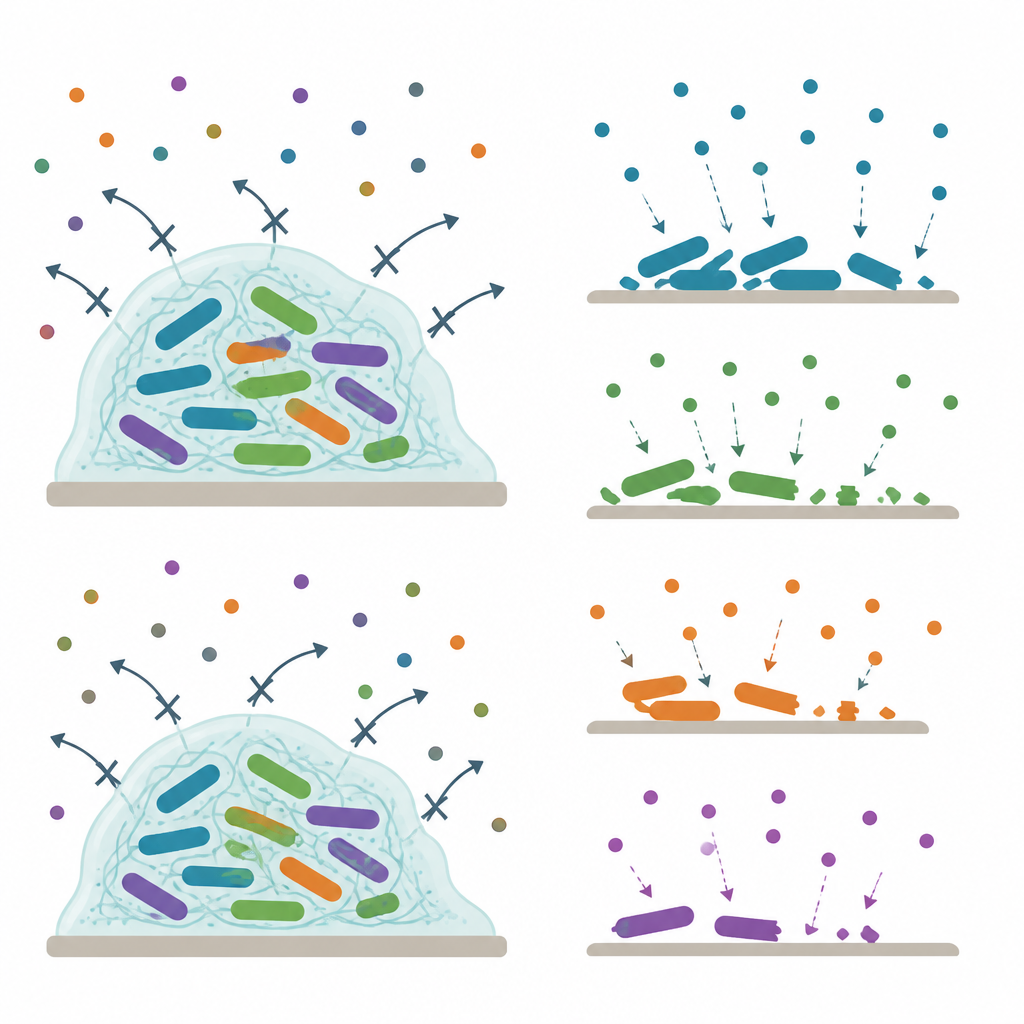
The researchers then challenged the bacteria with trimethoprim, a common antibiotic used in human medicine that also turns up in surface waters, sometimes at elevated levels near wastewater outlets. When grown as free-swimming cells, three of the four strains showed clear, dose-dependent drops in growth, with one species being particularly sensitive. Under this stress, the more vulnerable strains shifted their chemistry and boosted production of their energy-storage granules, a response known from other microbes to help them ride out difficult conditions. In biofilms, trimethoprim reshaped the thickness and structure of the slimy layers and increased signs of membrane damage in many cells, but the details depended on the species and on whether the water was neutral or slightly acidic.
Strength in Numbers Inside Mixed Films
The most intriguing effects appeared when all four river species were grown together in one shared biofilm. Confocal microscopes showed a layered structure: motile cells clustered closer to the surface, while other species formed a more solid matrix higher up. A combination of advanced imaging and chemical fingerprinting revealed that one of the most sensitive species formed small clusters within this mixed community, surrounded by neighbors that were better able to tolerate the drug. Even under antibiotic exposure in acidic water, these clusters remained, and the elongated, stressed cell shapes seen in single-species biofilms were much less obvious. The results suggest that, in a realistic community, the more robust partners and the shared matrix help shield the fragile ones from harm.
What This Means for Rivers and Pollution
Overall, the work establishes a versatile, well-characterized model of a river biofilm that scientists can use to study how environmental stressors affect both bacteria and the slimy matrix that surrounds them. It shows that the same drug can have very different impacts depending on whether bacteria live alone, in a thick film, or in a diverse community. In mixed biofilms, sensitive species may be protected by neighbors and by shared protective layers, allowing them to survive antibiotic exposure that would harm them in isolation. For real rivers, this means that pollution by medicines can subtly reshape microbial life and its chemistry, but that microbial teamwork can buffer some of the damage, with potential knock-on effects for nutrient cycles and food webs in freshwater ecosystems.
Citation: Yunda, E., Hagberg, A., Duteil, T. et al. Probing biofilm development, stress response and heterogeneity—spectroscopic characterization of single and multi-species consortia. npj Biofilms Microbiomes 12, 98 (2026). https://doi.org/10.1038/s41522-026-01010-x
Keywords: river biofilms, freshwater bacteria, antibiotic pollution, microbial communities, trimethoprim