Clear Sky Science · en
Disruption of IgA-mediated aggregation at weaning favors mucus encroachment by commensal bacteria
Why baby gut slime matters
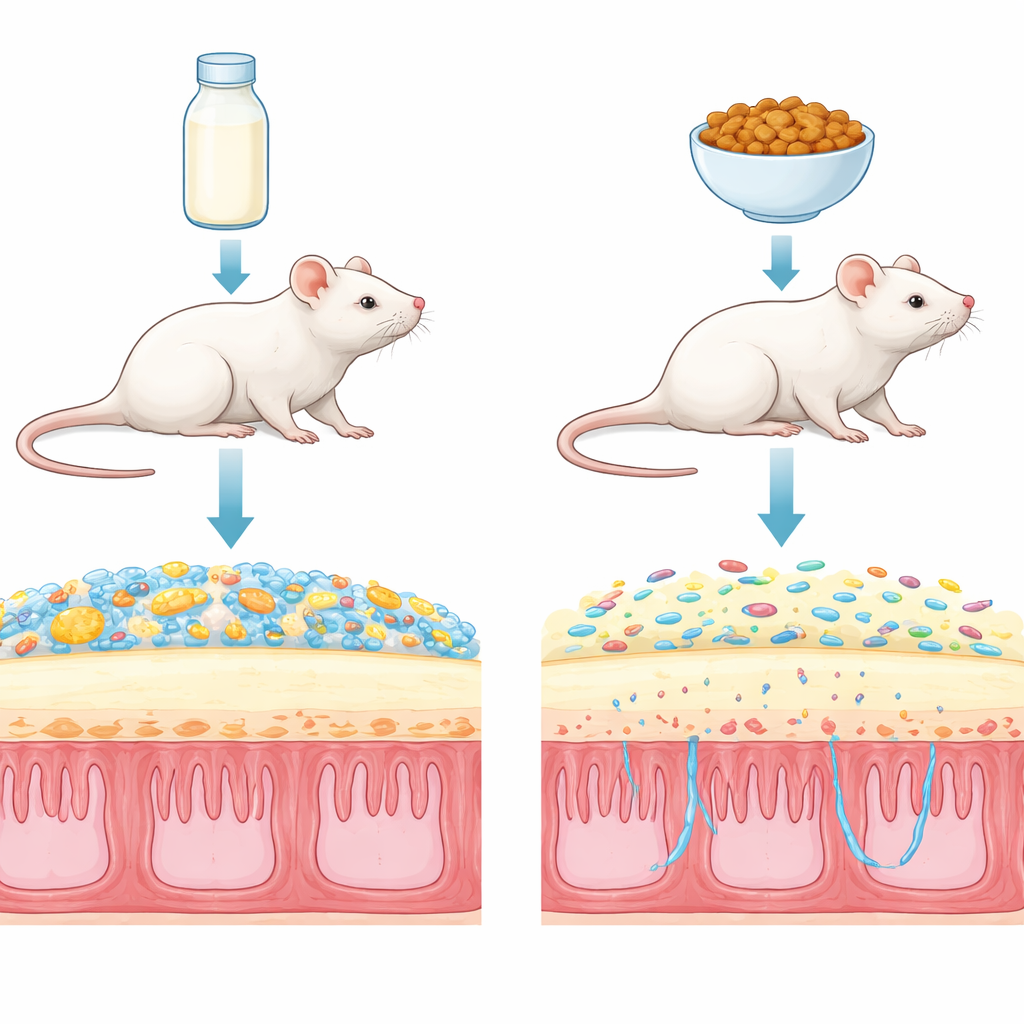
What happens in a baby’s gut during the switch from milk to solid food can quietly shape health for years to come. This study looks at the thin slimy coating that lines the intestine—a mucus layer that keeps friendly bacteria at arm’s length from our cells. By zooming in on how common gut bacteria move through this mucus before and after weaning, the authors uncover why breast milk–linked immune factors may be crucial for keeping microbes in their proper place.
A soft shield between us and our microbes
The intestine is covered by a gel-like mucus layer that acts as a living filter. It lets nutrients through while helping to keep microbes from pressing directly against the gut wall, where they could trigger inflammation or infection. In early life, this barrier is still maturing at the same time as the immune system and the gut microbiome develop. The mucus is made mostly of long sugar-rich molecules called mucins, but it also contains antibodies, especially immunoglobulin A (IgA), and various antimicrobial compounds. Together, these ingredients create both a physical and an immune shield between the host and the billions of bacteria in the gut.
The risky switch from milk to solid food
The transition from exclusive milk feeding to solid food—the weaning period—is a stressful time for the gut. Piglets, much like human infants, suddenly lose many protective factors that came through milk and are exposed to new foods and microbes. In farms, this period is notorious for outbreaks of gut infections and poor growth, often linked to strains of Escherichia coli. In people, weakened mucus barriers and bacteria creeping closer to the gut wall have been associated with chronic conditions such as inflammatory bowel disease, type 2 diabetes, and obesity. Despite this, the fine-scale behavior of motile bacteria inside real intestinal mucus has been difficult to study.
A microfluidic window into mucus
To watch bacteria and mucus interact, the researchers built a simple microfluidic device: a tiny chamber holding a droplet of purified small-intestine mucus next to a suspension of fluorescent E. coli. Under the microscope, they filmed in real time how bacteria approached, entered, and moved within the mucus over two hours. They compared mucus taken from suckling piglets still on milk with mucus from older piglets that had undergone weaning onto solid feed. By analyzing how far the fluorescent signal spread inward, they could calculate a characteristic penetration depth that summarizes how easily bacteria invaded each mucus sample.
Milk-time mucus corrals bacteria at the surface
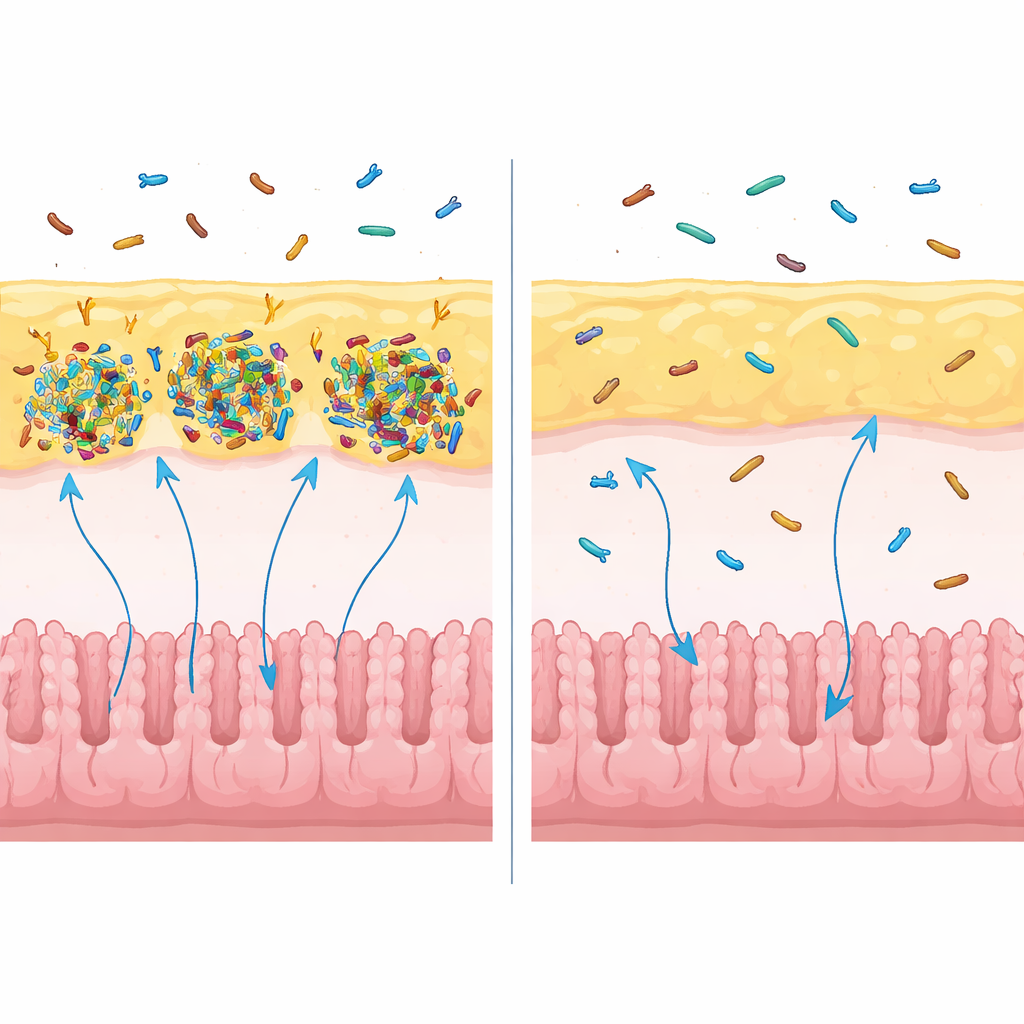
In mucus from weaned piglets, motile E. coli swam more than 100 micrometers into the gel—deeper than the natural thickness of the mucus layer in the intestine. In contrast, mucus from suckling piglets largely stopped the bacteria near the droplet’s edge. A key visual difference was how bacteria organized themselves. In suckling mucus, bacteria formed dense clusters at the mucus surface, extending just outside the droplet into the surrounding liquid, and very few penetrated the interior. In weaned mucus, clusters appeared mainly inside the droplet, and bacteria could be found much deeper. This suggested that a process of bacterial aggregation at the interface was crucial for blocking their advance.
The quiet work of targeted antibodies
Because IgA in mucus and breast milk is known to glue microbes together and help sweep them away, the team measured IgA levels in all samples. On average, mucus from suckling piglets contained more IgA than mucus from weaned animals, consistent with the loss of maternal antibodies at weaning. Yet the link was not straightforward: one suckling sample had very high IgA but behaved like weaned mucus, allowing deep penetration with little aggregation. This pointed to the idea that not just the amount, but the specificity and “quality” of IgA—how well it recognizes particular bacteria—controls clustering at the mucus surface.
Borrowed immunity can restore the barrier
To test this, the scientists separated mucus into a solid-rich “pellet” (mostly mucin gel) and a liquid “supernatant” containing soluble factors such as antibodies. When they added supernatant from suckling mucus, or purified IgA from human breast milk, to bacterial suspensions, E. coli began to clump together. More strikingly, when supernatant from suckling mucus or added IgA was combined with the gel portion from weaned mucus, the resulting droplets once again trapped bacteria near the surface and sharply reduced penetration. Swapping in weaned supernatant did not weaken the protective behavior of suckling mucus, suggesting that key protective molecules are present both within the gel and in the surrounding fluid. Overall, soluble immune factors—especially well-targeted IgA—emerged as prime drivers of bacterial aggregation and barrier function.
What this means for lifelong gut health
This work shows that during suckling, antibodies passed from mother to offspring help organize gut bacteria into harmless clumps at the mucus surface, preventing them from burrowing toward the intestinal wall. After weaning, as this maternal IgA pool declines and the young animal’s own, less experienced antibodies take over, bacteria can move deeper into the mucus, potentially increasing the chances of infection and low-grade inflammation. By providing a precise, ex vivo way to measure how far microbes get into mucus, the study also offers a tool to evaluate how diets, drugs, or engineered antibodies might reinforce this fragile barrier during vulnerable windows of life.
Citation: Simpson, K., Baillou, R., Le Roy, T. et al. Disruption of IgA-mediated aggregation at weaning favors mucus encroachment by commensal bacteria. npj Biofilms Microbiomes 12, 79 (2026). https://doi.org/10.1038/s41522-026-00946-4
Keywords: gut mucus barrier, maternal IgA, weaning transition, bacterial aggregation, intestinal microbiome