Clear Sky Science · en
Unveiling the hidden viral biodiversity and potential ecological functions with global coral holobiont virome database
Why tiny reef hitchhikers matter
Coral reefs are often called underwater rainforests because they teem with life despite growing in relatively poor, clear waters. For years, scientists have focused on the corals themselves, their resident algae, and bacteria to explain this surprising productivity. This study shines a spotlight on an overlooked cast of characters: viruses that live in and around corals. By cataloging these tiny entities across the globe and testing their effects in controlled experiments, the researchers show that viruses help shape who lives on reefs and how nutrients like carbon, nitrogen, and phosphorus are recycled—offering fresh clues to the long‑standing puzzle of how reefs stay so productive.
Building a global map of coral viruses
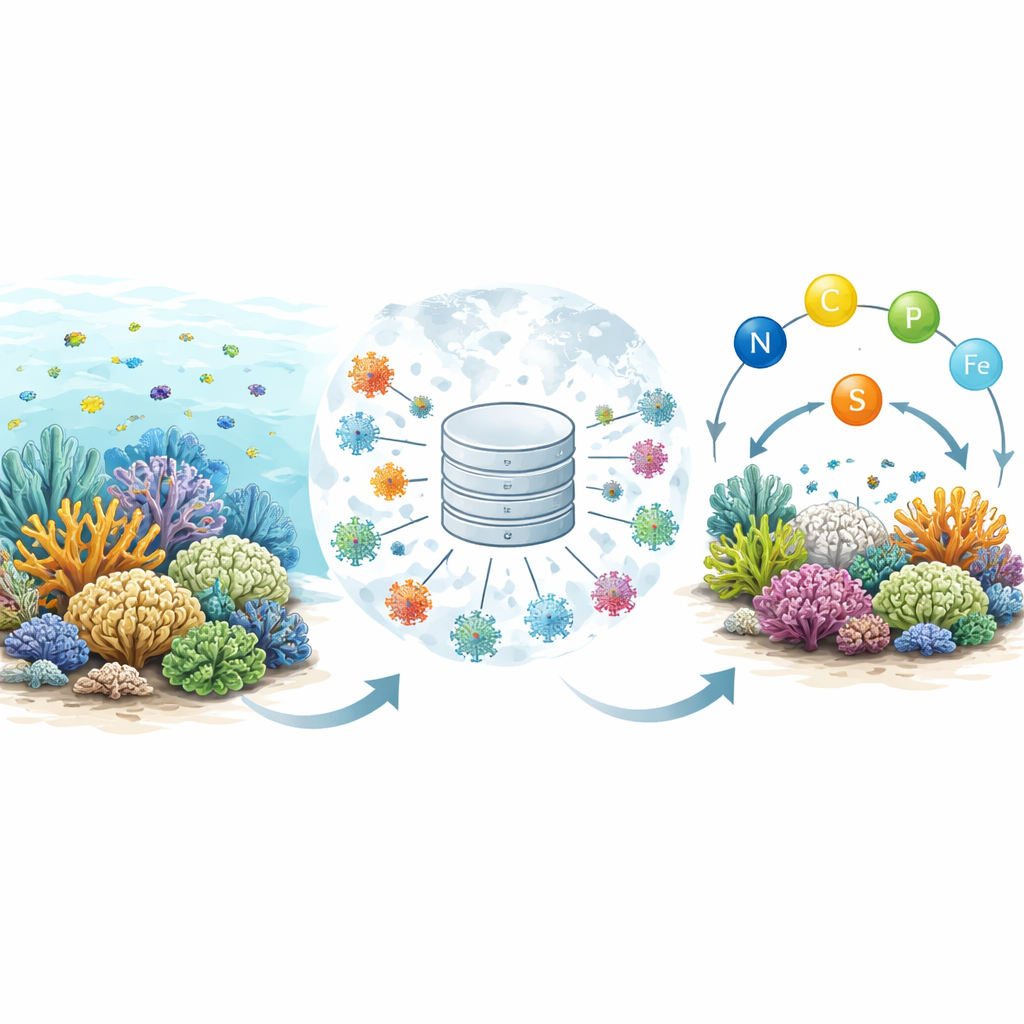
The team assembled the Global Coral Holobiont Virome Database, drawing on DNA sequences from 513 reef samples that span 36 coral species and 18 regions worldwide. From these data, they recovered more than 36,000 distinct viral types associated with corals. Many fell into a handful of major viral groups known to infect bacteria and other microbes, but roughly two‑thirds were so unfamiliar that they could not be placed into existing categories—evidence of a vast hidden viral diversity on reefs. The dataset also includes thousands of nearly complete viral genomes, giving scientists a much clearer starting point for studying coral‑associated viruses than ever before.
Who lives where, and why it matters
By comparing reefs across latitudes, the researchers found that both viruses and their microbial hosts are most diverse at mid‑latitude sites, with distinct communities at low and high latitudes. Yet geography explained only a small fraction of the differences between viral communities. Far more important was which coral species was present and which microbes that coral hosted. In other words, the identity of the coral and its resident bacteria and archaea did more to shape the viral community than simple distance on a map. Many predicted virus–host pairs showed strong positive associations, suggesting that dense host populations support rich viral populations and that these partners are tightly linked in their ecology.
Viruses as hidden engineers of reef chemistry
Looking more closely at viral genes, the team uncovered thousands of so‑called auxiliary metabolic genes that can tweak how infected microbes process key elements. These viral genes were tied to at least six major nutrient cycles: carbon, nitrogen, phosphorus, sulfur, iron, and methane. Many encoded functions that help microbes scavenge scarce phosphorus and iron, two elements known to limit reef productivity, or that adjust how microbes store and burn carbon. Rather than just hijacking cells to make more virus particles, these genes appear poised to redirect microbial metabolism in ways that free up nutrients, fuel energy production, and keep chemical cycles turning rapidly within the coral community.
Putting viruses to the test in living corals
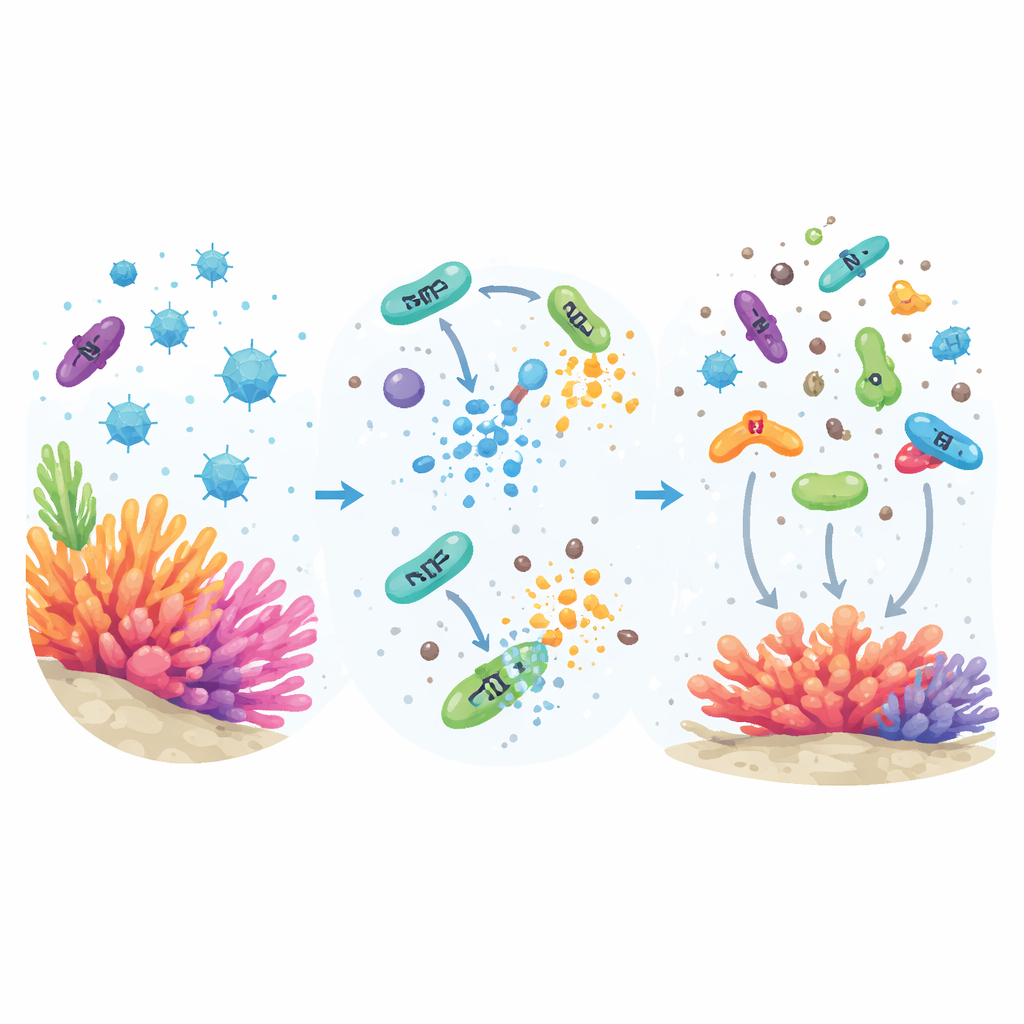
To move beyond patterns in DNA data, the researchers ran mesocosm experiments with a common reef‑building coral, exposing it to low and high doses of concentrated viral mixtures. The coral’s symbiotic algae, which provide much of its food through photosynthesis, appeared unaffected: their numbers and performance stayed stable. The bacterial community, however, shifted markedly. Viral addition increased bacterial diversity, reduced the dominance of some common groups, and allowed rarer types to expand. Gene activity measurements showed coordinated changes in pathways linked to carbon use, nitrogen transformations, phosphorus and sulfur handling, iron metabolism, and methane‑related reactions. Together, these results indicate that viruses can reorganize microbial communities and rewire nutrient processing inside the coral without visibly harming the animal or its algae.
What this means for reef health
By combining a global viral catalog with targeted experiments, this study recasts coral‑associated viruses as active players in reef ecosystems, not just potential pathogens. They help determine which microbes live with corals, control the rise and fall of microbial populations through infection, and carry genes that fine‑tune how those microbes move nutrients through the reef. These hidden interactions help explain how reefs can remain highly productive even in waters that are relatively poor in nutrients, offering a mechanistic, virus‑centered perspective on the classic “Darwin’s paradox.” Understanding these viral roles may improve predictions of how reefs respond to environmental stress and could ultimately inform strategies to protect and restore these vulnerable ecosystems.
Citation: Wu, M., Wen, X., Liu, S. et al. Unveiling the hidden viral biodiversity and potential ecological functions with global coral holobiont virome database. npj Biofilms Microbiomes 12, 77 (2026). https://doi.org/10.1038/s41522-026-00944-6
Keywords: coral reefs, marine viruses, microbiome, nutrient cycling, reef resilience