Clear Sky Science · en
Imaging-derived biological age across multiple organs links to mortality and aging-related health outcomes
Why some bodies age faster than others
Two people can share the same birthday yet have very different health. One might run marathons, while the other struggles with heart disease or memory loss. This study asks a simple but powerful question: can medical images of our organs reveal how old our bodies really are on the inside, and can those hidden ages warn us about future illness and even early death?
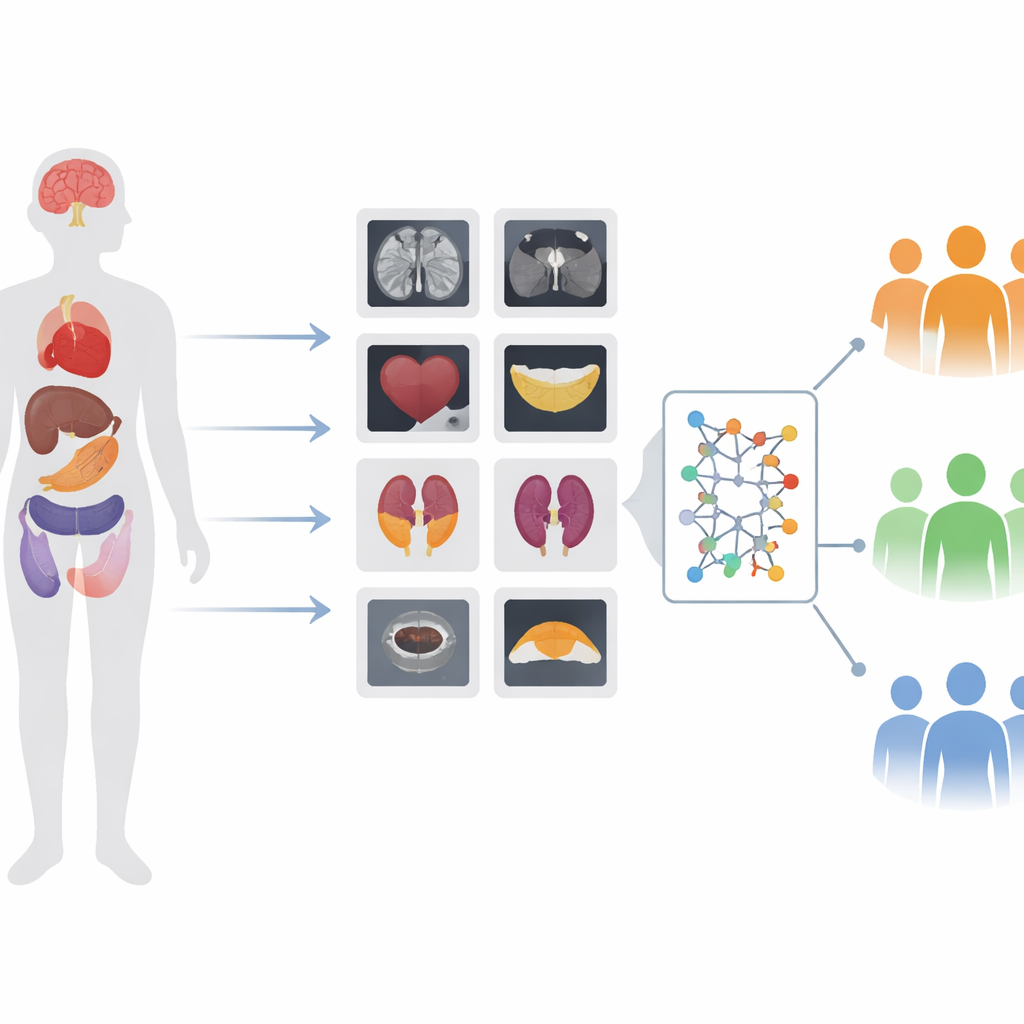
Looking inside seven key organs
The researchers analyzed scans from more than 70,000 participants in the UK Biobank, a large health study of middle-aged and older adults. They focused on seven organs that are central to common age-related diseases: the brain, heart, liver, pancreas, spleen, both kidneys, and the light-sensing layer at the back of the eye (captured with eye imaging rather than MRI). These scans capture how organs look and move in great detail, but the patterns of aging hidden in them are far too complex to spot by eye alone.
Teaching computers to read organ age
To decode those patterns, the team used deep learning, a form of artificial intelligence that excels at finding structure in images. For each organ, they trained a model on scans from people who were considered healthy for that organ, using the person’s calendar age as a stand-in for their “normal” biological age. The computer learned what a typical 50-, 60-, or 70-year-old organ looks like without anyone hand-picking features. When applied to the broader population, the models produced a predicted organ age; subtracting the actual age from this value yielded a “predicted age gap.” A positive gap meant the organ appeared older than expected (accelerated aging), while a negative gap suggested it looked younger (decelerated aging).
Uneven aging across the body
The models accurately tracked age for all seven organs, with the brain showing the tightest match between predicted and actual age, likely because its structure changes strongly and consistently over time. Yet the different organs did not age in lockstep. For most people, the predicted age gaps for one organ were largely independent of those for others. Stronger links appeared only between paired organs, such as the two kidneys and the two eyes, and among organs in the abdomen, where the liver’s aging pattern showed moderate ties to those of neighboring organs. This patchwork pattern supports the idea that aging is not a single uniform process but a mosaic: one person’s heart may age faster while another’s brain or kidneys lead the way.
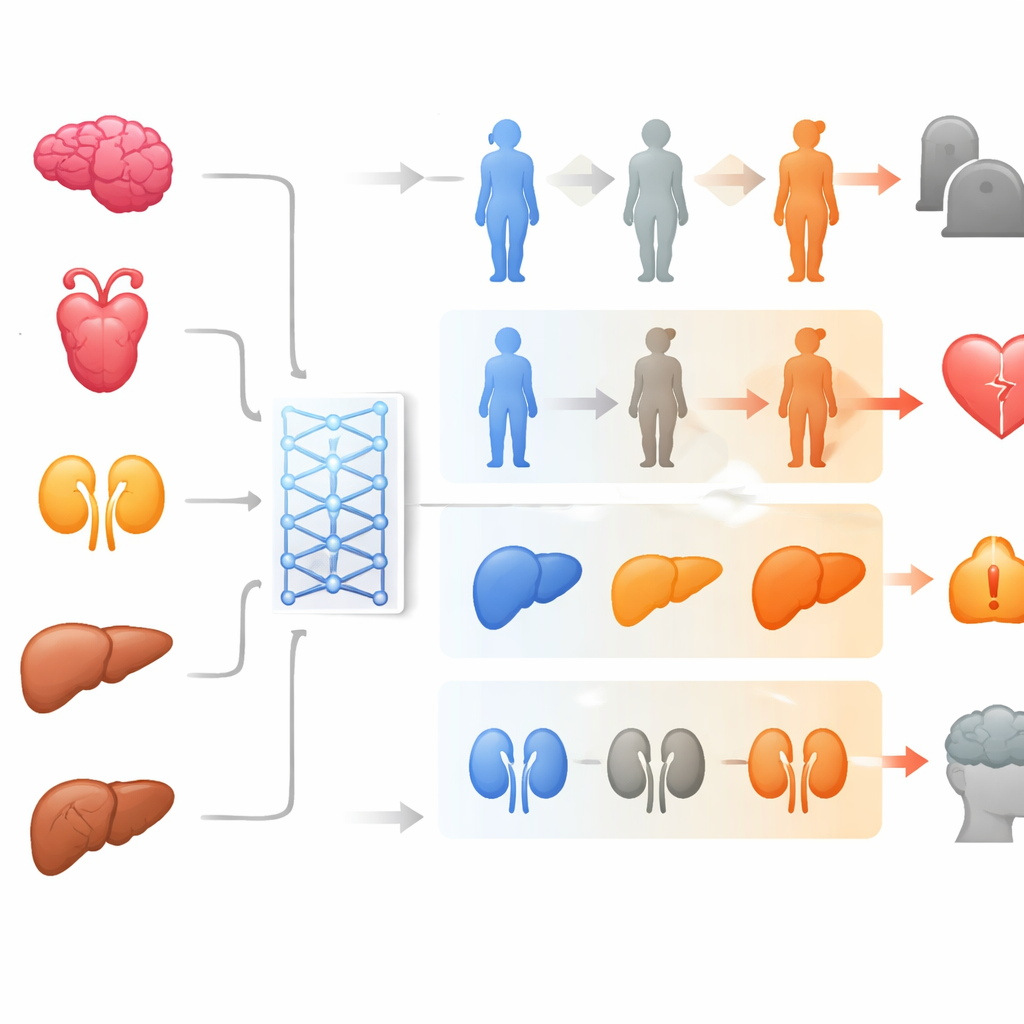
Early warning signs for disease and death
The crucial test was whether these organ age gaps actually matter for health. The researchers followed participants over time, tracking who developed major conditions such as Alzheimer’s disease, heart attacks, chronic kidney disease, and type 2 diabetes, and who died during the study period. People whose brain, heart, or pancreas appeared older than their calendar age faced a noticeably higher risk of dying earlier. An older-looking brain strongly predicted later Alzheimer’s disease; an older-looking heart foretold heart attacks and chronic heart disease; and older kidneys signaled a markedly higher chance of chronic kidney disease. In many cases, organs appeared biologically older years before any diagnosis, suggesting that imaging-based ages could serve as early warning lights long before symptoms appear.
How the model sees aging
To check that the computer was paying attention to meaningful changes rather than random noise, the team visualized which parts of each image influenced its age estimates most. For the brain, the model focused on the fluid-filled spaces that enlarge as brain tissue shrinks with age. In the eye images, it concentrated on blood vessels and the optic disc, which are known to change with aging. In the heart, it highlighted the muscular walls and main pumping chamber, and in the kidneys and liver it emphasized regions associated with blood flow and organ shape. These patterns matched established medical knowledge, giving confidence that the model’s predictions reflect real biological changes.
What this means for future health care
Together, these findings show that simple scans, interpreted by modern AI, can estimate how old our organs behave biologically and that these hidden ages carry real information about future disease and survival. The work is still early: the study mostly included older adults from relatively similar backgrounds, and the exact cutoffs between “normal” and “accelerated” aging are not yet settled. But if validated in more diverse groups and combined with other health data, imaging-based biological age could become a powerful tool for personalized medicine—helping doctors identify which organs need extra care long before illness takes hold.
Citation: Ecker, V., Yang, B., Gatidis, S. et al. Imaging-derived biological age across multiple organs links to mortality and aging-related health outcomes. npj Aging 12, 51 (2026). https://doi.org/10.1038/s41514-026-00377-7
Keywords: biological age, medical imaging, deep learning, multi-organ aging, disease risk prediction