Clear Sky Science · en
Spontaneous speech enables scalable digital phenotyping of physical functional deficits in aging
Why Your Voice Can Reveal How Well You Move
As we grow older, many of us worry about slowing down—climbing stairs, keeping our balance, or simply walking to the store. This study suggests that a surprisingly simple everyday action—speaking for one minute into a smartphone—may reveal how strong our legs are, how steady our balance is, and even how easily we tire. By turning casual conversation into a kind of “digital checkup,” the researchers hope to make early detection of physical decline far easier and more widely available.
Listening for Hidden Signs of Physical Slowdown
The team studied 271 older adults living in the community, with an average age of about 77 years. Each person completed a detailed physical examination covering ten areas of function, including leg strength and power, walking speed, grip strength, balance, flexibility, muscle mass in the arms and legs, endurance, mobility, and fatigue. At the same visit, participants recorded two one-minute stories on a tablet: one about a positive life event and one about a negative event. These short emotional monologues provided natural, everyday speech rather than scripted sentences, making the test simple to perform and closer to real-life conversation.

Teaching Computers to Hear the Body in the Voice
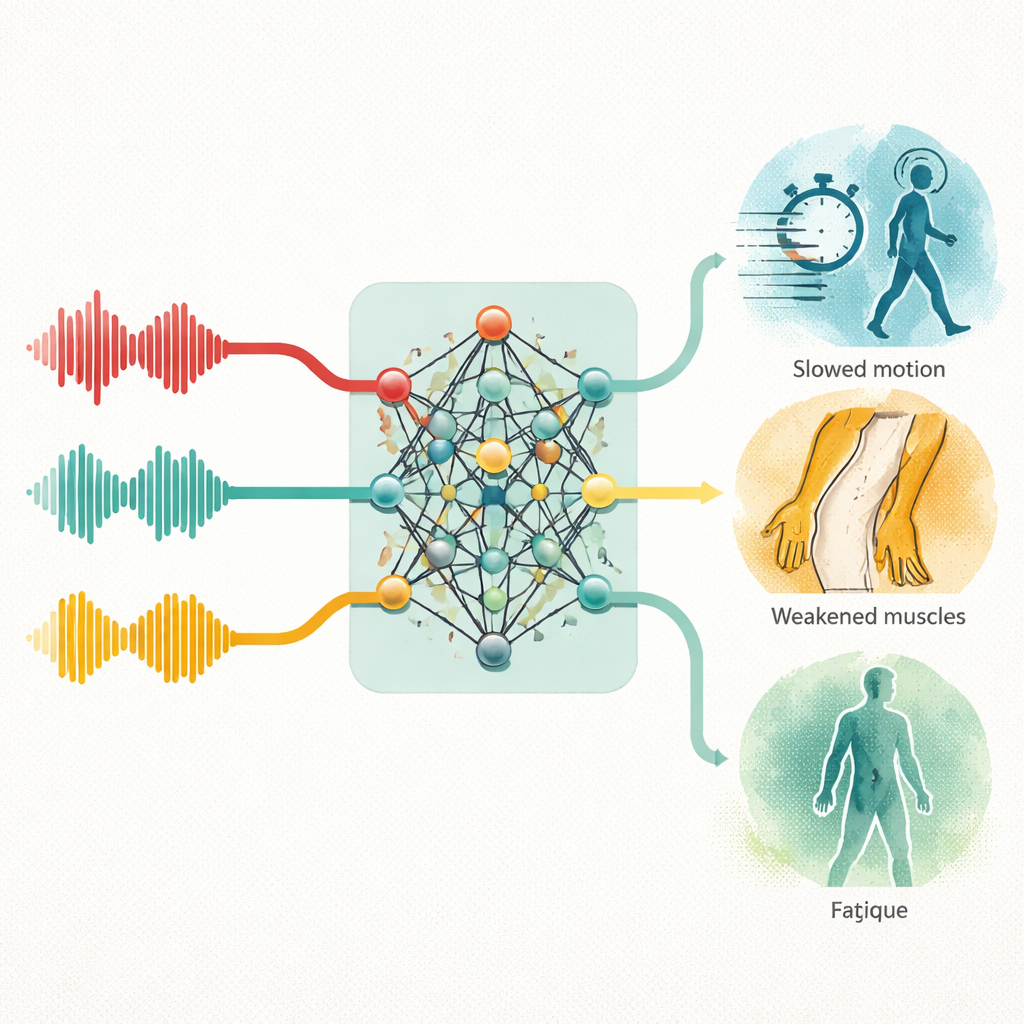
Instead of focusing on what people said, the researchers examined how they said it. Using software, they broke each recording into three types of features. Acoustic features captured qualities like pitch, loudness, and subtle irregularities in the sound. Temporal features described timing—how fast words and sounds were produced, and how often and how long people paused. Linguistic features reflected the way language was used: the richness of vocabulary, the complexity of sentences, and the types of words chosen. These hundreds of measurements were then fed into machine-learning models trained to decide whether each person showed a deficit or normal performance in each physical domain.
Strong Digital Signals of Physical Weakness
The computer models turned out to be remarkably accurate. Across the ten types of physical function, the systems achieved a mean area under the curve (AUC) of about 0.91, a level often considered clinical grade. In other words, from just one minute of speech, the algorithms could reliably distinguish between older adults with and without problems such as weak leg muscles, poor balance, slow walking, reduced mobility, low muscle mass, or marked fatigue. Combining information from both the positive and negative speech tasks in “stacked” models further improved performance for most physical measures, and sharply reduced missed cases for important outcomes like handgrip strength and gait speed.
Three Main Ways Speech Reflects the Aging Body
When the researchers opened the “black box” of their models using explainable AI tools, they found that the most important clues came from acoustic and timing features, with language patterns playing a substantial but variable role. They observed three broad clusters of changes. First, many people with physical deficits showed simpler language: fewer descriptive words and more basic constructions, suggesting that mental resources may be shifted away from crafting complex sentences toward maintaining smooth speech. Second, there was neuromotor-temporal slowing: slower or more fragmented speech, longer consonant sounds, and more frequent or longer pauses, hinting at shared slowing of the muscles used for both speaking and moving. Third, there was articulatory-spectral decline: less stable voice quality, reduced pitch variation, and altered resonance patterns, consistent with age-related weakening of the vocal folds and breathing muscles.
A Potential “Aging Clock” in Your Voice
Intriguingly, standard factors like age and sex contributed very little to the models’ decisions compared with the speech features themselves. This suggests that a person’s voice may reflect their “physical age” more than the number of candles on their birthday cake. The authors propose that spontaneous speech could act as a kind of physical aging clock—tracking the body’s strength, balance, and endurance over time. Because the test requires only a brief recording on a common device, it could eventually support home-based screening, especially in rural or low-resource settings where full physical testing is difficult. While more studies in other languages and populations are needed, this work points toward a future in which routine conversation doubles as a powerful, effortless health check for older adults.
Citation: Da Cunha, E., Zory, R., Chorin, F. et al. Spontaneous speech enables scalable digital phenotyping of physical functional deficits in aging. npj Aging 12, 52 (2026). https://doi.org/10.1038/s41514-026-00343-3
Keywords: digital biomarkers, aging and frailty, speech analysis, machine learning in geriatrics, remote health monitoring