Clear Sky Science · en
Cell-type-specific autophagy in root-hair-forming cells is essential for salt stress tolerance in Arabidopsis thaliana
Why salt is a quiet threat to crops
Salt creeping into farmland soils is a growing problem around the world, quietly reducing yields of many staple crops. Plants cannot simply move away from salty ground, so they must rely on clever cellular tricks to survive. This study reveals how tiny root hair cells in the model plant Arabidopsis use an internal recycling system to trap salt safely and protect the whole plant, offering clues that could guide future strategies to keep crops productive on salty soils.
Small root hairs with a big job
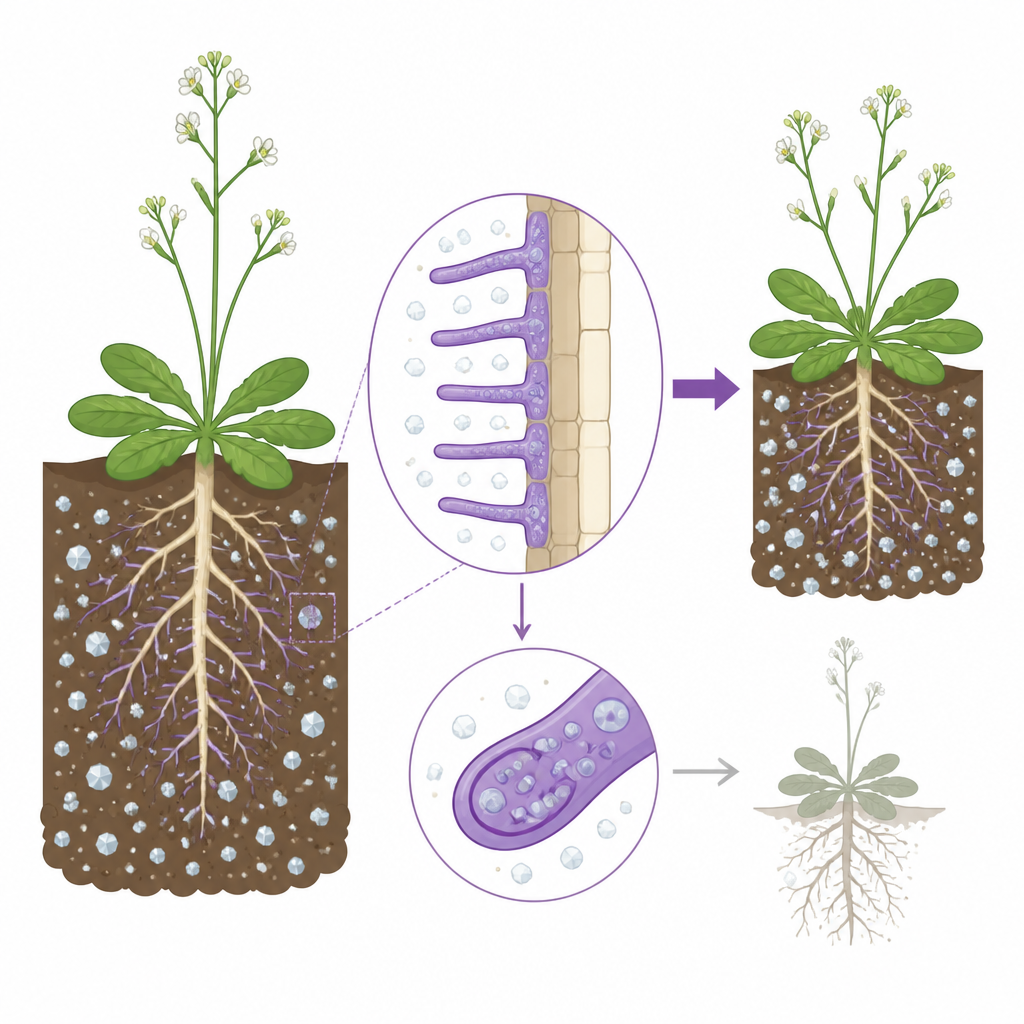
Plant roots are sheathed in a single cell layer that contains two kinds of cells: those that grow root hairs, which explore the soil, and smooth, non-hair cells that sit between them. The authors discovered that hair-forming cells run their internal recycling machinery at much higher levels than their neighbors. This process, called autophagy, breaks down and repurposes worn-out cell parts inside a central storage compartment. Using fluorescent markers and high-resolution microscopes, the team showed that, under normal conditions and during salt or nutrient stress, hair cells consistently contain more autophagic structures than non-hair cells right beside them.
Cell identity tunes the recycling system
Root hair cells and non-hair cells are specified early in root development by a well-known genetic program. To test whether this developmental script also sets the pace of recycling, the researchers examined mutant plants in which the balance between the two cell types is altered. When the basic hair-versus-non-hair identity remained intact, hair-positioned cells still showed stronger autophagy. But when key fate regulators were disrupted and cells lost clear identity, the difference in autophagy vanished. In one mutant, the usual recycling markers became trapped on internal membranes instead of forming proper recycling structures, linking the cell fate program directly to the machinery that builds these tiny recycling vesicles.
How recycling helps plants handle salt
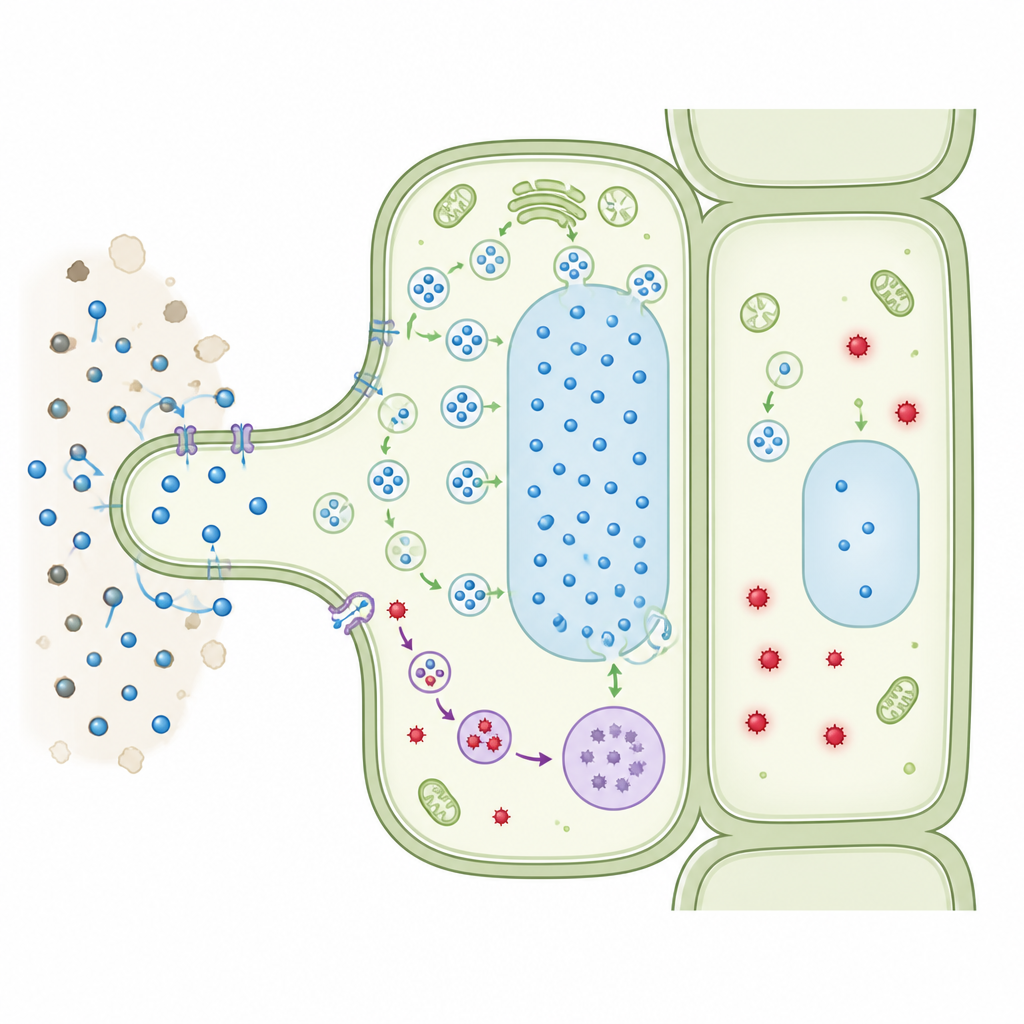
Why would hair cells need extra recycling power? The team focused on how roots manage sodium ions, the main culprit in salt stress. Using a sodium-sensitive dye, they found that in the mature part of the root, hair cells store more sodium inside their large central vacuoles than neighboring non-hair cells. In plants defective in core autophagy genes, this difference disappeared: sodium levels were equalized and overall salt tolerance dropped, as seedlings developed pale, damaged leaves when grown on salty media. By switching off the recycling machinery only in hair cells, the researchers erased the sodium-storage advantage and reduced survival under salt, while restoring autophagy specifically in those cells brought back both the sodium buildup and improved tolerance.
Keeping chemical stress under control
Salt stress not only floods cells with sodium but also promotes harmful reactive oxygen species, unstable molecules that can damage proteins and membranes. The study showed that when autophagy is impaired, these reactive molecules build up more strongly in hair cells than in their neighbors after salt treatment. Blocking autophagy only in hair cells produced a similar spike, whereas rescuing autophagy in those cells prevented the excess. These findings suggest that hair cells rely on heightened recycling to clear damaged components and keep these harmful by-products in check, helping them function as frontline guardians against salt.
What this means for future crops
Together, the work reveals that a plant’s ability to endure salty conditions depends not just on whole-root behavior but on a tailored recycling program in specific cells. Root hair cells are wired by their developmental identity to run stronger autophagy, which lets them lock sodium safely into storage compartments and remove harmful by-products of stress. In simple terms, plants survive salt better when their root hairs act as high-capacity cleaning and storage units. Understanding and eventually tuning this cell-type-specific recycling in crops could provide new ways to help agriculture adapt to increasing soil salinity without sacrificing growth.
Citation: Zhao, J., Gao, P., Xiang, S. et al. Cell-type-specific autophagy in root-hair-forming cells is essential for salt stress tolerance in Arabidopsis thaliana. Nat. Plants 12, 1008–1021 (2026). https://doi.org/10.1038/s41477-026-02285-w
Keywords: plant autophagy, root hairs, salt stress tolerance, sodium sequestration, Arabidopsis thaliana