Clear Sky Science · en
Membrane remodelling mediates lipopeptide-induced immunity in Arabidopsis
How friendly microbes help plants fight disease
Farmers and gardeners are always looking for ways to protect crops without relying heavily on chemical pesticides. This study uncovers how helpful soil bacteria send a molecular "wake up" call to plant roots, teaching plants to better resist attack from a common leaf-infecting fungus. By zooming in from whole plants down to individual cell membranes, the researchers reveal an unexpected way that tiny bacterial molecules can stiffen plant cell skins and flip open tension‑sensitive gates, launching an internal alarm system.
A helpful message from soil bacteria
Some root‑dwelling bacteria produce small soap‑like molecules called lipopeptides. One of these, surfactin, is made by friendly Bacillus species that live near plant roots. When the team treated the roots of Arabidopsis, a model plant often used in labs, with purified surfactin, the leaves later became more resistant to the gray mold fungus Botrytis cinerea. The plants formed fewer spreading lesions, and their leaves accumulated more of a natural antifungal compound called camalexin. Surfactin treatment also put the plant into a "primed" state: when the leaves later encountered standard microbial warning signals, they produced stronger bursts of reactive oxygen molecules, a hallmark of heightened defence. 
A different kind of early alarm
Plants usually sense microbes through surface receptors that recognize bits of bacterial or fungal material and trigger a classic pattern‑triggered immunity program. Surfactin, however, did not follow this script. It did not cause the typical strong burst of reactive oxygen outside cells, and it barely changed the activity of thousands of defence genes that are normally switched on during this type of immunity. Arabidopsis mutants lacking known pattern‑recognition receptors, or key partner proteins that relay their signals, still responded to surfactin. This pointed to a sensing mechanism that bypasses the usual receptor proteins and instead acts directly through the physical properties of the cell surface.
The cell skin as a sensitive sensor
The outer skin of a plant cell is a thin oily membrane built from many types of lipids. Using artificial membranes and computer simulations, the researchers showed that surfactin prefers to dock into a particular family of lipids called glucosylceramides, which are abundant in the outer layer of the root cell membrane. When surfactin slips into this layer, it thins and reorganizes the membrane and makes it stiffer and more tense overall. High‑resolution imaging and scattering techniques confirmed that model membranes and real plant cell membranes both become more ordered and less flexible after surfactin exposure. Plants with genetic defects that reduce these glucosylceramide lipids showed much weaker responses to surfactin and lost most of the added protection against the gray mold fungus.
Stretch‑sensitive gates relay the warning
Membranes are not just passive barriers; they also host protein gates that react to physical stress. The team found that when surfactin tightens the membrane, it activates mechanosensitive ion channels, which are pores that open when the membrane is stretched. In root cells, surfactin caused characteristic shifts in electrical charge, subtle but consistent pulses of calcium ions, and a rise in reactive oxygen inside cells. Blocking stretch‑sensitive channels with a specific inhibitor sharply reduced these signals, while mutations in two families of known plant mechanosensitive channels also dampened the response. These mutants failed to gain full systemic resistance after surfactin treatment, tying channel activity directly to the plant’s enhanced disease protection. 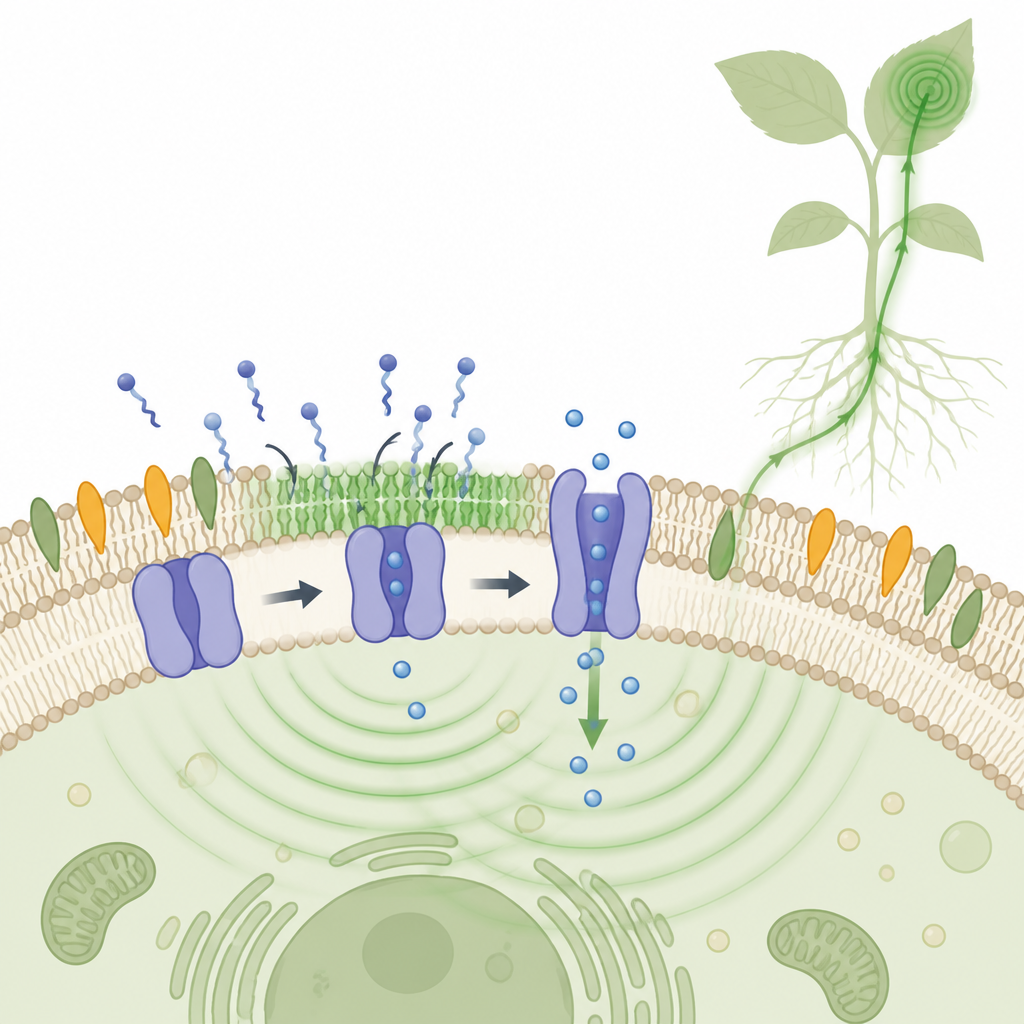
What this means for future crops
Together, the findings show that plants can read physical changes in their own cell skins as a sign of nearby friendly bacteria and use that information to tune their defences. Instead of relying on classic immune receptors, Arabidopsis senses the way surfactin reshapes glucosylceramide‑rich patches of its root membranes, which in turn nudges open stretch‑sensitive ion channels and launches a mild but effective internal alarm. Because this route does not heavily rewire gene activity, it may strengthen protection without the usual growth penalties that come with chronic immune activation. In the long run, understanding this membrane‑based language between roots and beneficial microbes could guide the design of safer biological treatments to help crops fend off disease while reducing dependence on conventional pesticides.
Citation: Gilliard, G., Pršić, J., Crowet, JM. et al. Membrane remodelling mediates lipopeptide-induced immunity in Arabidopsis. Nat. Plants 12, 1034–1050 (2026). https://doi.org/10.1038/s41477-026-02270-3
Keywords: plant immunity, surfactin, mechanosensitive channels, sphingolipids, induced systemic resistance