Clear Sky Science · en
Stress drives plasticity in leaf ageing transcriptional dynamics in Arabidopsis thaliana
Why thirsty plants matter to us
As heatwaves and dry spells become more common, crops are increasingly forced to grow with less water. Plants cannot run to the shade or search for a stream, so they survive by reshaping how they grow. This study reveals, in unprecedented detail, how a small model plant changes the life cycle of its leaves when water is scarce—and how tweaking a single gene in one leaf cell type can soften the growth penalty of drought. Understanding these inner adjustments could guide smarter breeding or engineering of crops that stay productive under harsher climates.
How leaves grow and grow old
Leaves do not simply appear fully formed; they pass through a sequence of stages, from tiny emerging blades to fully expanded energy factories and, eventually, to yellowing, dying tissue. The authors took advantage of this built-in age ladder in rosettes of Arabidopsis, a workhorse plant in biology. They carefully collected hundreds of leaves spanning 15 visible stages of development over several days. Using a powerful technique that reads RNA from individual cell nuclei, they built an “atlas” of more than a quarter million leaf cells, grouped into major types such as the outer skin, inner photosynthetic tissue, and veins. This atlas showed which genes turn on or off as each cell type moves from youthful growth to mature and ageing states.
Inside the changing leaf
The atlas revealed that different leaf cell types age in distinct ways. In the outer skin, young cells strongly expressed genes linked to cell division and wall loosening, reflecting active growth. Older skin cells, by contrast, ramped up genes tied to stress resistance and the winding down of growth. Similar age-related patterns appeared in the inner photosynthetic tissue, known as the mesophyll, where genes involved in photosynthesis and leaf size shifted as leaves matured. By analyzing many genes at once, the researchers could define broad trends: some genes steadily increased with leaf age, others declined, and each pattern was specific to certain cell types. This provided a baseline “clock” describing how a healthy leaf normally progresses from youth to old age.
When drought makes leaves act older
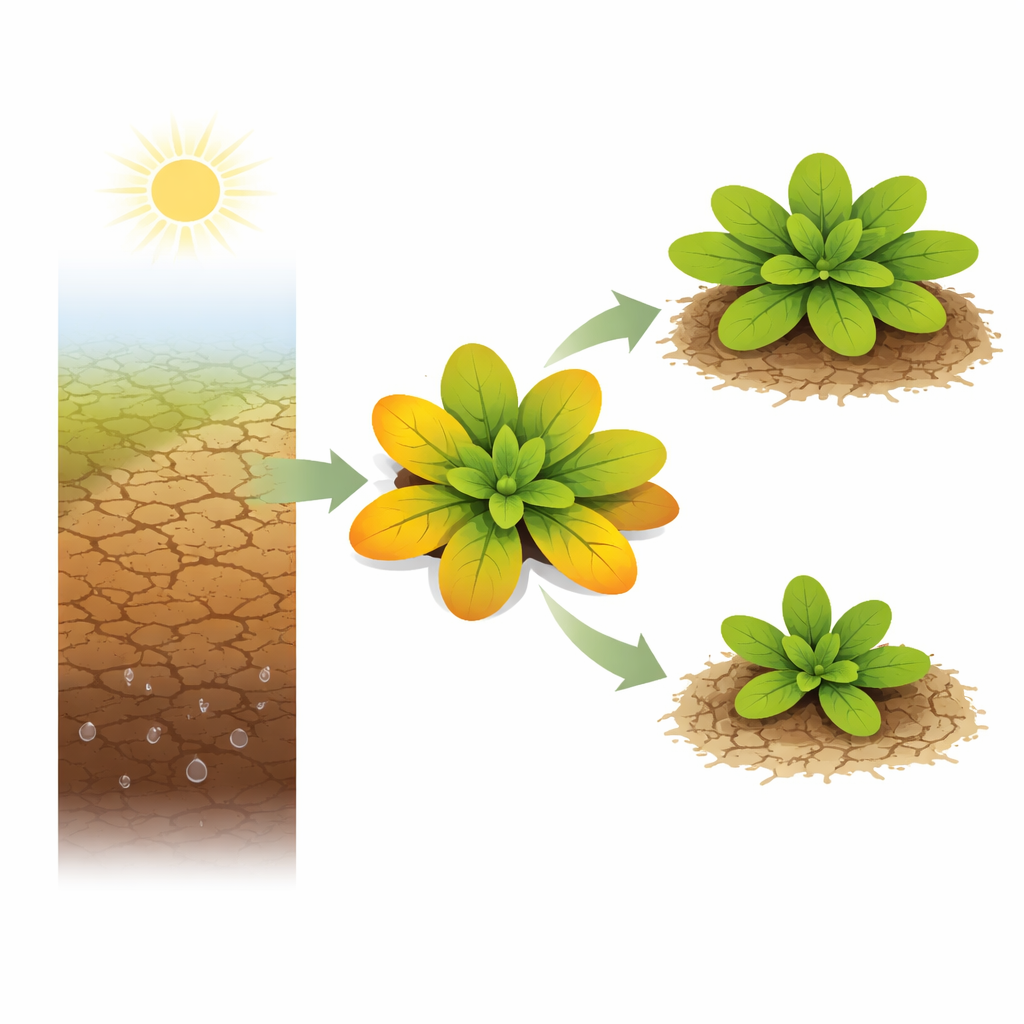
The team then asked what happens to this ageing clock when water runs short. They repeated their time-course, but now withheld water from plants grown in a soil-like substrate. As expected, the plants stayed smaller and their leaves covered less area. At the molecular level, drought caused many genes that usually turn on late in leaf life to switch on earlier, especially in the mesophyll and outer skin. Younger leaves began to resemble older ones in their RNA profiles, as if drought had pushed their biological age ahead of their calendar age. This shift increased with stress severity, showing a dose–response relationship: the drier the pot or the harsher the artificial drought in a “hard agar” system, the more strongly ageing-like gene patterns were advanced, and the more leaf and shoot growth was curtailed.
Signals and switches behind the shift
Plants coordinate their growth with chemical signals often called hormones. By briefly bathing rosettes in different hormones and then profiling their cells, the authors identified which genes respond to which signals, and in which cell types. They found that drought appears to push and pull on these hormonal levers in a way that accelerates leaf ageing. Signals known to encourage maturation and senescence tended to be boosted, while those that normally promote expansion were dampened, particularly in the mesophyll. This rewiring of hormonal responses helps explain how water shortage can simultaneously slow new growth and hasten the decline of existing leaves, leading to a compact, conservative plant form that wastes less water.
A single gene that helps leaves resist shrinkage
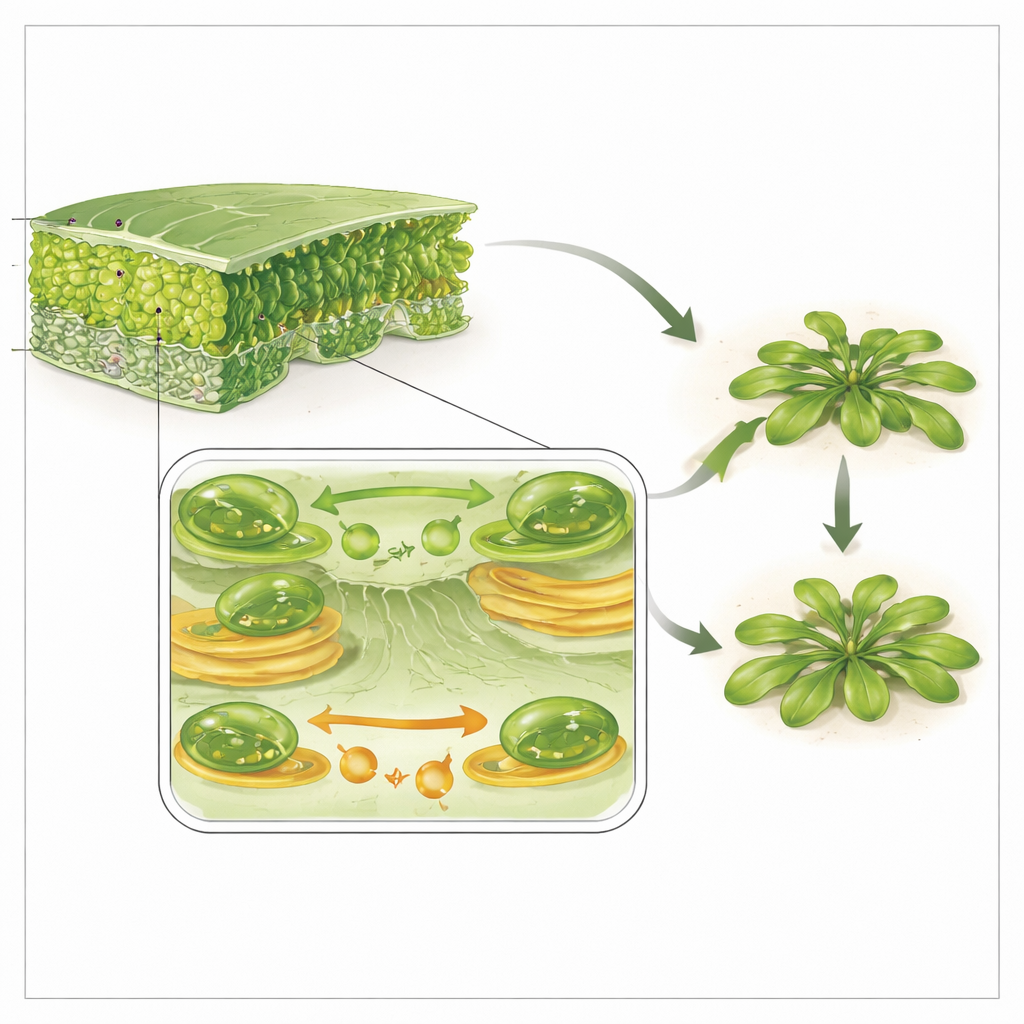
The researchers next looked for individual genes whose behavior most strongly tracked with shoot size under drought-like conditions. Among hundreds of candidates, one stood out: FRO6, which is active mainly in mesophyll cells and is involved in handling iron, a key ingredient for the energy-producing machinery of chloroplasts. Normally, FRO6 activity rises as leaves age but is suppressed when plants are stressed by lack of water. Using a cell-type-specific genetic trick, the team boosted FRO6 only in mesophyll cells, without changing its activity in roots or other leaf tissues. Under drought or simulated drought, these modified plants maintained larger shoots and heavier rosettes than normal plants, while looking similar under ample water. This suggests that turning down FRO6 in mesophyll is one of the dials the plant uses to shrink itself under stress—and that carefully turning it back up can partially preserve growth without obvious drawbacks in benign conditions.
What this means for future crops
Altogether, the study shows that drought does not merely damage leaves; it actively pushes their internal programs toward an older state, in a way that scales with stress intensity and is orchestrated differently in each cell type. The mesophyll emerges as a surprising hub where gene activity, hormonal cues, and iron handling integrate to decide how big the shoot will be when water is scarce. By mapping these pathways at single-cell resolution and pinpointing FRO6 as a modifiable component, the work offers a roadmap for designing crops that keep more of their growth while still surviving dry spells—one carefully tuned leaf cell at a time.
Citation: Swift, J., Wu, X., Xu, J. et al. Stress drives plasticity in leaf ageing transcriptional dynamics in Arabidopsis thaliana. Nat. Plants 12, 780–790 (2026). https://doi.org/10.1038/s41477-026-02254-3
Keywords: plant drought stress, leaf ageing, Arabidopsis mesophyll, single-cell transcriptomics, crop resilience