Clear Sky Science · en
Open-channel block of human TRPV6 by polyamine spermine
How a Tiny Molecule Can Quiet a Calcium Gate
Our cells constantly move calcium ions in and out to control processes like muscle movement, hormone release, and even how fast some cancers grow. This article looks at how a small natural molecule inside our bodies, called spermine, slips into a specific calcium channel named TRPV6 and partly plugs it. Understanding this microscopic interaction could help scientists design new ways to fine-tune calcium entry in health and disease.
The Role of a Busy Calcium Gate in the Body
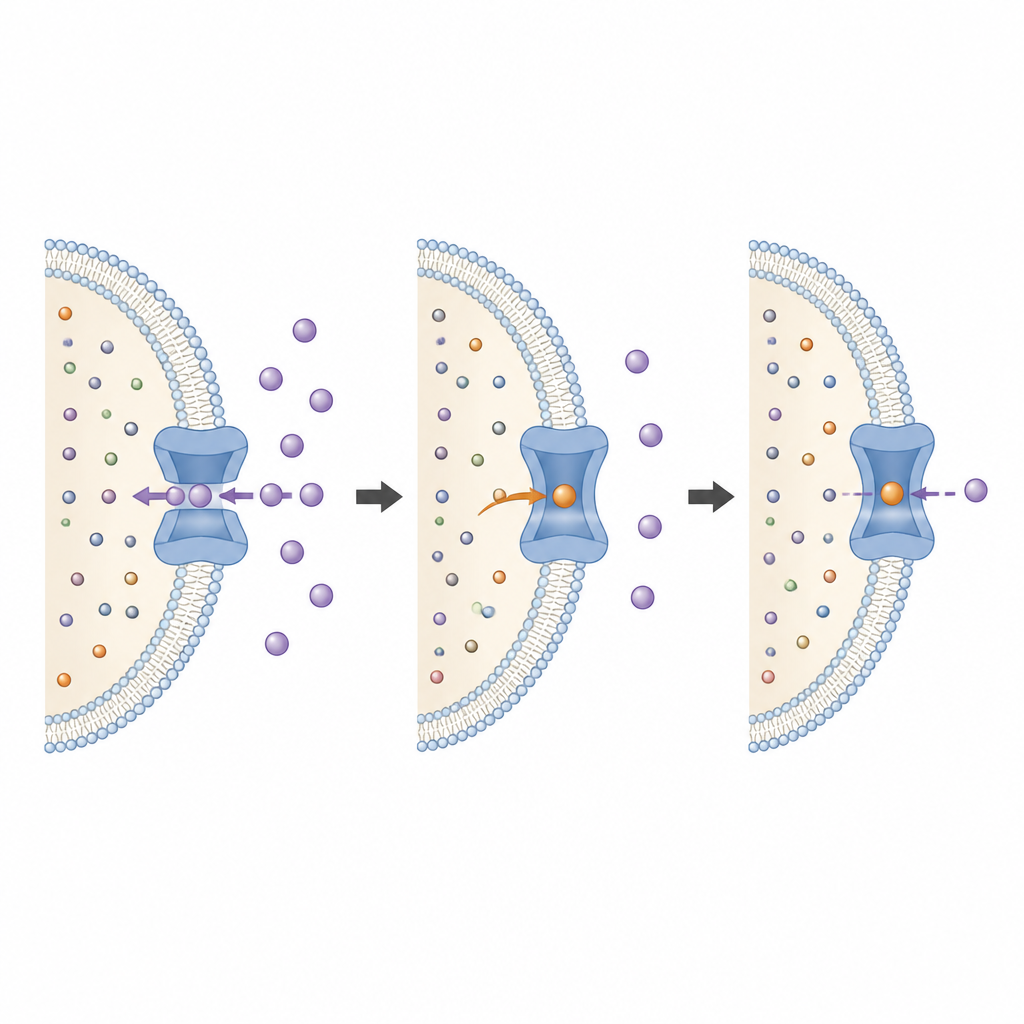
TRPV6 is a protein that forms a narrow tunnel in the membranes of certain cells, especially in the intestine, pancreas, placenta, and reproductive organs. It allows calcium ions to pass from the outside to the inside of the cell and is active almost all the time. Because calcium entry can spur cell growth and division, TRPV6 has been linked to several conditions, including bone and mineral disorders, digestive problems, and multiple cancers where the channel is found at unusually high levels. This makes TRPV6 a tempting focus for therapies that aim to gently reduce calcium flow in selected tissues.
A Natural Cell Molecule Steps In as a Blocker
Spermine is one of several small, positively charged molecules that are naturally present in nearly every cell. Earlier work showed that such molecules can regulate many different ion channels, but exactly how they do this was often unclear. In this study, the researchers measured how spermine affects TRPV6 currents in human cells grown in the lab. They found that spermine reduces the flow of ions through TRPV6 in a way that depends on the electrical voltage across the cell membrane and on spermine concentration. The effect is stronger when spermine is present on the inside of the cell, suggesting that it enters the channel from the inner side rather than from the outside.
Seeing the Blocker Inside the Channel
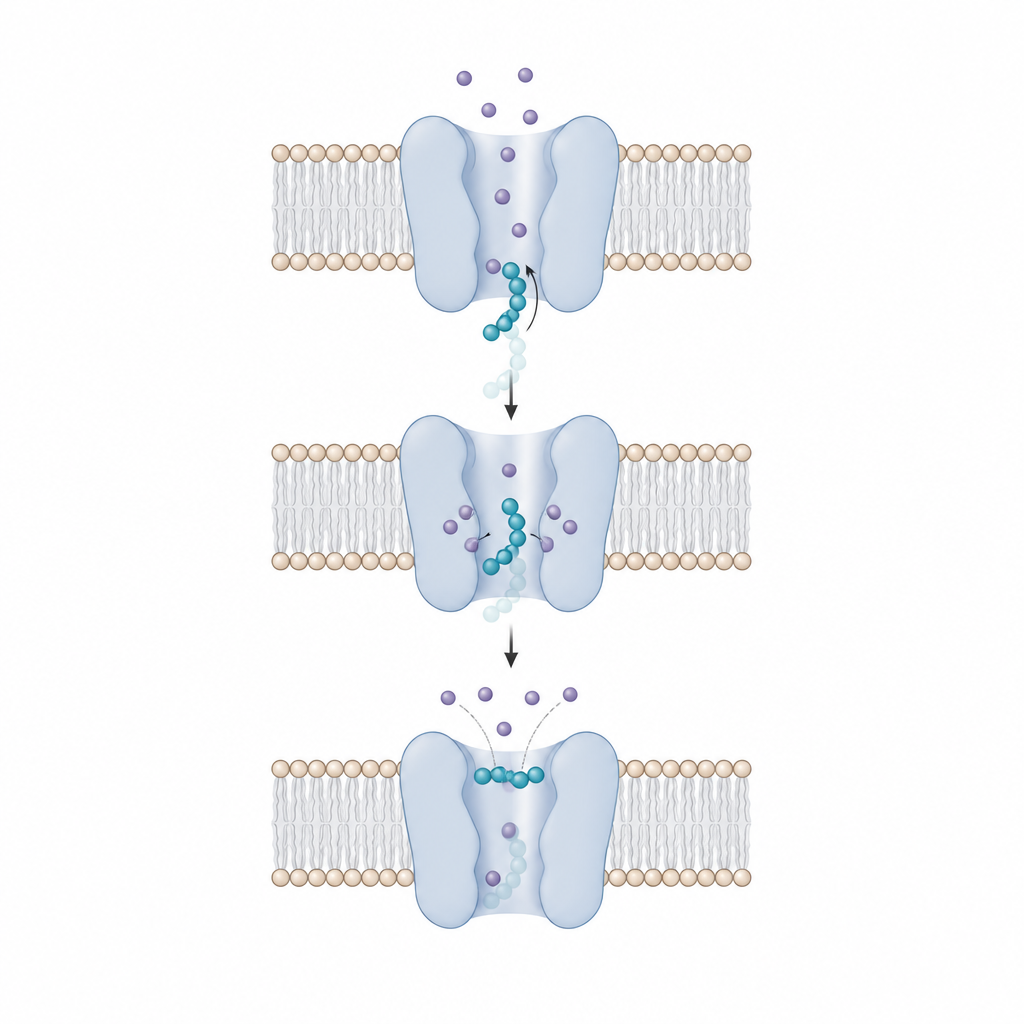
To understand what is happening physically, the team used cryo electron microscopy, a technique that images frozen samples at very high resolution. They purified a version of human TRPV6, placed it into artificial membrane discs, added a high amount of spermine, and then imaged it. The resulting three dimensional map showed an extra sausage shaped density running along the open pore of the channel, from the narrow upper filter down into a central cavity. This extra density fits the shape and charge of a spermine molecule, indicating that spermine binds inside an already open channel and physically occupies the path that calcium ions would normally follow.
Tracking a Stepwise Journey Through the Pore
Because spermine is flexible and fast moving, the static images alone could not fully capture how it travels through the pore. The scientists therefore turned to computer simulations that model atoms in motion in a realistic membrane environment. These simulations revealed a three step journey. First, spermine briefly sticks at the inner mouth of the pore, interacting with a ring of negatively charged building blocks there. Next, it moves into a central cavity, where it pushes away other ions. Finally, it settles into the narrow selective region at the top of the pore, where it makes close contacts with specific channel positions and effectively blocks the passage. Changes in two of these key positions, introduced by targeted mutations, weakened or almost abolished the blocking effect, confirming that these sites are crucial for spermine’s action.
What This Means for Health and Disease
This work shows that spermine acts like a plug in the open TRPV6 channel, entering from inside the cell and moving through a set of preferred resting spots until it blocks the main path for calcium. The channel itself stays in its open shape; it is the presence of spermine in the pore that stops the ions. By mapping this route in structural detail and linking it to changes in channel behavior, the study provides a blueprint for how natural cell molecules can tame calcium entry. These insights could guide the design of new drugs that mimic or refine this blocking action, with the long term goal of better controlling TRPV6 activity in conditions such as cancer and calcium related disorders.
Citation: Neuberger, A., Veretenenko, I.I., Shalygin, A. et al. Open-channel block of human TRPV6 by polyamine spermine. Nat Commun 17, 4720 (2026). https://doi.org/10.1038/s41467-026-73653-5
Keywords: TRPV6, spermine, calcium channel, polyamines, ion channel block