Clear Sky Science · en
Quantum beats of exciton-polarons in CsPbI3 perovskite nanocrystals
Light, tiny crystals, and quantum rhythms
In many modern devices, from solar cells to single-photon sources for quantum communication, the way light interacts with tiny crystals is crucial. This study looks at cesium lead iodide nanocrystals, a type of perovskite, and shows that light can create long‑lasting, rhythmical quantum motion inside them. Understanding and controlling these rhythms could help design materials that store and process quantum information more reliably.
Why these nanocrystals matter
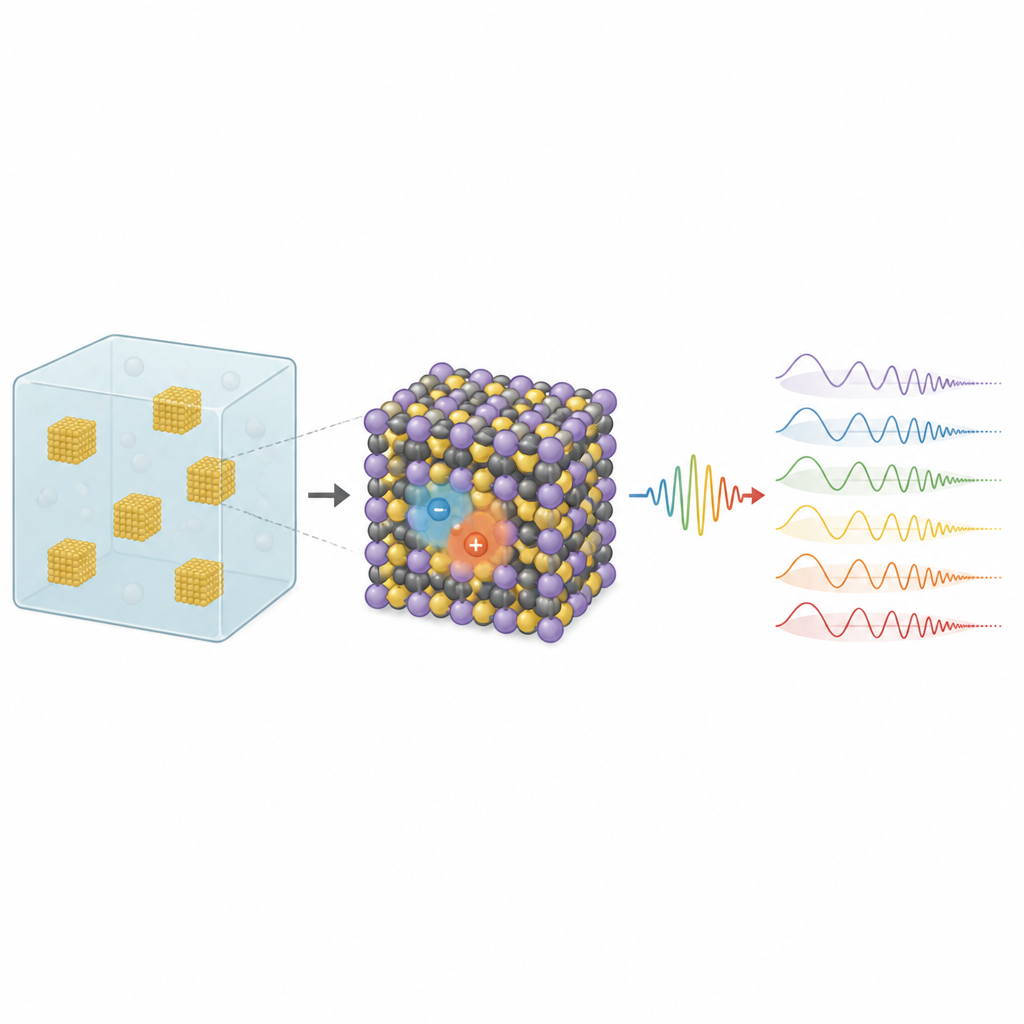
Perovskite nanocrystals are tiny cubes only a few billionths of a meter across. They absorb and emit light very efficiently and can act as nearly ideal "quantum emitters" that release single particles of light. At very low temperatures, the main light‑carrying entity in these crystals is an exciton, a bound pair of an electron and a hole. In this material, excitons strongly disturb the surrounding crystal lattice, which responds with vibrations. This close partnership between the exciton and the vibrating lattice creates a new hybrid object known as an exciton‑polaron.
Watching quantum echoes of light
To probe these hybrid states, the researchers used an ultrafast technique called two‑pulse photon echo. They sent two very short laser flashes into a glass sample containing many perovskite nanocrystals and then measured a weak echo signal emitted by the sample. Because each nanocrystal has a slightly different size, their light response is spread out in energy, and the echo appears at a specific delay time that refocuses this spread. By varying the delay between the two pulses and recording how the echo strength changed, the team could follow how the quantum state evolved over hundreds of picoseconds, a long time on atomic scales.
Quantum beats from light and lattice
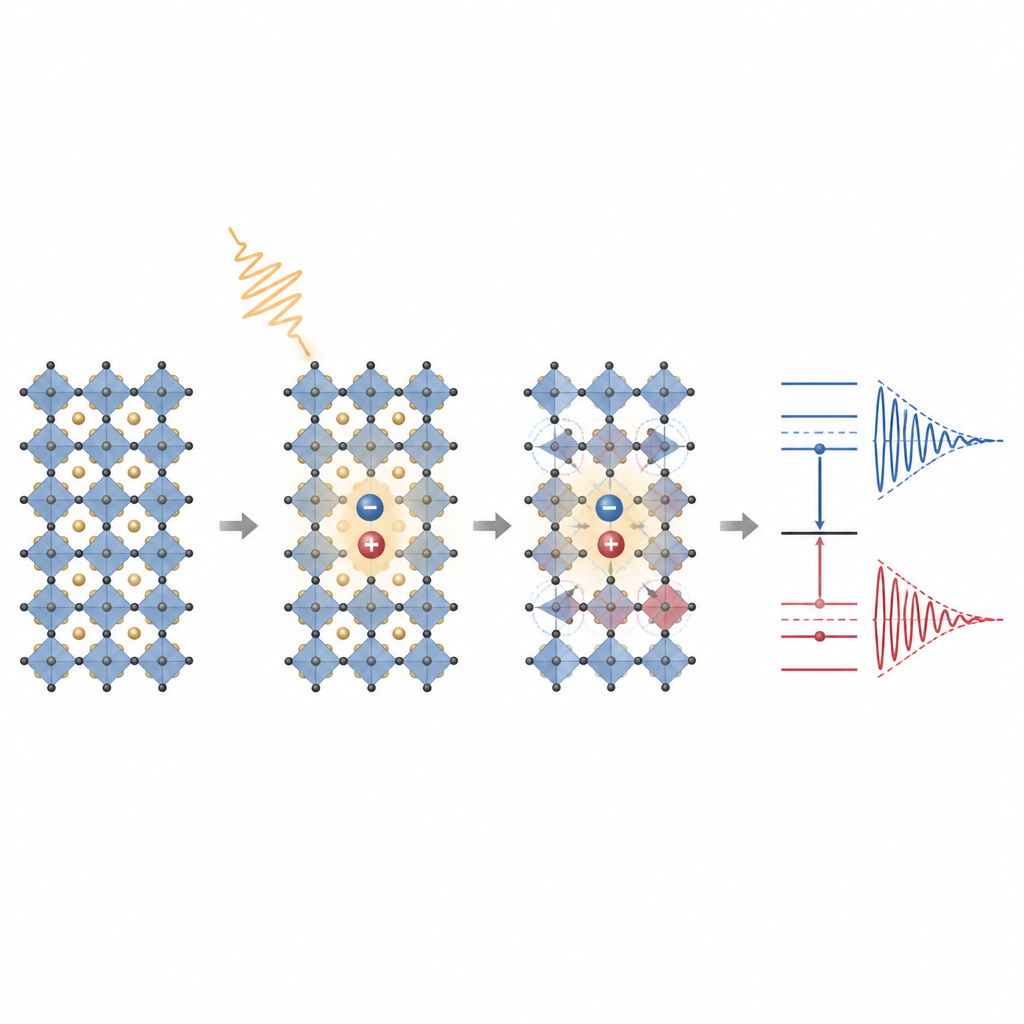
The echo signal did not simply decay smoothly. Instead, it showed rapid oscillations, or quantum beats, during the first few trillionths of a second. A polarization analysis allowed the scientists to separate slower oscillations due to the internal spin structure of the exciton from faster oscillations that did not depend on polarization. By comparing these fast beats with Raman measurements of lattice vibrations, they identified them as signatures of two specific optical phonons, that is, localized lattice vibrations with energies of 3.2 and 5.1 millielectronvolts. The exciton and these phonons form a small ladder of exciton‑polaron states, and interference between different rungs of this ladder gives rise to the observed beats.
A simple model for a complex dance
The team described this dance of light and vibrations with a compact four‑level model that includes the ground state of the nanocrystal, a state with only a phonon, the relaxed exciton‑polaron state, and an excited exciton‑polaron state that carries one phonon. Solving the quantum equations for this system reproduces the oscillations and their decay. From the relative strength of the oscillatory part and the slowly decaying background, the authors extracted Huang–Rhys factors, simple numbers that quantify how strongly excitons couple to the phonons. They found values between about 0.05 and 0.12 for the lower‑energy mode and between 0.02 and 0.04 for the higher‑energy mode, along with phonon lifetimes of roughly 5 to 15 picoseconds.
Size as a knob for quantum control
Because the sample contained nanocrystals of different diameters, the researchers could tune which subset of sizes they excited by changing the laser energy. This revealed that smaller crystals exhibit stronger exciton‑phonon coupling but shorter phonon lifetimes, while larger crystals show weaker coupling and longer‑lived vibrations. The measured size trends match theoretical expectations for how localized carriers interact with lattice motion inside a confined volume. This means that by tailoring nanocrystal size and composition, one can adjust both the strength and the duration of exciton‑polaron coherence.
What this means for future devices
Overall, the study shows that in these perovskite nanocrystals, the combined motion of light‑made excitons and lattice vibrations can remain coherent far longer than previously seen. The long optical coherence of about 300 picoseconds, together with well‑defined lattice vibrations, allows clean quantum beats that can be described with a simple model. For a layperson, this means that these tiny crystals can sustain orderly, clock‑like quantum rhythms that are sensitive to their size. Such control over quantum motion is a key ingredient for building solid‑state platforms for quantum communication and information technologies.
Citation: Trifonov, A.V., Nestoklon, M.O., Hollberg, M.A. et al. Quantum beats of exciton-polarons in CsPbI3 perovskite nanocrystals. Nat Commun 17, 4685 (2026). https://doi.org/10.1038/s41467-026-73506-1
Keywords: perovskite nanocrystals, exciton polarons, quantum coherence, phonon coupling, photon echo