Clear Sky Science · en
Accessing medically relevant complex regions with a pangenome graph of 20 near-complete Japanese haplotypes
Why this hidden DNA matters
Much of our DNA is like a crowded city of repeated blocks that has been very hard to map. Yet many of these busy stretches influence immune function, fertility, and serious diseases. This study focuses on people in Japan and shows how new sequencing tools can finally chart these tricky regions in detail, giving doctors and researchers a clearer picture of medically important genetic variation.
Building a fuller map for Japanese genomes
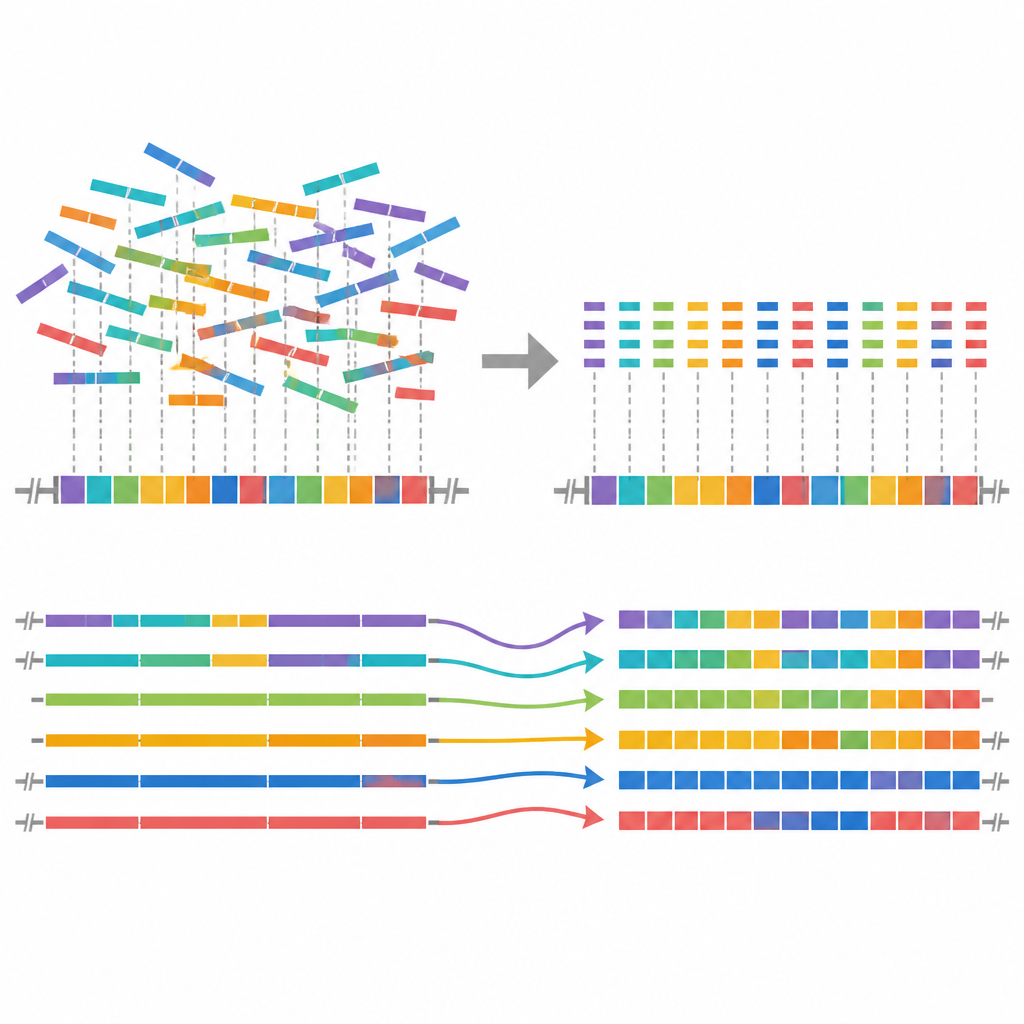
The researchers sequenced the genomes of ten Japanese men using three cutting edge technologies that read DNA in long, accurate stretches and capture how pieces are arranged in three dimensions. From each person they reconstructed both parental copies of every chromosome, yielding 20 near complete “haplotypes.” These assemblies are far more continuous than most past efforts, with typical DNA pieces longer than 100 million bases and several chromosomes per person running from tip to tip without gaps.
Comparing with global genome references
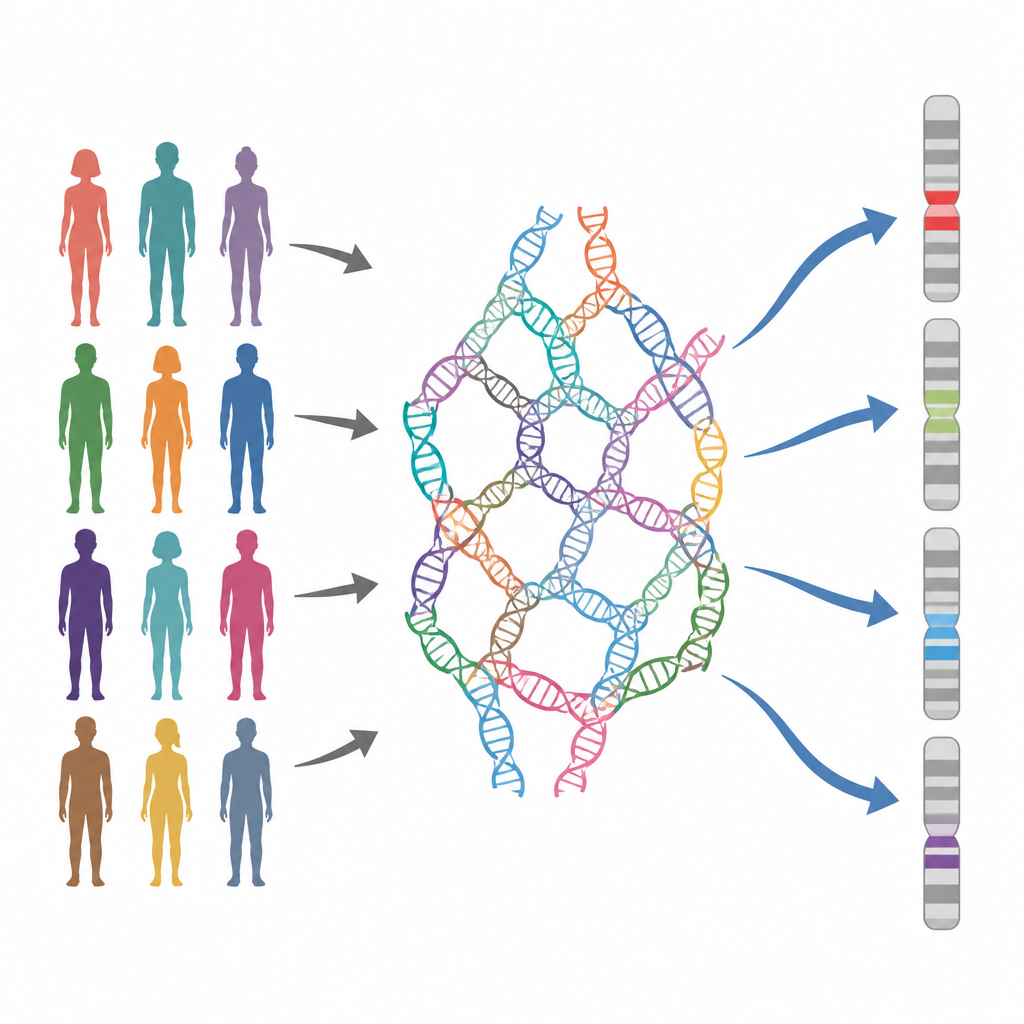
Once the Japanese haplotypes were built, the team combined them with two existing reference genomes into a shared structure called a pangenome graph. Instead of one “standard” genome, this graph weaves together many individual sequences and their differences. The comparison showed that most small variants seen earlier in the 1000 Genomes Project were recovered, and that many larger structural changes match those found in other East Asian populations. At the same time, the graph revealed stretches of duplicated DNA and sequence changes that appear much more common, or even specific, in the Japanese samples.
Zooming in on medically important hotspots
Many genes tied to immunity, spinal muscular atrophy, skin disease, and male fertility sit inside long duplicated blocks that have been especially troublesome to assemble. The team selected 30 such complex regions, including well known clusters like KIR, HLA, SMN, and beta defensins. In these areas, the new Japanese assemblies greatly outperformed previous international pangenome projects from the Human Pangenome Reference Consortium and the Chinese Pangenome Project. On average, over 90 percent of Japanese haplotypes in these regions were complete, with no gaps, no suspicious drops in read coverage, and almost no mismatches to the raw data.
Previously unseen gene patterns
With this higher resolution, the researchers uncovered gene layouts that had not been observed in earlier global datasets. In the KIR region, which helps guide natural killer cells in the immune system, they found several examples of the less common “B type” haplotypes and one striking case where a trio of KIR genes is duplicated in tandem. In the SMN region, central to spinal muscular atrophy, two Japanese haplotypes carry three copies of the SMN gene cluster, with one copy of SMN1 and two of SMN2. Such patterns were missing from earlier pangenome graphs, likely because older assemblies broke apart in these highly repetitive segments rather than because the variants are truly rare.
Clues to non random evolution in complex DNA
The study also searched for hints of “gene conversion,” where one repeat copy overwrites another, subtly reshaping the DNA landscape. In regions around the SMN and beta defensin genes, they detected many such events and found that a notable fraction seem biased in one direction, suggesting these regions are not evolving by chance alone. As more high quality haplotypes are added from other populations, these patterns may illuminate why certain gene copies and arrangements become common or remain rare.
What this means for future medicine
By creating some of the most complete Japanese genome sequences to date, this work fills in hard to reach parts of the genetic map that matter for disease risk and treatment response. It shows that long read sequencing and pangenome graphs can capture subtle but important gene patterns that older methods missed. For a layperson, the message is that our understanding of DNA is moving from a rough sketch to a detailed atlas, one that better reflects population specific diversity and can support more precise genetic studies in Japan and around the world.
Citation: Suzuki, Y., Owa, C., Kobayashi, H. et al. Accessing medically relevant complex regions with a pangenome graph of 20 near-complete Japanese haplotypes. Nat Commun 17, 4555 (2026). https://doi.org/10.1038/s41467-026-73461-x
Keywords: pangenome, Japanese genetics, complex genomic regions, long read sequencing, medical genomics