Clear Sky Science · en
Measuring multi-site pulse transit time with an AI-enabled mmWave radar
Why watching your pulse matters
Heart and blood vessel problems often creep up silently over many years. Doctors know that the “stiffness” of your arteries and your blood pressure hold important clues about future risk of heart attack, stroke and other diseases. This study explores a way to track those clues without cuffs, wires or even touching the skin, using a compact radar and artificial intelligence to watch tiny movements in the body caused by each heartbeat.
A new way to listen to the heartbeat
Every time the heart squeezes, it sends a pressure wave through the arteries, much like a ripple traveling down a hose. The time it takes that wave to move between two points, called pulse transit time, reflects how stiff or flexible the arteries are, and it relates to diastolic blood pressure, the pressure when the heart relaxes. Today this is usually measured with contact sensors or inflatable cuffs, which can be uncomfortable and hard to wear for long periods. The researchers set out to see whether a single small millimeter wave radar could track these pulse waves at several spots on the upper body without touching the person at all.
How the radar sees invisible motion
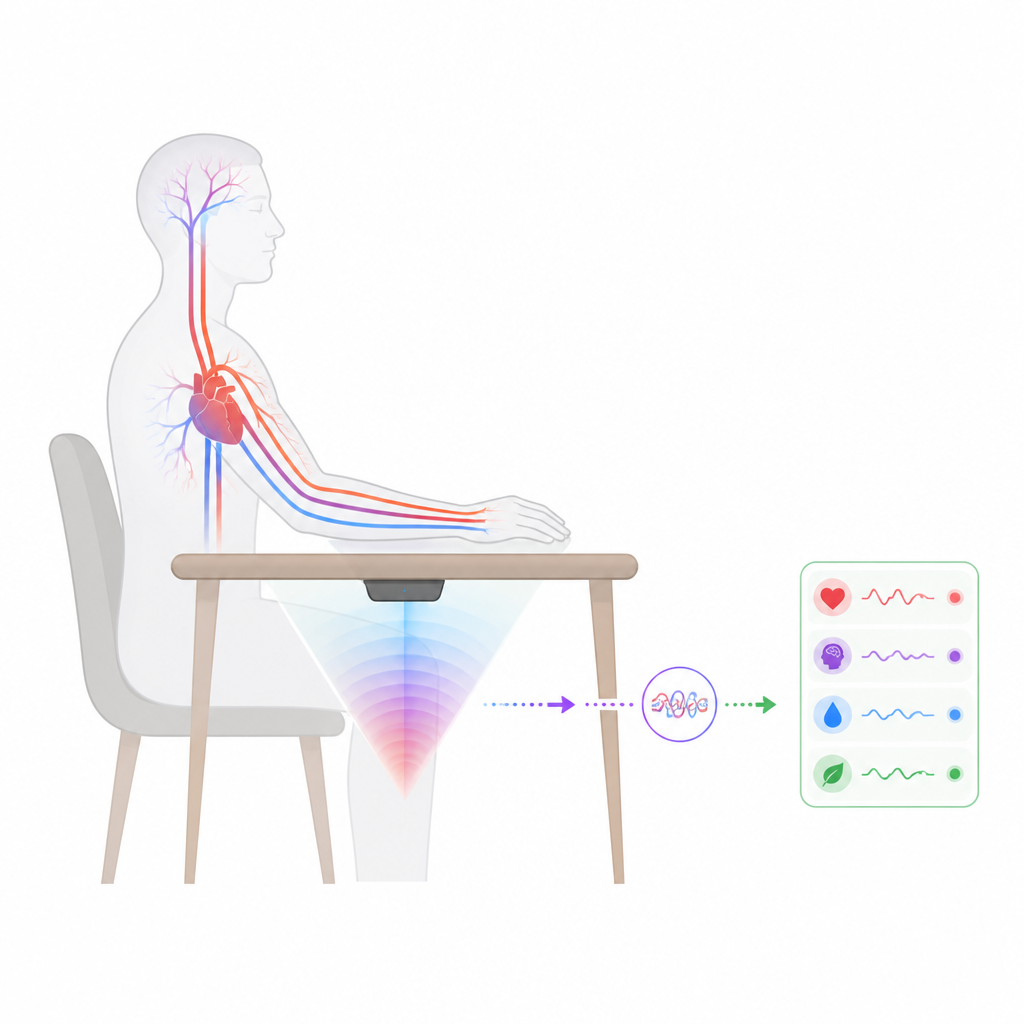
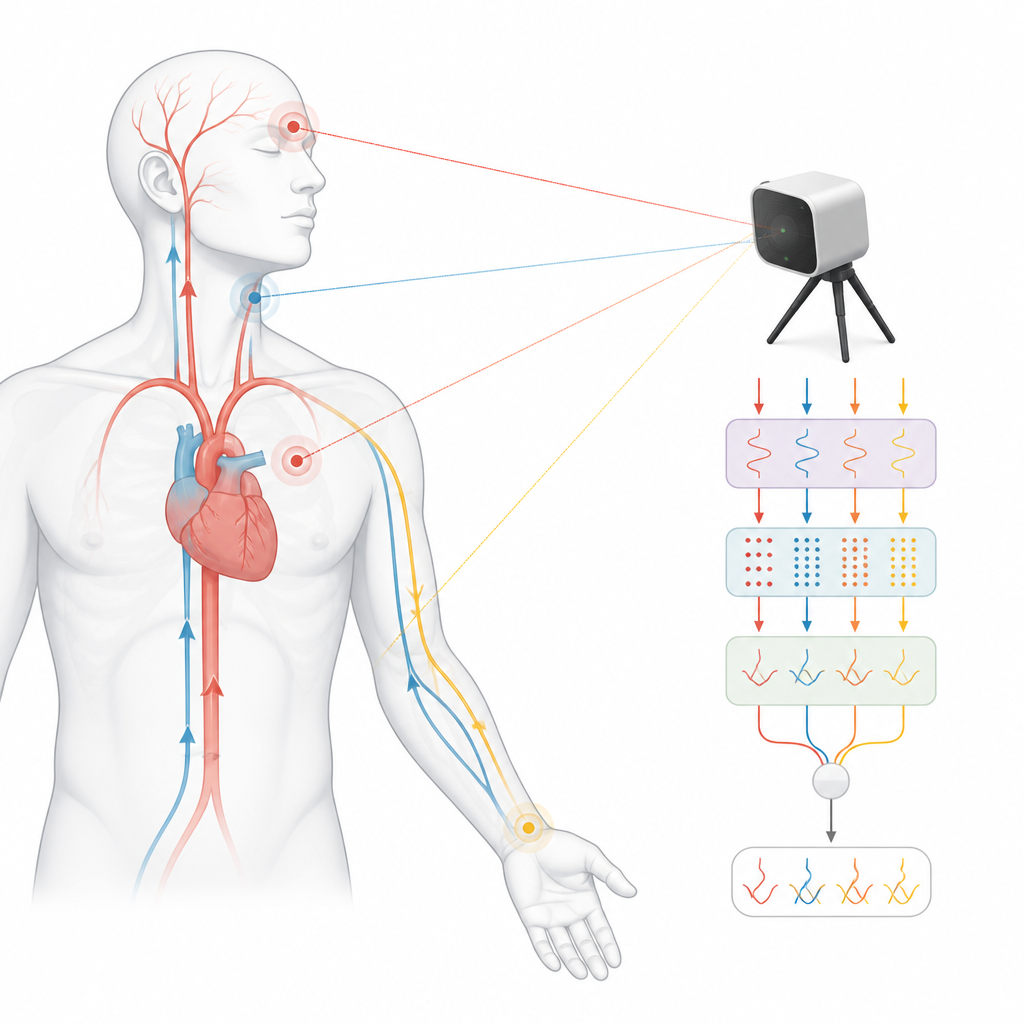
The team’s prototype, called PolyPulse, sits under a table beneath a seated person’s wrist. It sends out very high frequency radio waves that bounce off the body and return to the device. Because each heartbeat makes the chest, neck, head and wrist move by tiny amounts only tens of micrometers across, the returning waves carry a faint but regular pattern. Using beamforming, the radar steers its attention toward four specific regions: the apex of the heart in the chest, the mastoid area behind the ear, the carotid artery in the neck and the radial artery at the wrist. Subtle timing differences between when the pulse appears at these four sites reveal how fast it travels along three paths: heart to wrist, heart to neck and head to wrist.
Teaching artificial intelligence to find the pulse
Turning raw radar echoes into useful numbers is not straightforward. Signals from breathing, small fidgets and reflections from nearby objects can easily drown out the tiny pulse movements, especially at narrow arteries like the wrist. To tackle this, the researchers built a deep neural network that processes both the strength and phase of the radar signals from many nearby beams around each body site. First, a signal processing step ranks radar beams by how strongly they show a repeating heartbeat pattern. The neural network then learns to spot key landmarks in the waveforms, such as the moment the heart’s main valve opens or the first upswing of the pulse at the wrist and neck. By aligning these landmarks beat by beat across all four sites, the system estimates pulse transit times and, after a simple per-person calibration, diastolic blood pressure.
Putting the system to the test
The team evaluated PolyPulse in a study of 47 adults with a range of ages, body sizes and health histories, including some with high blood pressure, atrial fibrillation or other heart conditions. Participants sat upright at a table wearing standard contact sensors on the chest, neck, head and wrist, while the radar recorded from below. To create natural swings in pulse transit time and blood pressure, volunteers cycled on a stationary bike between rest periods while measurements continued. Across hundreds of sessions, the radar’s pulse transit times closely tracked those from the contact sensors along all three paths, with typical errors of only a few milliseconds. When these timings were converted to diastolic blood pressure using a simple regression model tailored to each person, the radar estimates met international guidelines for noninvasive blood pressure devices, with average errors under one millimeter of mercury and modest variation.
Robustness and limits in everyday settings
Beyond basic accuracy, the researchers checked how well the system held up under real-world variations. They changed the radar’s distance and tilt, added layers of clothing over the body, asked a participant to talk, use a computer mouse or fidget, tried different rooms and repeated measurements a year later. Errors generally stayed within a few milliseconds for pulse timing and within about 5 millimeters of mercury for diastolic pressure, even through clothing and in different indoor spaces, though strong body movements could still disturb the readings. The method also performed similarly across groups divided by age, height, body mass index, sex and the presence or absence of cardiovascular disease, although the number of participants with diagnosed conditions was small.
What this could mean for heart health
For a layperson, the main message is that a shoebox-sized radar and smart software can watch how pulse waves move through the body at several points at once, without cuffs or sticky patches, and recover information that aligns well with standard measures of artery stiffness and diastolic blood pressure. While this is an early laboratory study and not yet a home device, it hints at a future where people at risk of heart and blood vessel disease might track subtle changes in their cardiovascular health simply by sitting near a discreet sensor in their living room.
Citation: Zhu, J., Yuan, K., Prabhakara, A. et al. Measuring multi-site pulse transit time with an AI-enabled mmWave radar. Nat Commun 17, 4554 (2026). https://doi.org/10.1038/s41467-026-73453-x
Keywords: pulse transit time, mmWave radar, contactless monitoring, blood pressure estimation, cardiovascular health