Clear Sky Science · en
Cellular and subcellular heterogeneity of astrocytic Na⁺ homeostasis tuning astrocytes into functionally distinct subgroups in the mouse brain
Guardian cells that quietly keep brain signals in balance
Every thought, memory, or movement in the brain depends on a delicate balance of charged particles such as sodium and potassium. This study looks at astrocytes, star-shaped support cells, and shows that their internal sodium levels are far more varied than previously believed. That hidden variety affects how different astrocytes help control brain activity and keep nerve cells working smoothly.
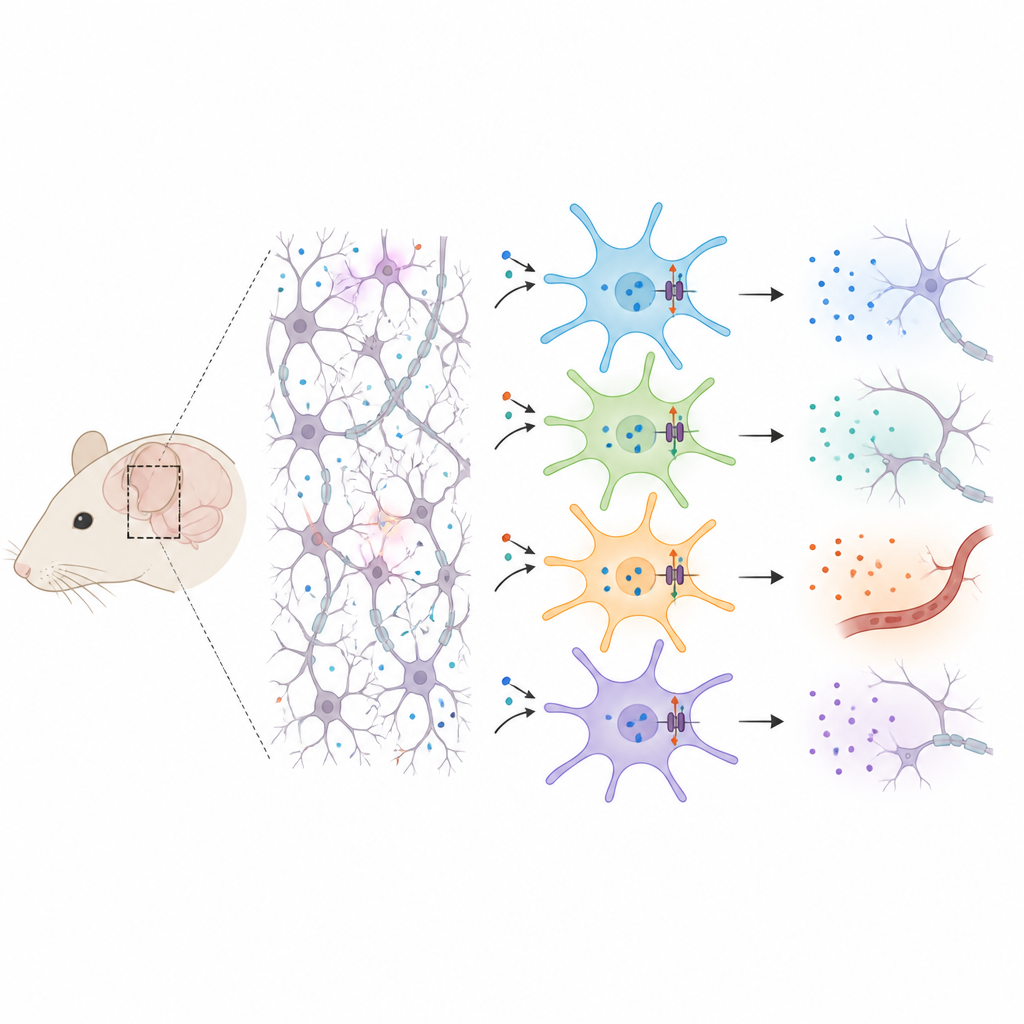
Star-shaped helpers with hidden differences
Astrocytes surround nerve cells and their connections, where they mop up chemical messengers and soak up excess ions from the fluid between cells. For a long time, scientists assumed that the sodium concentration inside astrocytes was low and fairly uniform, because this inward sodium gradient powers many of their essential transport systems. Using a sensitive optical method that reads out fluorescence lifetimes rather than brightness, the authors measured sodium levels in hundreds of astrocytes in mouse brain slices and in live mice. Instead of a single typical value, they found a wide spread of sodium levels, with two preferred ranges, hinting at at least two functional groups of astrocytes.
Fine branches show even stronger variety
Astrocytes are not just round cell bodies; they extend many thin branches that weave among synapses. The team directly loaded a sodium-sensitive dye into single astrocytes and then measured sodium in individual branches. These tiny processes consistently had higher sodium than the nearby cell body, and sodium levels increased with distance from the soma. Even neighboring branches of the same cell could differ by more than 20 millimolar. This means that sodium balance is not uniform inside an astrocyte, but organized into local zones, especially in the fine processes that sit closest to active synapses.
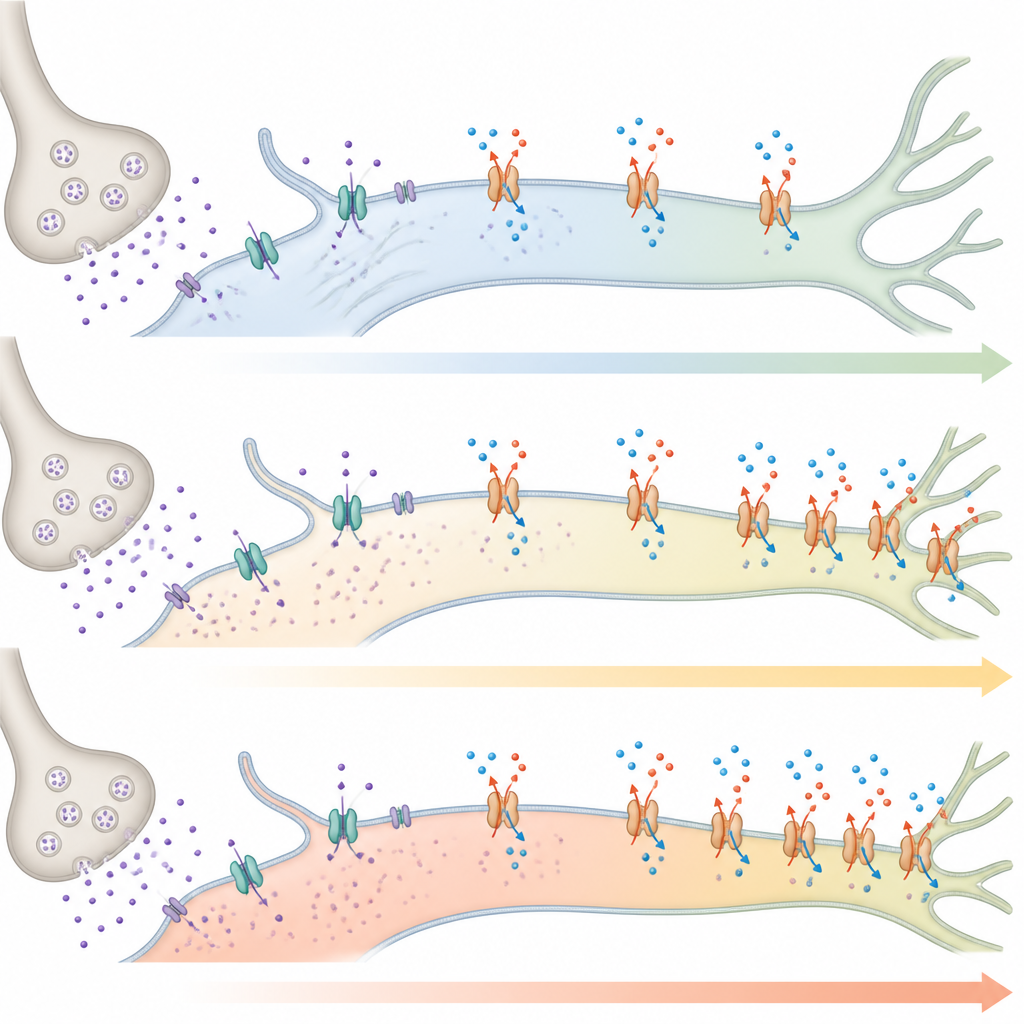
How pumps and transporters shape sodium patterns
The researchers then asked what sets these different sodium levels. They tested the role of electrical activity, gap junctions that link astrocytes, and several key transport systems. Blocking nerve-cell firing had little effect, but blocking channels that couple astrocytes to each other increased both the average sodium level and its spread, suggesting that sodium normally diffuses between cells and smooths out extremes. Temporarily weakening the sodium–potassium pump by lowering external potassium caused dramatic sodium entry into astrocytes, especially in cells that already had high baseline sodium, showing that pump strength and sodium influx differ from cell to cell. Blocking glutamate uptake, which normally brings sodium into astrocytes, caused sodium to fall and erased the two-peaked distribution, indicating that glutamate transport is a major source of the heterogeneity.
Different molecular pumps mark different astrocyte types
To connect these functional differences to molecular machinery, the authors mapped the distribution of two versions of the pump’s beta subunit, called β1 and β2, in hippocampal astrocytes. Both forms were present, but β2 was more prominent, especially in astrocyte processes. Computer models that varied the mix of pump subunits, overall pump density, and sodium influx rates could reproduce the experimentally observed sodium ranges, including the two preferred levels and the higher sodium in distal processes. In the models, astrocytes richer in the β2-containing pump variant settled at higher sodium levels and showed stronger changes when external potassium rose or when the pump was inhibited.
Local specialists for keeping brain activity in check
Putting these findings together, the study suggests that astrocytes are not a uniform support grid but include distinct subgroups and subregions tuned to their local network. Cells and processes with higher sodium, stronger glutamate-driven influx, and a particular pump makeup appear especially suited to rapidly clear potassium and glutamate from the space around synapses, thereby stabilizing neuronal firing. Others, with lower sodium and different pump properties, may play more modest or different roles. For a lay reader, the take-home message is that the brain’s support cells are finely specialized at the microscopic level, and this quiet diversity in sodium handling helps keep neural circuits stable and flexible.
Citation: Meyer, J., Bornemann, V., Bhattarai, A. et al. Cellular and subcellular heterogeneity of astrocytic Na⁺ homeostasis tuning astrocytes into functionally distinct subgroups in the mouse brain. Nat Commun 17, 4515 (2026). https://doi.org/10.1038/s41467-026-73435-z
Keywords: astrocytes, sodium homeostasis, ion transport, Na K ATPase, glutamate uptake