Clear Sky Science · en
Defective ventral neurogenesis due to midfetal Chd8 mutation drives autistic-like behavior in mice
Why tiny changes before birth can matter
Autism spectrum disorder affects how people interact, communicate, and cope with the world, yet the earliest roots of these differences are still being uncovered. This study uses mice to zoom in on a brief window in fetal life, asking a simple question with big implications: if a gene strongly linked to autism is disturbed at a specific time and place in the developing brain, can that alone tilt behavior later in life? The answer, the authors find, is yes, and it centers on a cluster of developing brain cells deep in the fetal brain.
A key gene under the microscope
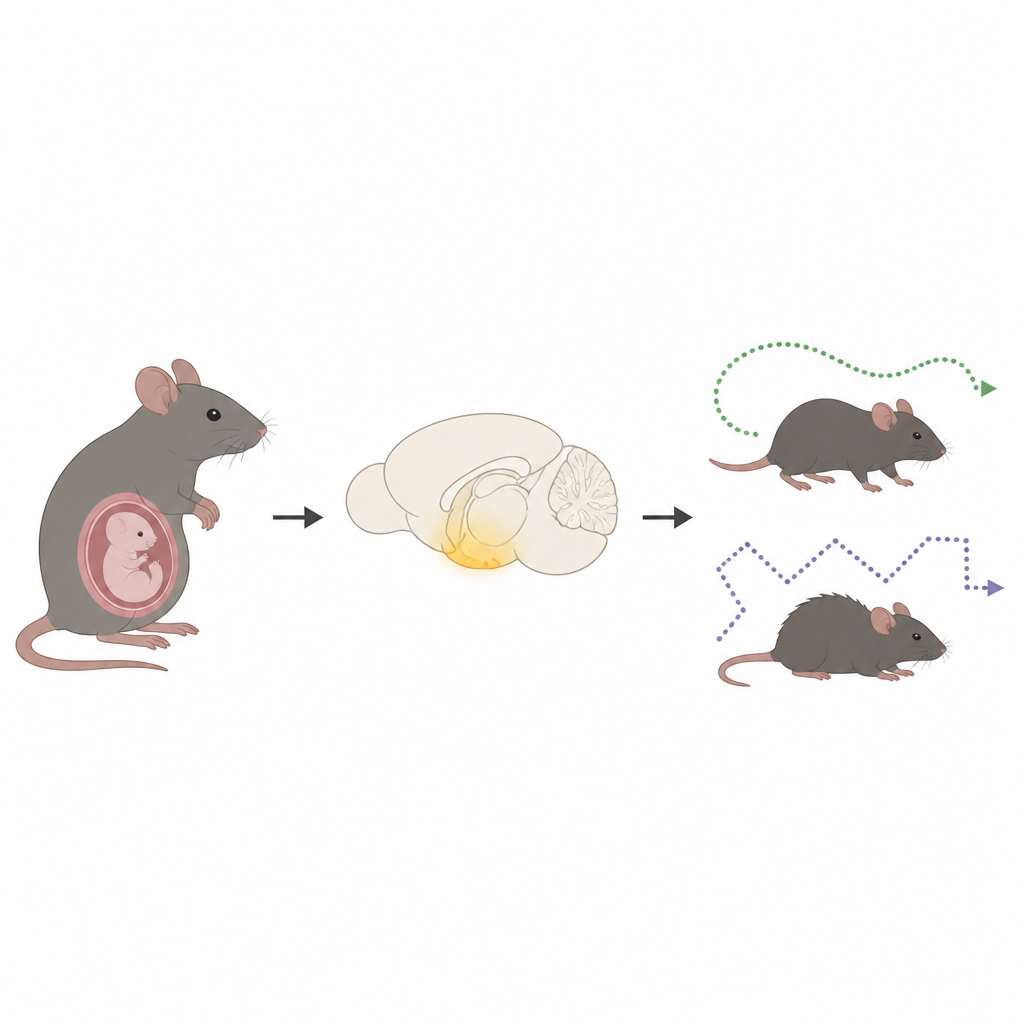
The researchers focus on a gene called Chd8, the mouse counterpart of human CHD8, one of the most frequently altered genes in people with autism. Rather than disrupting this gene everywhere and from the very start, they used genetic tools to switch Chd8 off only in brain cells and only at chosen times before or just after birth. By giving pregnant mice a drug that triggers this switch at different stages, they could ask when a partial loss of Chd8 starts to matter for behavior. They then put the offspring through a series of standard tests that measure social interaction, anxiety-like responses, and general movement.
A narrow fetal window shapes later behavior
The timing turned out to be crucial. When Chd8 was disrupted around the middle of fetal development, roughly corresponding to the second trimester in humans, the adult mice showed autistic-like traits: they behaved unusually in direct social contact tests and showed stronger anxiety-like responses in tasks that weigh comfort with open or brightly lit spaces. The same genetic change switched on later, just before birth or in the first days after, did not produce these behavioral shifts. This pointed to a short but sensitive midfetal window during which Chd8 helps set up brain circuits that later influence behavior.
Deep brain builders leaving too soon
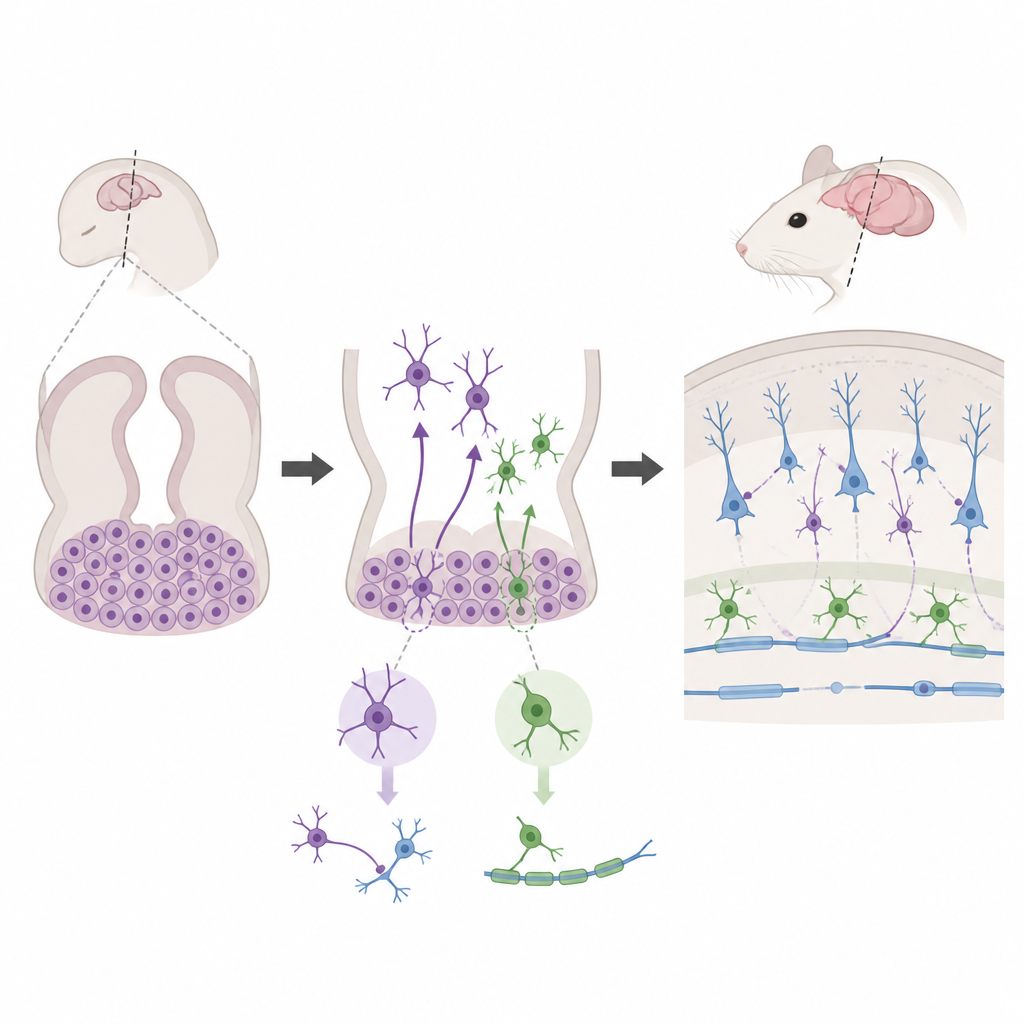
To find out what was going wrong inside the brain during this window, the team tagged and sorted the brain cells that experienced the Chd8 change, then read out which genes each single cell was using. They saw broad shifts in cell types and gene activity, especially in cells that become inhibitory nerve cells and myelin-forming support cells. A closer look at fetal brains showed that in the lower, or ventral, part of the developing forebrain, many progenitor cells were leaving the cell cycle and turning into mature cells earlier than they should. This early push toward differentiation was not seen in the upper, or dorsal, region that produces many excitatory nerve cells, making the ventral zone stand out as the main trouble spot.
From altered wiring to altered signals
The consequences of these early shifts could still be seen in the adult brain. Using a high‑resolution spatial gene map, the researchers found region‑specific changes in gene activity in inhibitory neurons and myelin cells in the cortex and the striatum, two regions important for emotion, decision making, and movement. Genes linked to inhibitory signaling and myelin wrapping tended to be dialed down. Functional tests echoed these molecular changes: when scientists activated inhibitory neurons in the prefrontal cortex with light, nearby cells in Chd8 mutant mice were not quieted as strongly as in controls, suggesting weakened inhibitory connections. Recordings from cultured neurons showed that excitatory cells fired less often, while inhibitory cells formed shorter axon branches, and staining of brain slices revealed fewer inhibitory contact points around nerve cell bodies.
Reversing course by rescuing the right cells
Perhaps the most striking result came from doing the reverse experiment. The team engineered mice in which Chd8 is normally reduced but can be turned back up in selected cells and at chosen times. Restoring normal Chd8 levels in neural stem cells at or before the midfetal stage, or specifically in ventral progenitor cells that give rise to inhibitory neurons and myelin cells, largely normalized both the altered cell differentiation and the autistic‑like behaviors, even though other features such as larger brain size remained. Fixing Chd8 later did not help. This shows that correcting gene activity in the right cell population during a brief developmental window can redirect brain development toward more typical behavioral outcomes.
What this means for understanding autism
For a general reader, the message is that not all brain cells or time points are equal when it comes to risk from gene changes linked to autism. In this mouse model, partial loss of Chd8 during a midfetal window pushes deep brain builder cells to mature too quickly, subtly reshaping how inhibitory and myelin‑forming cells wire up brain circuits. These wiring differences weaken the balance of signals in key regions and are tied to autistic‑like behaviors. Importantly, restoring the gene’s function in those specific cells at the right time can prevent many of these outcomes, suggesting that at least some aspects of autism risk may be tied to narrowly defined stages and cell types during brain development.
Citation: Nitahara, K., Kawamura, A., Tashiro, A. et al. Defective ventral neurogenesis due to midfetal Chd8 mutation drives autistic-like behavior in mice. Nat Commun 17, 4457 (2026). https://doi.org/10.1038/s41467-026-73416-2
Keywords: autism, CHD8, brain development, inhibitory neurons, mouse model