Clear Sky Science · en
Highly luminescent carbazole-functionalized tris(tribromophenyl)methyl radicals with stable circularly polarized photoluminescence
Bright spinning molecules for future tech
Light and magnetism lie at the heart of many emerging technologies, from secure quantum communication to ultra-sensitive sensors. This study explores a special family of glowing molecules that carry an unpaired electron, making them behave a bit like tiny bar magnets while also shining bright red light. By learning how to make these molecular "spinners" both luminous and stable, researchers move a step closer to using individual molecules as elements in future quantum devices.
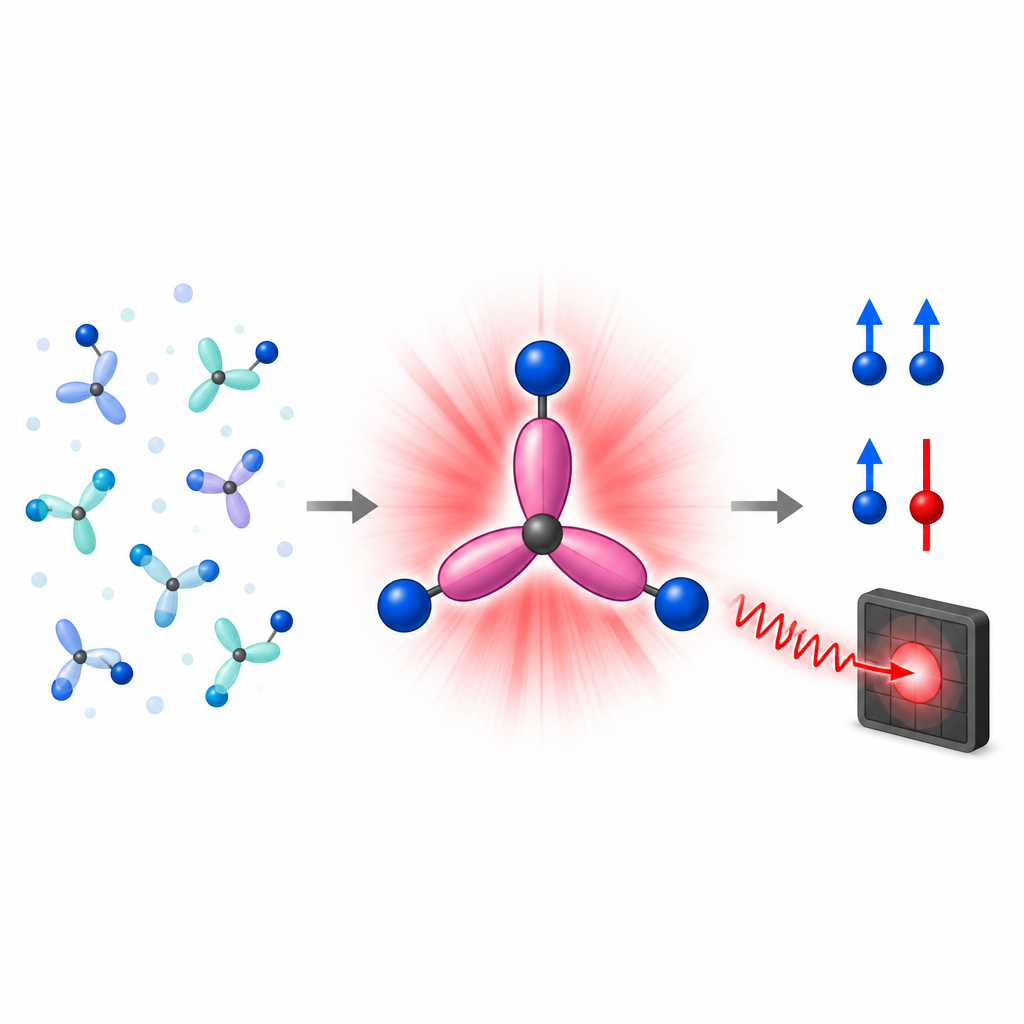
Why glowing radicals matter
Most everyday molecules have electrons neatly paired up, but a small class known as radicals carry a lone electron. That stray electron makes radicals useful for spin-based technologies, where information could be stored and read out using magnetic states instead of electric charge. A long-studied radical family called trityl radicals is especially promising because its members are chemically robust and can remain magnetically coherent for relatively long times. Unfortunately, the brominated version of these molecules, which is attractive for quantum applications, emits light very weakly, making optical readout of the spin state difficult. The challenge has been to boost their brightness without sacrificing their magnetic advantages.
Building brighter molecular propellers
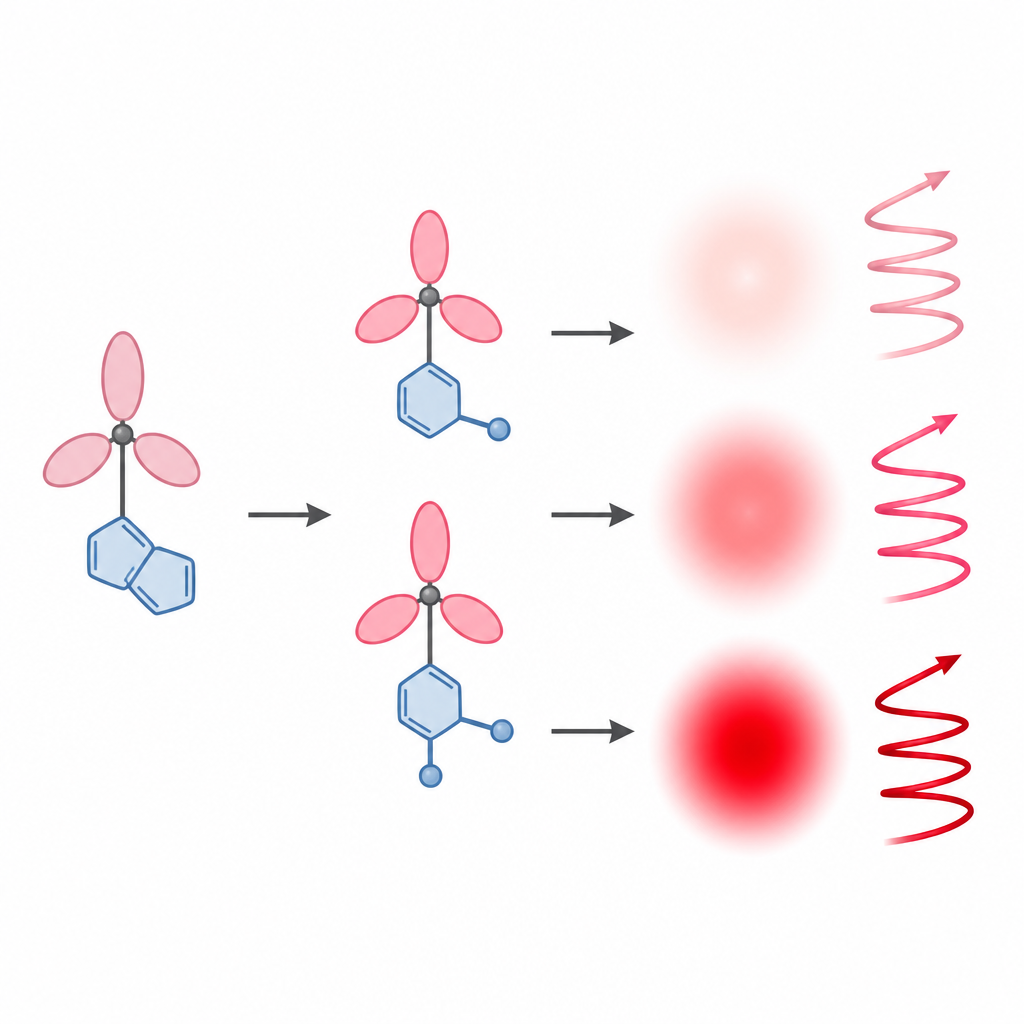
The team tackles this problem by attaching a light-absorbing carbazole unit to the brominated trityl core, creating propeller-shaped molecules that combine a strong electron donor with the radical center. Using a palladium-based cross-coupling reaction, followed by a two-step chemical sequence to generate the radical, they prepare three related compounds whose donor strength is tuned by adding zero, one, or two small methyl groups. This careful design disrupts the perfect symmetry that previously suppressed light emission and encourages charge to move from the carbazole donor to the radical core when the molecule is excited. As a result, the new radicals reach photoluminescence quantum yields as high as about 72 percent, while emitting deep red light at wavelengths between 646 and 688 nanometers.
Spins, shapes, and polarized light
Beyond brightness, the researchers study how the unpaired electron behaves and how the molecules respond to circularly polarized light, a property linked to their twisted propeller shape. Electron spin resonance measurements show that the unpaired electron remains largely localized on the trityl core and that bromine atoms increase spin–orbit coupling, shortening the spin memory time compared with lighter chlorine-based relatives. Even so, the new radicals preserve microsecond-scale coherence, suitable for exploring quantum behavior. By separating the left- and right-handed versions of each molecule using chiral chromatography, the team records matching mirror-image signals in circular dichroism and circularly polarized photoluminescence. These measurements confirm that each enantiomer emits slightly more of one handedness of circularly polarized light than the other, an important feature for chiral optics and spin readout.
Tuning color, stability, and performance
Systematic optical and electrochemical tests reveal how the added methyl groups strengthen the donor part, making the charge-transfer character more pronounced and shifting both absorption and emission to lower energies. The red glow moves to longer wavelengths as the donor grows stronger, while the overall brightness remains high. Detailed lifetime measurements show that the radiative rate stays almost constant across the series, whereas non-radiative loss pathways become more important for the most strongly methylated versions. Interestingly, these same methyl groups greatly improve photostability, especially in toluene, where the molecules survive minutes of intense ultraviolet irradiation before losing half their brightness. Together with the preserved spin properties, this balance of strong emission and robustness suggests that donor tuning offers a powerful handle on performance.
What this means for future devices
For non-specialists, the key takeaway is that the researchers have turned a dim but magnetically attractive radical into a bright, color-tunable, and chiral light source without destroying its useful spin behavior. These redesigned molecular propellers emit intense red light, respond differently to left- and right-circularly polarized light, and retain spin coherence long enough to be interesting for quantum information schemes. In practical terms, the work removes a major barrier to using brominated trityl radicals as building blocks for molecular-scale spintronic devices and potential molecular qubits, where light could be used to read and maybe one day control the state of a single spinning electron.
Citation: Schöneburg, L., Gross, M., Thielert, P. et al. Highly luminescent carbazole-functionalized tris(tribromophenyl)methyl radicals with stable circularly polarized photoluminescence. Nat Commun 17, 4381 (2026). https://doi.org/10.1038/s41467-026-73265-z
Keywords: organic radicals, circularly polarized light, molecular qubits, spintronics, photoluminescence