Clear Sky Science · en
Self sustained oscillations of a nonlinear optomechanical system in the low excitation regime
Why tiny vibrating devices matter
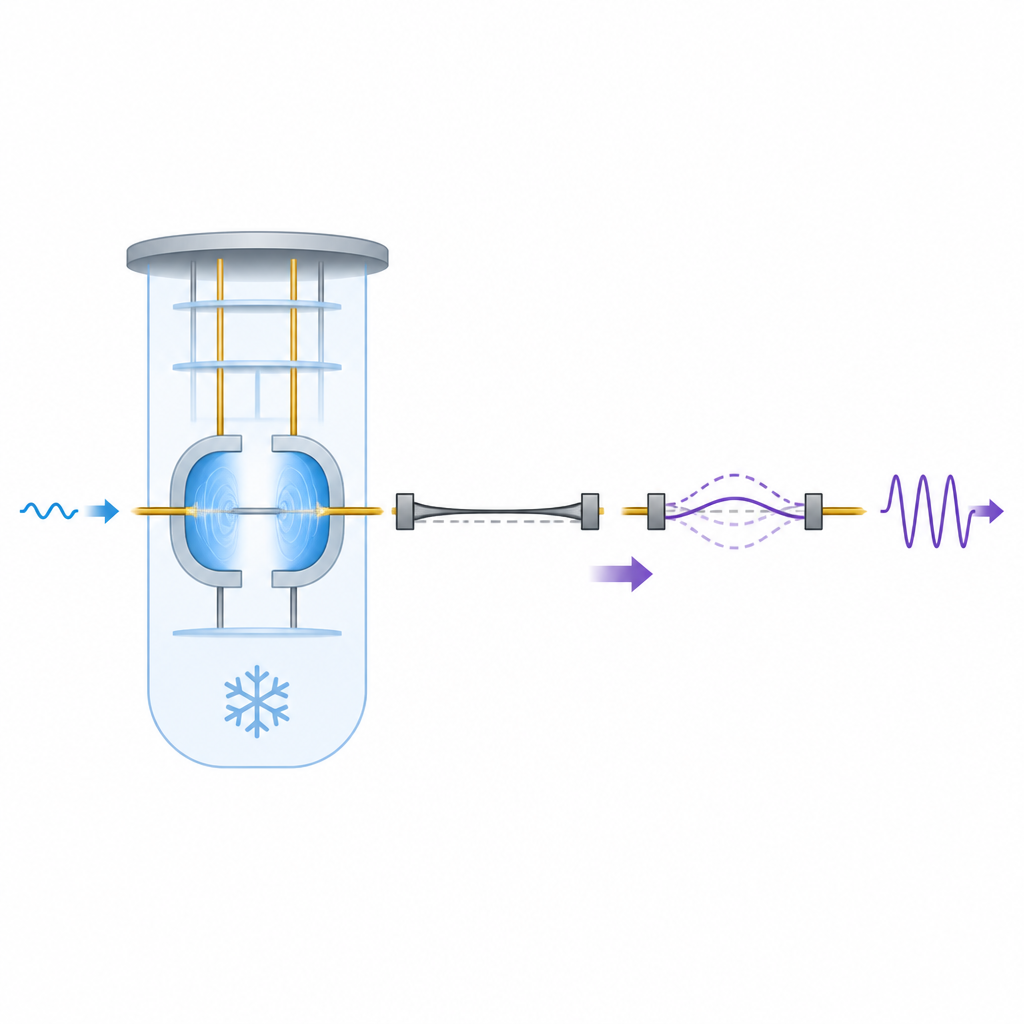
Imagine a guitar string so small it fits on a computer chip and is listened to by a microwave antenna cooled almost to absolute zero. Subtle vibrations of such “nanostrings” can reveal faint forces and form the building blocks of future quantum technologies. This study shows how to make these tiny mechanical systems behave in a strongly nonlinear way, even when driven by only a handful of light particles, opening doors to ultra-sensitive measurements and new quantum experiments.
A chip that lets light push on motion
The researchers work with an optomechanical device, where microwaves in a resonant circuit interact with a nanoscale mechanical string. When the string moves, it slightly changes the circuit’s properties, and the circuit’s microwaves push back on the string. This feedback loop is at the heart of many advanced sensors, from devices that weigh single molecules to instruments that listen for gravitational waves. Traditionally, to see rich nonlinear behavior such as multiple stable responses or self-sustained vibrations, these systems must be driven with relatively large powers, which is incompatible with delicate quantum states.
Adding a twist to the circuit
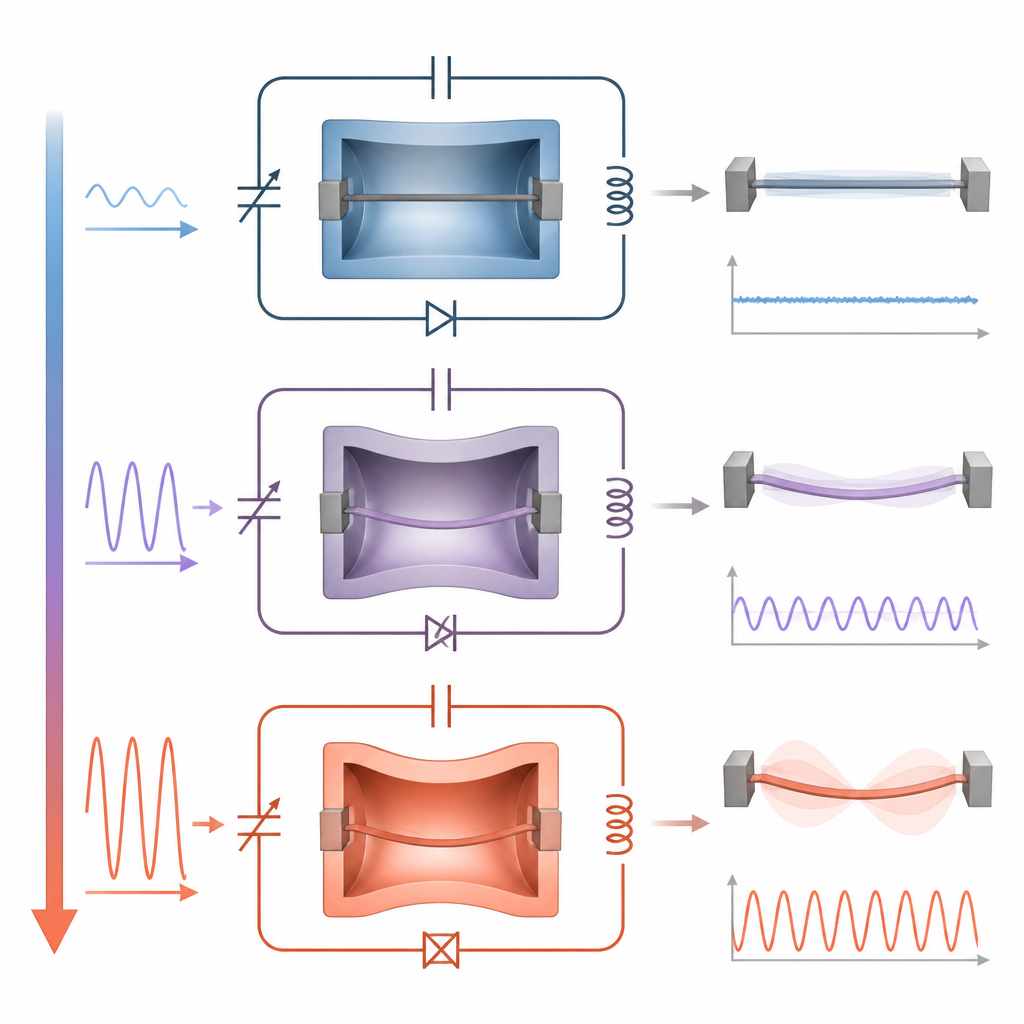
To lower the required drive power, the team introduces a strong built-in nonlinearity into the microwave circuit itself. They use a superconducting resonator whose end is formed by a tiny loop with two Josephson junctions, a structure known as a dc-SQUID. This loop behaves like an inductor whose properties depend on the magnetic field and on the microwave energy inside the resonator. As a result, the resonator’s frequency shifts with power in a way described as a Kerr nonlinearity. By carefully tuning magnetic fields, the researchers can control both the strength of the coupling between the microwaves and the nanostring and the amount of this Kerr nonlinearity.
Finding the tipping points
Using a combination of theory and experiment, the authors map out when the system is stable and when it becomes unstable and starts to oscillate on its own. Their model describes the coupled motion of microwaves and the mechanical string and predicts regions with one or several possible steady states. By computing how these states change with drive frequency and power, they identify where the system undergoes bifurcations, such as Hopf bifurcations, which mark the onset of self-sustained oscillations. The key result is that the Kerr nonlinearity from the superconducting circuit dramatically lowers the threshold drive. Compared with a similar device without this nonlinearity, the required number of microwave photons drops by roughly four orders of magnitude, down to only a few to a few tens of photons.
Watching the circuit ring itself up
Experimentally, the team probes the device with a single microwave tone whose frequency they sweep across the resonator. They work at millikelvin temperatures so that thermal noise is strongly suppressed. For each probe frequency, they let the system evolve long enough for any transient behavior to fade and then record the steady response. At very low power, the resonator behaves linearly, showing a simple symmetric dip in transmission. As the power increases modestly, the resonance becomes distorted and shifts in frequency, reflecting the Kerr effect. At slightly higher powers, an additional dip appears offset by the mechanical vibration frequency. This new feature signals self-sustained oscillations of the nanostring, driven effectively by the blue sideband of the microwave tone. Detailed numerical simulations that include the full nonlinear dynamics closely match the measured spectra across many drive powers and tuning settings.
Looking toward quantum motion
For a general reader, the central message is that the authors have built and understood a chip-scale device where strong nonlinear behavior appears even when only a few light quanta are present. This is important because it brings complex mechanical motion, such as persistent oscillations and other nonlinear effects, into a regime where quantum properties are not washed out by large drive powers. With further cooling and control, similar devices could host non-classical mechanical states and be used for quantum-enhanced sensing, where strange quantum vibrations of tiny strings help detect extremely weak signals.
Citation: Dhiman, S., Rubenbauer, K., Luschmann, T. et al. Self sustained oscillations of a nonlinear optomechanical system in the low excitation regime. Nat Commun 17, 4560 (2026). https://doi.org/10.1038/s41467-026-73259-x
Keywords: optomechanics, nanomechanical resonators, Kerr nonlinearity, self-sustained oscillations, quantum sensing