Clear Sky Science · en
Discovery of a KLHL41 Ligand for Muscle Specific Protein Degradation
Why muscle focused medicines matter
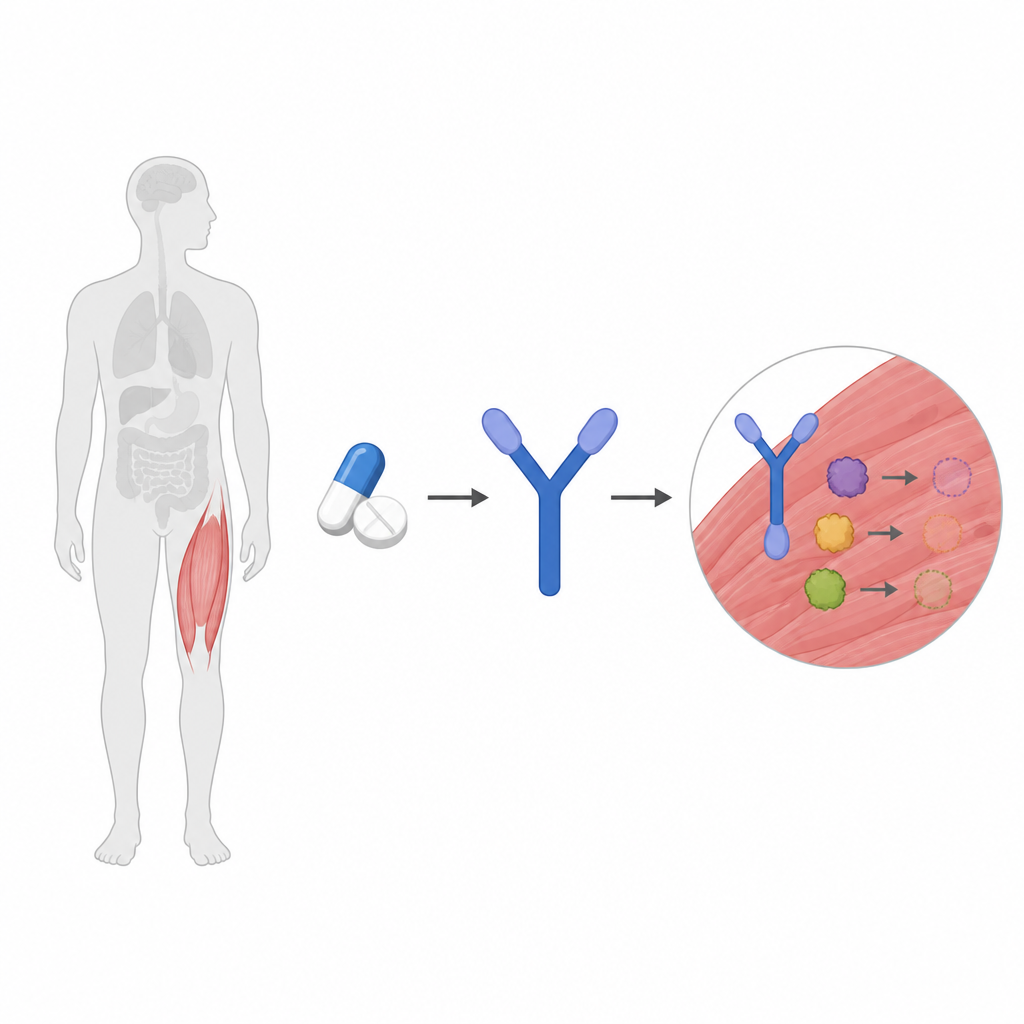
Many diseases damage our muscles, yet most modern drugs spread throughout the whole body, which can cause side effects in healthy organs. This study explores a way to design pills that only switch off harmful proteins inside muscle cells, leaving the rest of the body largely untouched. By building a smart “molecular tool” that works only where a muscle specific helper protein is present, the researchers show how to make targeted treatments for muscle disorders more precise and potentially safer.
Finding a muscle only doorway
To create a muscle focused drug, the team first needed a molecular doorway that exists mainly in muscle tissue. They turned to KLHL41, a protein that helps control other proteins in muscle cells. Because no detailed structure of KLHL41 was available, they used AlphaFold, an artificial intelligence system, to predict its 3D shape. They then virtually tested about 230,000 small molecules on a likely binding site of KLHL41, using several rounds of computer docking and energy calculations to narrow the list to 34 promising candidates for lab testing.
Pinpointing a key helper molecule
The researchers next asked which of these candidate molecules truly binds to KLHL41 inside living cells. Using a method that measures how well a protein withstands heat in the presence of a compound, they found one clear winner, called EN10, that stabilized KLHL41. Follow up experiments with light activated crosslinkers and chemical tags confirmed that EN10 attached directly and selectively to KLHL41, but not to its closely related cousin KLHL40. They also mapped how EN10 could be extended with chemical linkers without losing its grip on KLHL41, setting the stage for building more complex designer molecules.
Building a muscle specific protein eraser
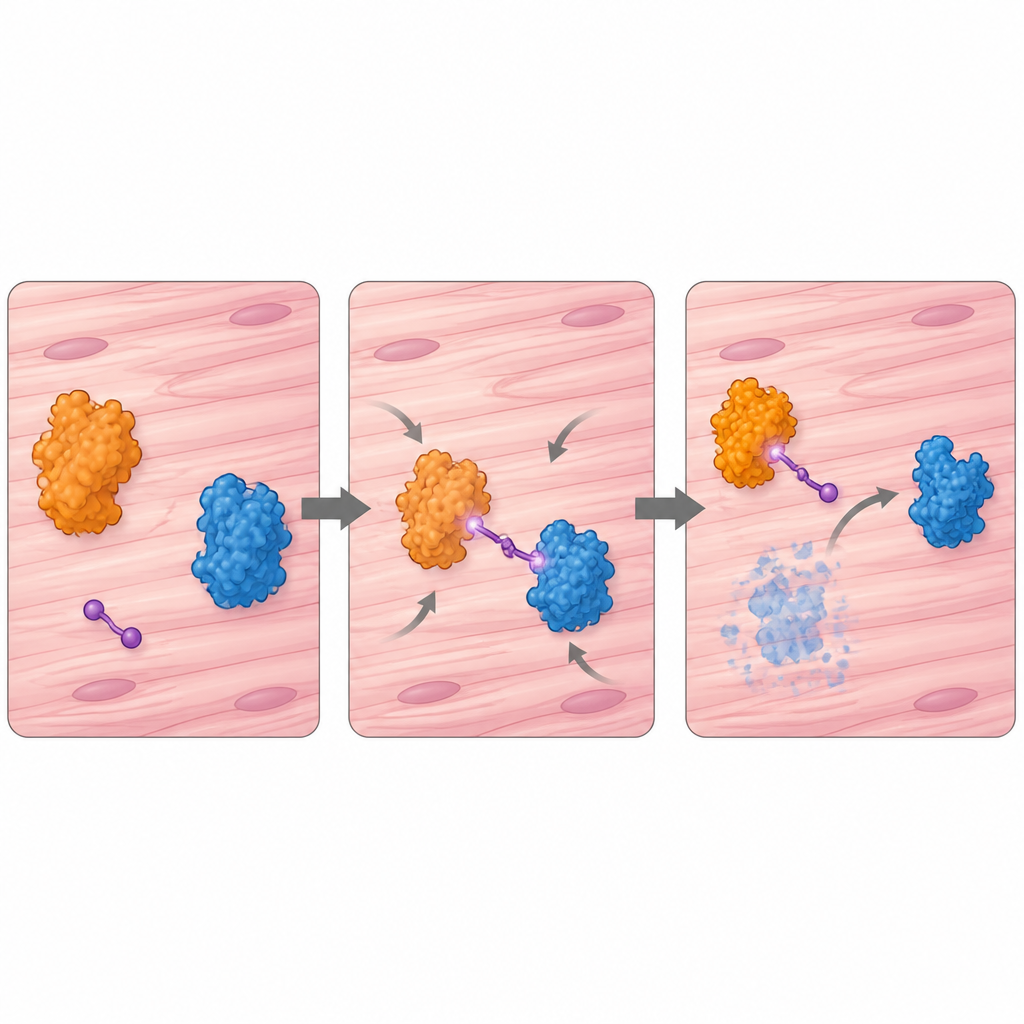
With EN10 in hand, the group constructed “PROTAC” molecules, which act like bridges between an unwanted protein and the cell’s natural waste disposal system. They linked EN10 to JQ1, a compound that binds BRD4, a protein involved in controlling gene activity and linked to several cancers. The first generation PROTAC, called KBD-1, could pull KLHL41 and BRD4 together and trigger BRD4 removal, but it worked only at relatively high doses. Crucially, it degraded BRD4 only in muscle cancer cell lines that naturally produce KLHL41, and not in other cell types, proving that the muscle specific doorway concept works in practice.
Making the eraser far more efficient
To boost potency, the scientists adopted a “two body” strategy. They modified EN10 so that it formed a permanent covalent bond with KLHL41, turning the pair into a stable unit that could repeatedly grab and destroy BRD4 molecules. This upgraded PROTAC, named cKBD-1, achieved BRD4 degradation at sub nanomolar levels, more than ten thousand times more efficient than KBD-1. It still acted only in cells and tissues that express KLHL41. In mice, a single dose of cKBD-1 selectively lowered BRD4 levels in muscle, while leaving brain, liver, lung, and other organs largely unaffected. Detailed protein surveys showed that BRD4 was the main target and that the normal functions of KLHL41 remained intact.
Extending the idea to other muscle diseases
Finally, the team showed that EN10 is not limited to one target. By swapping the BRD4 binding part for a molecule that recognizes the androgen receptor, they created a new degrader, cKAD-1, that efficiently removed this second protein in muscle cells using the same KLHL41 based strategy. This suggests that the KLHL41 ligand can serve as a flexible platform for designing muscle specific degraders against many disease related proteins.
What this means for future treatments
In simple terms, this work discovers a chemical key that fits a lock found almost only in muscle cells and then turns that lock into a switch that marks harmful proteins for cleanup. By combining computer design, clever chemistry, and cell biology, the researchers create a powerful, reusable way to aim protein destroying drugs squarely at muscle tissue. While more work is needed before such compounds reach patients, the study outlines a clear path toward precision treatments for muscle disorders that spare the rest of the body.
Citation: Yim, J., Lee, J., Kim, S. et al. Discovery of a KLHL41 Ligand for Muscle Specific Protein Degradation. Nat Commun 17, 4551 (2026). https://doi.org/10.1038/s41467-026-73252-4
Keywords: targeted protein degradation, muscle specific PROTAC, KLHL41, BRD4 degrader, covalent tPROTAC