Clear Sky Science · en
RBM20 isoform regulation by independent transcription start sites adapts alternative splicing in development and disease
How heart cells fine tune their own wiring
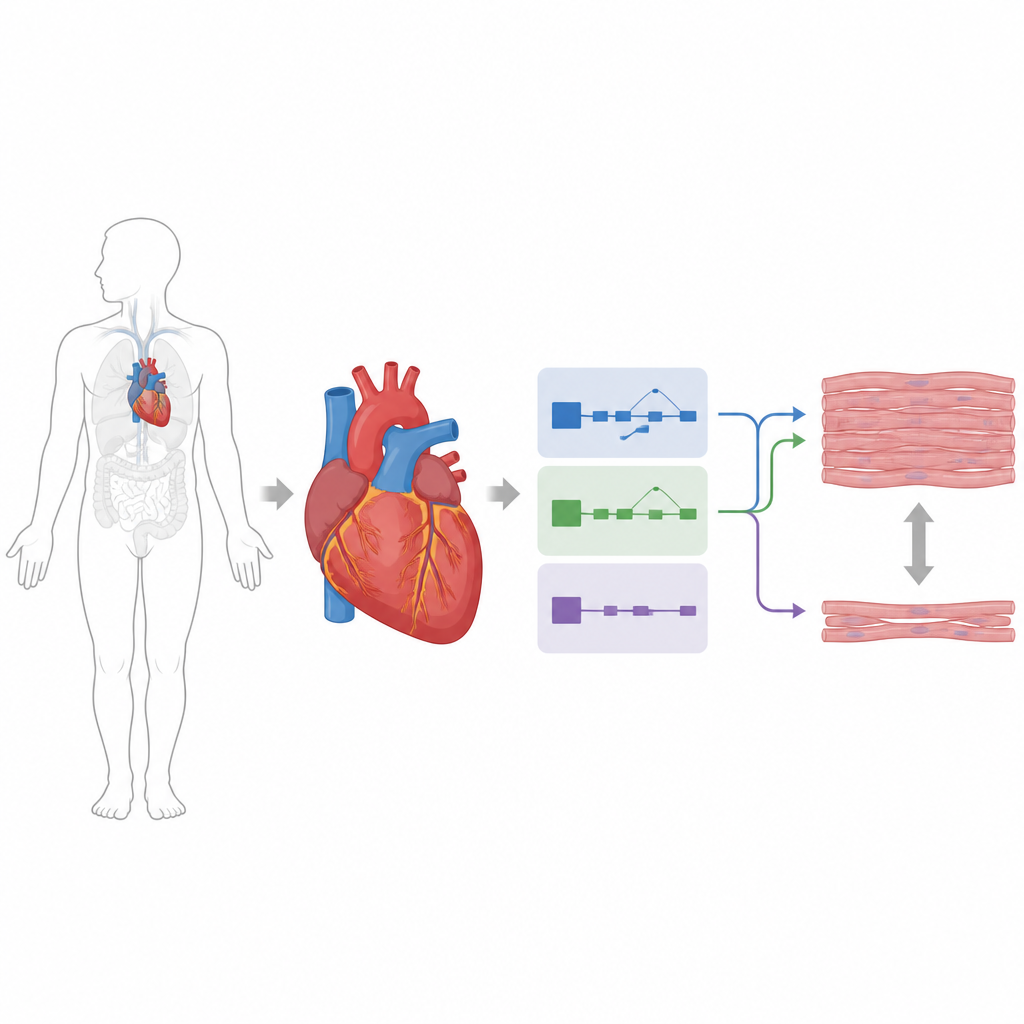
The heart beats for a lifetime, yet its muscle cells must stay flexible enough to adapt as we grow and as disease strikes. This study uncovers a hidden control knob inside those cells: different versions of a single regulatory protein, called RBM20, let the heart subtly adjust how its key structural and signaling genes are pieced together, shaping how stiff or relaxed the heart muscle becomes.
One gene, many messages
Most genes are not read out in a single fixed way. Instead, cells can cut and paste pieces of the initial RNA message, a process known as alternative splicing, to make several protein variants from one gene. In the heart, RBM20 is a central splicing regulator that helps decide how giant spring like proteins such as titin, and several calcium handling proteins, are assembled. These targets help set how stretchy the heart wall is and how efficiently it handles electrical and mechanical signals, so changes in RBM20 can have a powerful impact on heart performance and disease.
A hidden starting point inside the RBM20 gene
The researchers set out to test whether RBM20 might itself come in distinct versions. They engineered mice in which the usual starting section of the RBM20 gene was interrupted and replaced with a reporter sequence that lights up where RBM20 is active. Surprisingly, even though this should have shut off the standard RBM20 protein, the animals still made a shorter RBM20 form that localized properly to the cell nucleus and continued to control splicing of titin and other targets. By sequencing the RNA and tracking ribosomes, the team discovered a previously overlooked starting point inside the first intron and confirmed that most RBM20 protein actually begins from an internal code in the second exon, allowing a shorter but functional isoform to be produced.
Balancing isoforms during growth and in disease
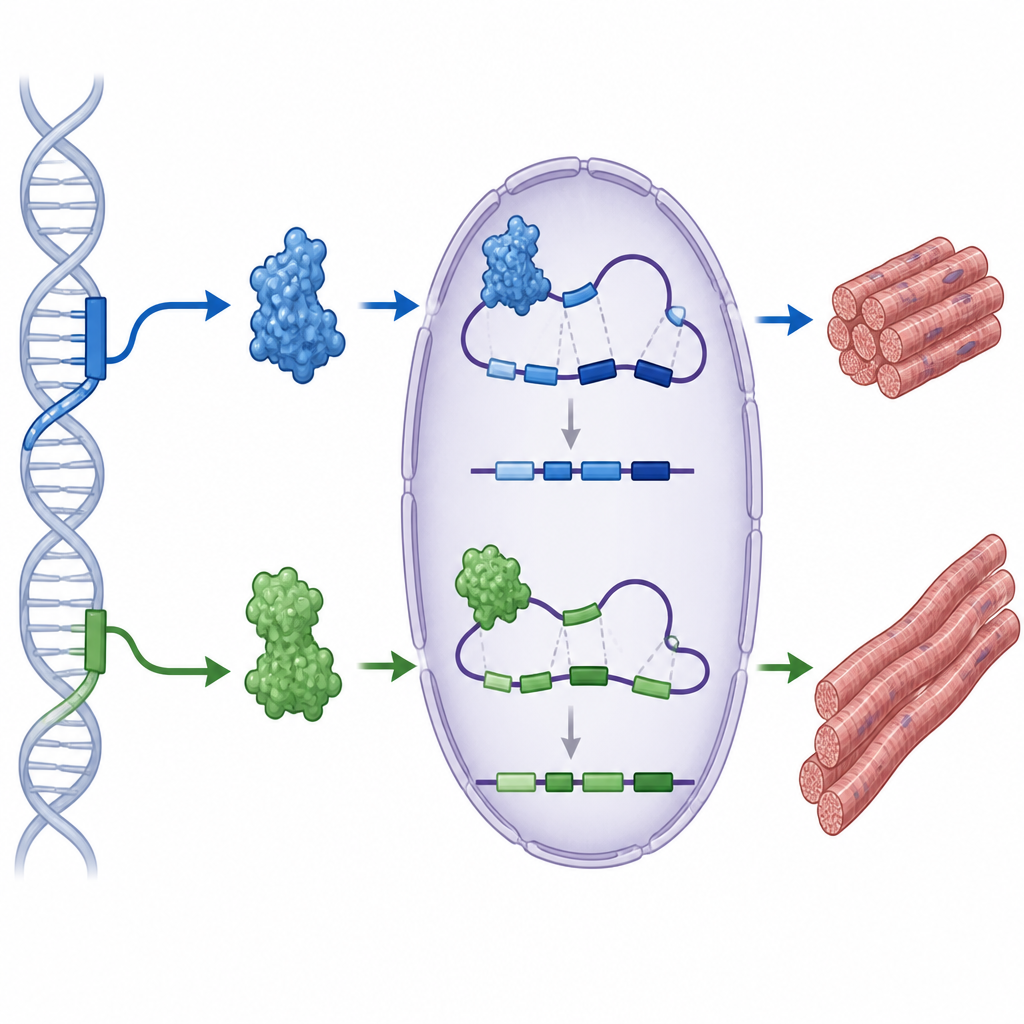
Using large scale RNA data from mice, rats, and humans, the authors found that RBM20 is controlled by several independent switching points at the front of the gene, each feeding into RNAs that share the main body of the code but differ at their beginning. In healthy development, both the classic and shorter isoforms rise around birth, the same window when the heart shifts from a softer, fetal titin variant to a stiffer adult form. The mix between isoforms is especially tightly regulated at this time, hinting that the heart needs a precise dose of each RBM20 version to remodel its internal wiring as it takes on the demands of postnatal life.
Different heart diseases tilt the switch in distinct ways
The study then examined hearts from animal models and patients with two major forms of cardiomyopathy: hypertrophic cardiomyopathy, where the heart wall thickens, and dilated cardiomyopathy, where the main chamber enlarges and weakens. In hypertrophic hearts from rats and humans, overall RBM20 levels were higher, but the increase came mainly from the shorter isoform, shifting the isoform ratio. In dilated hearts, both isoforms rose, with a stronger boost to the classic version. Despite these changes, titin splicing in adult human hearts changed little, suggesting that some RBM20 driven switches may already be maxed out, and that other networks, such as cytoskeletal and cell junction components, bear the brunt of disease related rewiring.
How the heart rewrites its own rules
Digging deeper, the authors explored why the different starting points are used. They mapped binding sites for transcription factors, the proteins that turn genes on and off, near each promoter. Distinct sets of these factors were active in hypertrophic versus dilated hearts, and natural genetic variation in the promoter of the classic isoform tracked with how strongly it was expressed. Together, these findings show that the heart does not simply raise or lower a single RBM20 level. Instead, it uses separate molecular switches and post processing steps to adjust which RBM20 isoform dominates, fine tuning how splicing programs respond during development, stress, and disease. This layered control may offer more precise ways to tweak heart stiffness and function in future therapies by targeting not just RBM20 quantity, but also its isoform balance.
Citation: Radke, M.H., Badillo Lisakowski, V., Meinke, S. et al. RBM20 isoform regulation by independent transcription start sites adapts alternative splicing in development and disease. Nat Commun 17, 4607 (2026). https://doi.org/10.1038/s41467-026-73230-w
Keywords: RBM20, heart muscle, alternative splicing, cardiomyopathy, titin