Clear Sky Science · en
Novelty exploration-activated ensemble in the lateral hypothalamus confers analgesic and anxiolytic effects
Why new experiences might ease pain
Anyone who has been absorbed in a good movie or unfamiliar place knows that attention can drift away from discomfort. This study asks a deeper question: does exploring something new simply distract the mind, or does it switch on specific brain circuits that dial down pain and worry? Using a series of experiments in mice, the researchers uncover a small but powerful group of brain cells that becomes active during novelty and, when engaged, makes pain feel less intense and emotions less anxious.
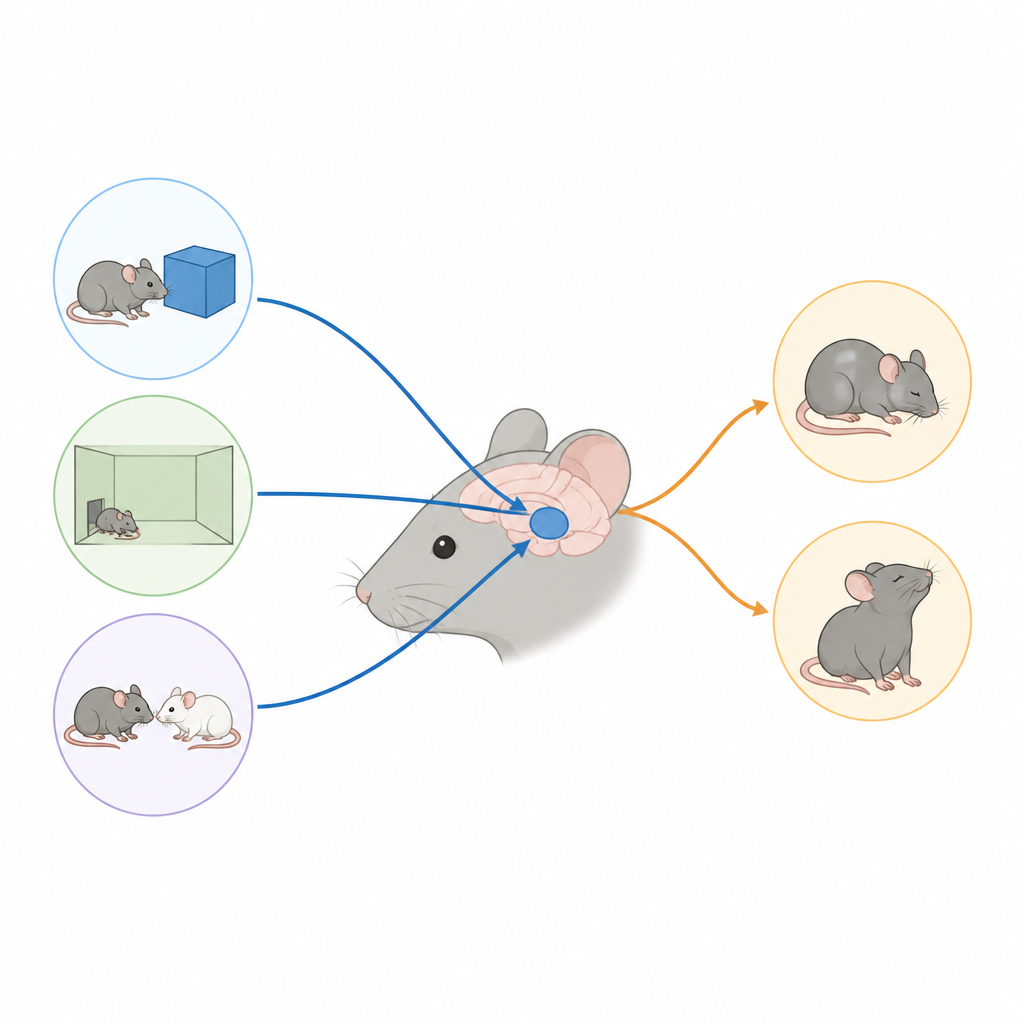
New sights and settings lessen pain in mice
The team first tested whether simple new experiences could change how mice respond to pain. After a mild chemical irritant was injected into a paw, mice normally spent time licking and guarding it, a standard measure of discomfort. When these mice were allowed to explore a new object or placed in a new box, they licked their paw less often and for shorter periods, showing that both kinds of novelty reduced pain-like behavior. The effect appeared in male and female animals and also showed up when heat was used instead of chemical irritation, suggesting that novelty broadly raises the threshold for pain.
A brain hub that notices both pain and novelty
To find where in the brain novelty was having its effect, the researchers looked for cells that turned on activity markers during exploration. Many regions lit up, but a small area deep in the brain, the lateral hypothalamus, stood out for its strong response. This region is already known to help control motivation, reward, and feeding. Here, it also became active when mice were exposed to different types of pain or to anxiety-provoking situations, such as being in the exposed arms of a raised maze. The overlap suggested that the same group of cells might be monitoring both pain and attention-grabbing events.
A shared circuit for salience, pain, and emotion
Using genetic tools that tag only those neurons activated during novelty, the team permanently labeled this "novelty ensemble" in the lateral hypothalamus. Later, when the mice experienced pain or other strong events, many of these labeled cells fired again, while neighboring unlabeled cells remained mostly quiet. Tiny light fibers were then used to switch this ensemble on or off. Turning it on made mice less sensitive to painful heat, pressure, and chemical irritation, and it also reduced signs of anxiety and negative mood. Turning it off had the opposite effect, increasing pain responses and anxious behavior even when the animals were otherwise healthy. These results show that novelty-linked cells do more than notice change; they actively shape how pain and emotion are experienced.
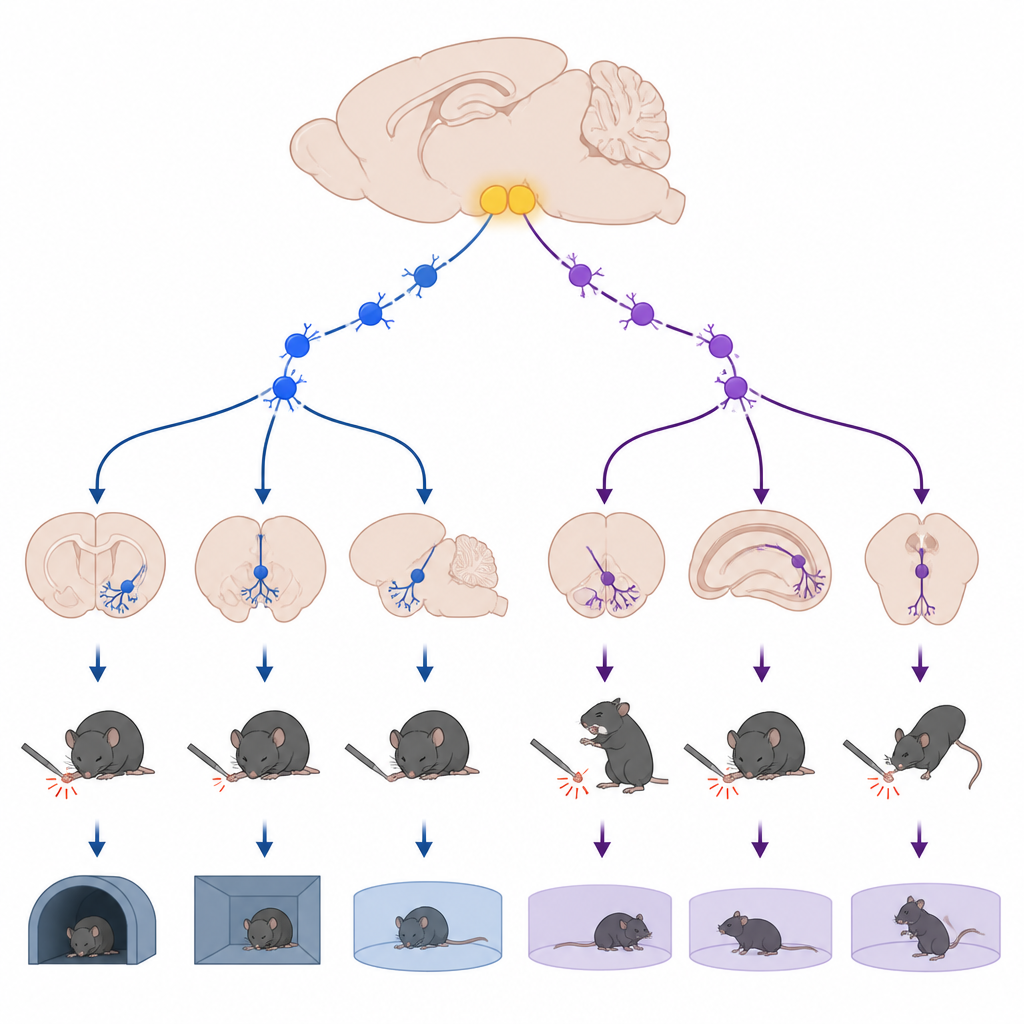
Two cell types, many output routes
The novelty ensemble turned out to be a mix of inhibitory and excitatory neurons, broadly described as GABA and glutamate cells. Both types responded to new objects, painful stimuli, rewards, and mild threats, and both could ease pain and anxiety when artificially activated. Tracing their long-distance connections revealed that these cells send signals to several key brain areas involved in motivation and defensive reactions. Specific pathways from the lateral hypothalamus to regions such as the lateral habenula, ventral tegmental area, lateral preoptic area, and a segment of the midbrain pain-control system each influenced pain and anxiety in slightly different ways. Some routes mainly reduced pain, others mainly calmed anxiety, and some did both.
What this means for relief without drugs
By showing that novelty recruits a defined set of brain cells that in turn dampen pain and anxiety through particular pathways, this work provides a biological explanation for why engaging experiences can make discomfort feel more manageable. In mice, this circuit operates largely outside of the body’s opioid system, meaning it could offer an alternative route to relief that does not rely on traditional pain medicines. While much remains to be learned before applying these findings to people, the study highlights how carefully designed activities that capture attention may tap into built-in brain mechanisms for easing both physical and emotional distress.
Citation: Jia, T., Peng, YT., Sun, YL. et al. Novelty exploration-activated ensemble in the lateral hypothalamus confers analgesic and anxiolytic effects. Nat Commun 17, 4418 (2026). https://doi.org/10.1038/s41467-026-73205-x
Keywords: novelty, pain, anxiety, lateral hypothalamus, neural circuits