Clear Sky Science · en
Atlantic sediments reveal interacting environmental and physiological controls on coccolithophore calcite production
Why tiny ocean builders matter to our future
Coccolithophores are microscopic algae that cover themselves with intricate shells of calcium carbonate. Though each cell is minuscule, together they produce a large share of the ocean’s chalky minerals and help move carbon from the surface to the deep sea. This study looks at how these tiny builders in the Atlantic Ocean respond to their surroundings and how their biology shapes the way carbon is stored on the seafloor, offering clues to both past climate shifts and future ocean change.
Small shells, big role in the carbon cycle
Coccolithophores draw dissolved carbon from seawater to power photosynthesis and to build their calcite plates. When these plates sink, they help bury carbon in marine sediments, influencing atmospheric CO2 and climate over thousands of years. Yet most of what we know about their behavior comes from short laboratory experiments with single strains, which are difficult to scale up to real ocean ecosystems or to interpret in ancient sediment records. The authors tackled this gap by using well preserved surface sediments from across the Atlantic to directly reconstruct how different coccolithophore groups grow and calcify in their natural environment.
Reading living strategies from Atlantic mud
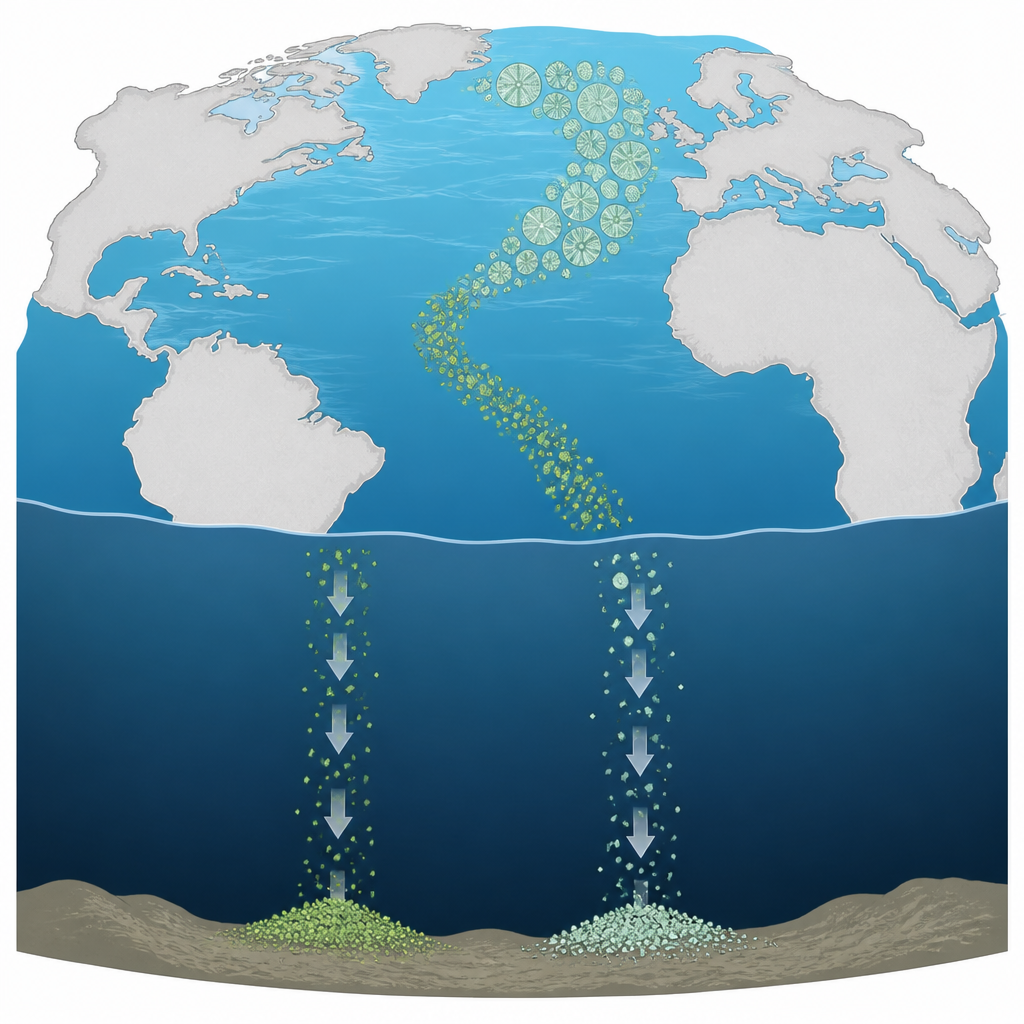
The team analyzed coccoliths from nineteen seafloor sites stretching from subpolar to equatorial waters. By counting how many coccoliths of each species were present and measuring their size and thickness, they estimated growth rate, productivity, and how much calcite each group produced. They focused on two broad sets of species: a low calcite group that invests relatively more carbon into organic matter and tends to form smaller cells, and a high calcite group that builds heavier shells per cell. These measurements allowed the researchers to link community composition and shell form to environmental conditions such as temperature, nutrients, and seawater carbon chemistry.
Two carbon strategies split the Atlantic
The results reveal a striking pattern. South of roughly 40 degrees North, the low calcite group dominates both in cell numbers and in total calcite exported to the seafloor. These smaller cells grow quickly and, in these mid latitude and subtropical waters, higher growth goes hand in hand with more intense shell building. Here, carbon supply from the environment generally keeps up with cellular demand, so faster division amplifies both organic production and calcification. North of about 40 degrees, the balance shifts. Larger, high calcite species become the main contributors to calcite in the sediments even though each cell actually builds thinner shells when they are growing fastest. In these cooler, well mixed waters, the high calcite group grows well but appears to run closer to the limit of how much carbon it can pull in, trading thick shells for more cells.
From reaction limited to transport limited growth
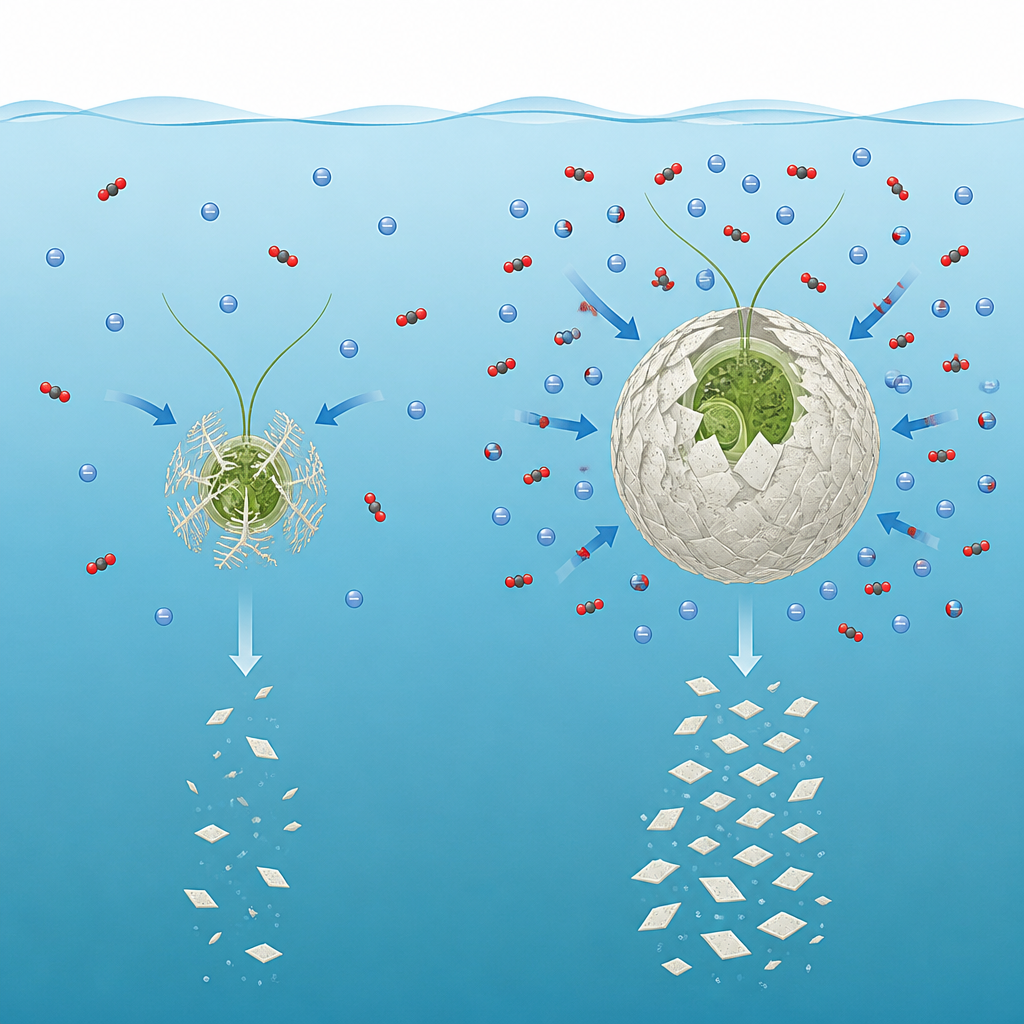
By comparing shell form and abundance with environmental data, the authors argue that these two regions reflect different bottlenecks in how calcite is made. In the higher latitudes, where dissolved carbon and nutrients are plentiful but temperatures are lower, crystal growth inside the cell is mainly set by the speed of the chemical reaction that precipitates calcite. In the warmer, lower latitude waters, small, fast growing cells have such high metabolic rates that the supply of carbon into the cell becomes the key limit. This transport limited regime produces more delicate, open crystals, while the reaction limited regime favors more solid, space filling plates. The boundary between these modes aligns with changes in temperature, nutrients, and the ratio of dissolved carbon to alkalinity in surface waters.
Lessons for past and future oceans
Because these growth and shell building patterns are recorded in sedimentary coccoliths, the framework developed here allows scientists to read past changes in ocean carbon balance from fossil shells. Thicker plates in the low calcite group, for example, signal times and places where these cells both grew quickly and used carbon efficiently, pointing to higher calcite production and altered carbon export. Shifts in the size and thickness of high calcite species can, in turn, hint at changing carbon availability in cooler waters. Looking ahead, the study suggests that as warming and acidification reshape carbon supply and metabolic rates, the dividing line between the two coccolithophore strategies may migrate, subtly reorganizing who builds the ocean’s chalky rain and how effectively the seas store carbon.
Citation: González-Lanchas, A., Baumann, KH., Stoll, H.M. et al. Atlantic sediments reveal interacting environmental and physiological controls on coccolithophore calcite production. Nat Commun 17, 4722 (2026). https://doi.org/10.1038/s41467-026-73162-5
Keywords: coccolithophores, marine carbon cycle, calcite production, Atlantic sediments, phytoplankton ecology