Clear Sky Science · en
Structure of ergosteryl-aspartate synthase reveals how an entrapped tRNA is used like a prosthetic swinging arm in the synthesis of aminoacylated sterols
How fungi fine tune their cell membranes
Fungi rely on sturdy yet flexible membranes to grow, spread, and sometimes cause disease in plants and people. This study reveals how a specialized fungal enzyme uses a trapped RNA molecule as a tiny swinging arm to bolt an amino acid onto a membrane fat, subtly reshaping the fungal surface and influencing growth, spore formation, and stress resistance. Understanding this unusual chemistry opens a window onto how fungi adapt to their environment and may suggest new ways to target harmful species.
A new twist on a familiar cell building block
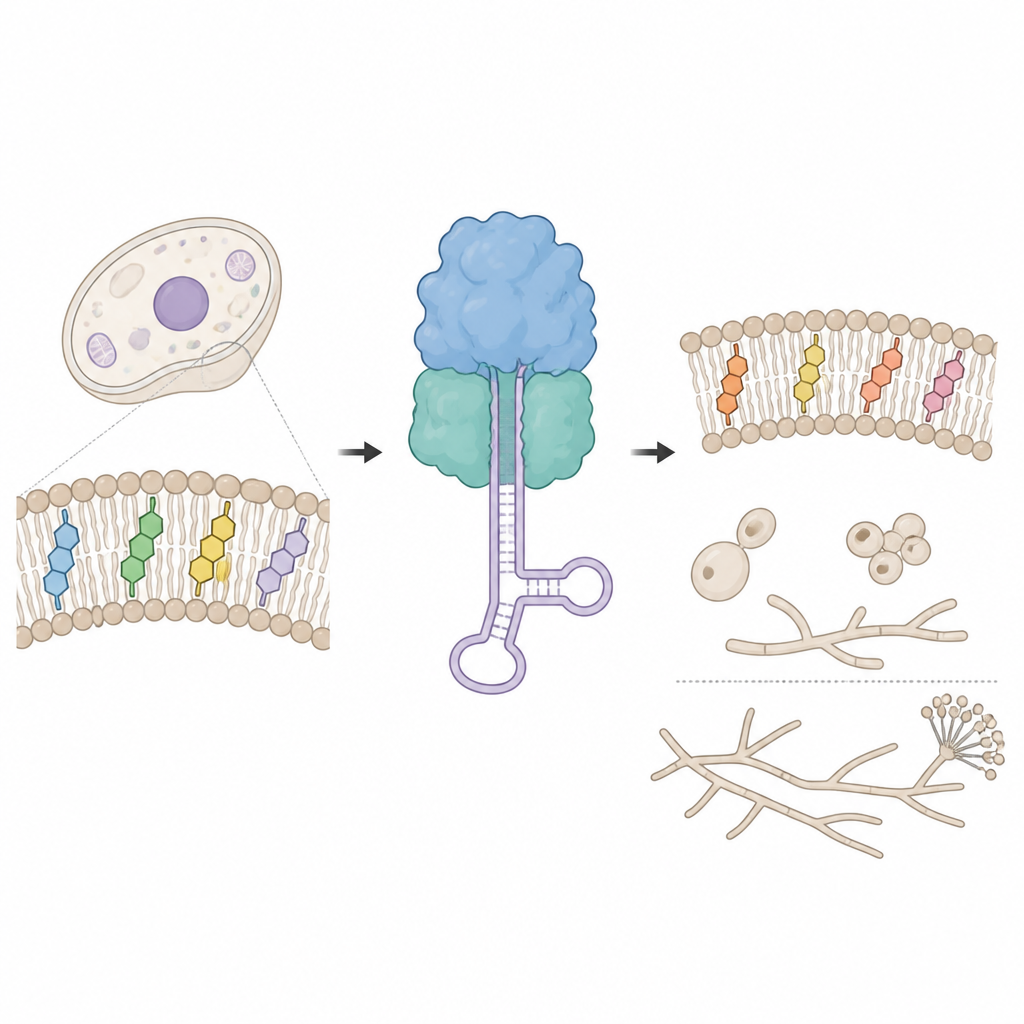
Fungal membranes are rich in ergosterol, a fat-like molecule that plays a role similar to cholesterol in human cells. The researchers previously discovered a modified version called ergosteryl-aspartate, in which the amino acid aspartate is attached to ergosterol. The new work shows that this add-on is made by a two-in-one enzyme called ErdS. One half of ErdS activates aspartate and attaches it to a transfer RNA (tRNA), while the other half moves the activated aspartate onto ergosterol. This reaction changes the chemical personality of ergosterol and, by extension, the properties of the fungal membrane.
Why this matters for fungal growth and survival
Using two important fungi, Aspergillus fumigatus, a human pathogen, and Magnaporthe oryzae, a rice pathogen, the team explored what happens when ErdS or its partner enzyme ErdH are removed or overproduced. ErdH normally removes aspartate from ergosteryl-aspartate, so together ErdS and ErdH act like a fine-tuning pair. In these fungi, losing ErdS reduced or delayed the production of asexual spores and slowed or desynchronized the germination of spores into growing filaments. In contrast, forcing extra ErdS activity produced colonies with unusually fluffy aerial filaments and delayed spore formation, showing that both too little and too much ergosteryl-aspartate can disrupt normal development.
Membranes, stress, and fungal fitness
The study also hints that ergosteryl-aspartate helps fungi cope with challenging conditions. In A. fumigatus, strains lacking ErdS were more sensitive to the cell wall–active dye Congo Red, but showed better spore formation than normal under high salt, suggesting shifts in how membranes and walls respond to stress. Levels of ergosteryl-aspartate dropped when nitrogen in the growth medium was removed, linking this unusual lipid to nutrient status. Throughout the fungal life cycle, fluorescent tags revealed that ErdS and ErdH move between the cytosol, internal compartments, and the plasma membrane, implying that the cell adjusts where and when it decorates ergosterol to match developmental stage and environment.
A trapped RNA used as a swinging arm
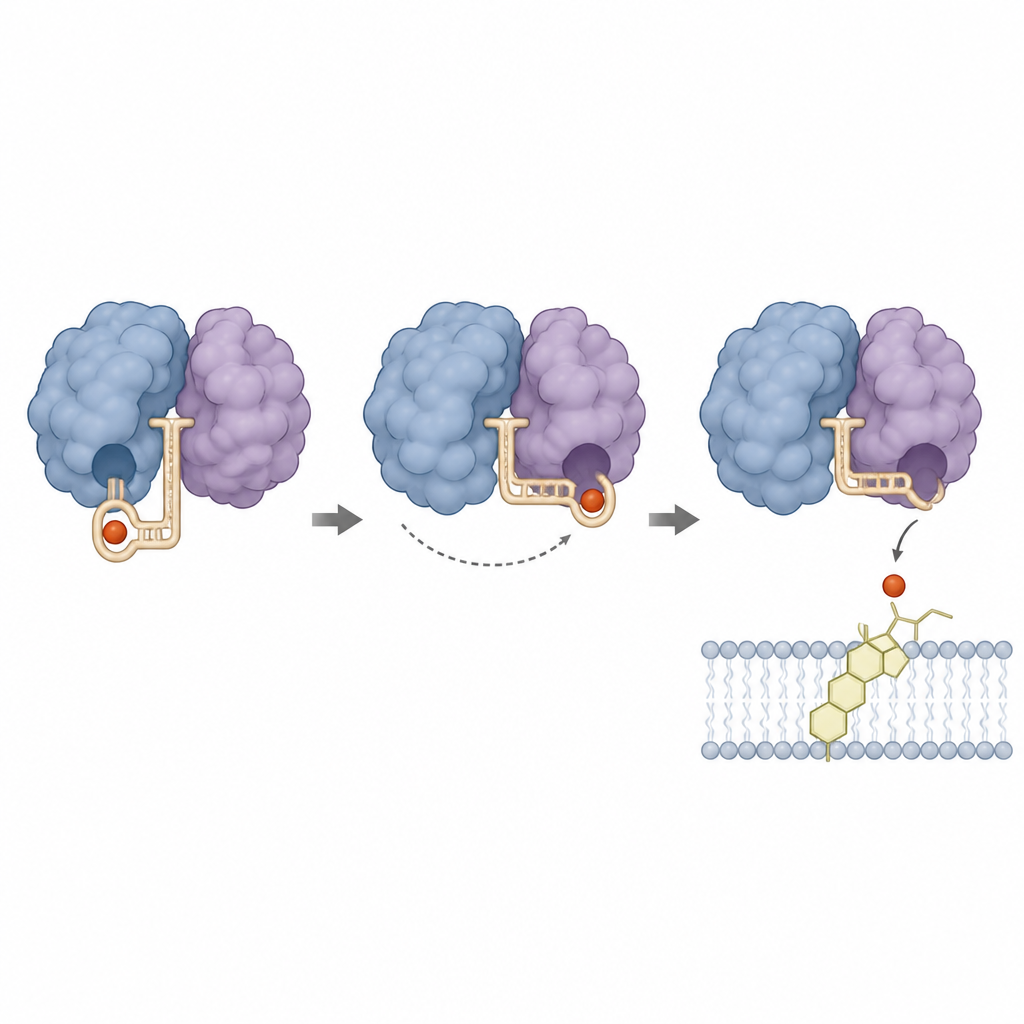
To uncover ErdS’s inner workings, the researchers solved its three dimensional structure using cryo electron microscopy and computer modeling. ErdS forms a dimer in which each copy carries both an aspartate-activating unit and a transfer unit that recognizes tRNA and ergosterol. The team found an unexpected deep pocket shaped to cradle sterols and position the crucial hydroxyl group that receives aspartate. Even more striking, they showed that the tRNA does not simply come and go. Instead, it is clamped in place by a long projecting helix and by both transfer units, and its tip swings about two nanometers from the first active site, where it picks up aspartate, to a second site, where that aspartate is handed to ergosterol. In this way, the tRNA acts like a built in swinging arm that repeatedly ferries the amino acid between sites without ever leaving the enzyme.
What this reveals about fungi and future therapies
By combining genetics, cell imaging, and atomic level structures, this work shows that fungi devote a specialized enzyme system to make ergosteryl-aspartate independently of protein synthesis, using tRNA as a permanent mechanical part rather than a disposable carrier. This modification helps set the timing and extent of spore production, the pace of spore germination, and the response to some stresses, thereby supporting fungal fitness in both medical and agricultural settings. The newly mapped sterol binding pocket and the unique swinging arm mechanism suggest precise features that future antifungal drugs could target to disrupt membrane tuning in disease-causing fungi while sparing human cells.
Citation: Murayama, H., Yakobov, N., Mahmoudi, N. et al. Structure of ergosteryl-aspartate synthase reveals how an entrapped tRNA is used like a prosthetic swinging arm in the synthesis of aminoacylated sterols. Nat Commun 17, 4455 (2026). https://doi.org/10.1038/s41467-026-73135-8
Keywords: fungal membranes, ergosterol, tRNA, aminoacylated sterols, antifungal targets