Clear Sky Science · en
Amplified response of cavity-coupled quantum-critical systems
Light in a box meets matter at its tipping point
When ordinary materials are chilled towards absolute zero, they can undergo dramatic transformations between distinct quantum states. Right at the tipping point of such a change, known as quantum criticality, the material becomes extraordinarily sensitive to tiny disturbances. This study explores what happens when such a delicately poised material is placed inside a reflective box of light, called an optical cavity. The authors show that the restless quantum motion at this tipping point can hugely boost how strongly the material responds to the trapped light, unlocking collective light emission and strong quantum correlations that are normally very hard to achieve.
A meeting of two powerful ideas
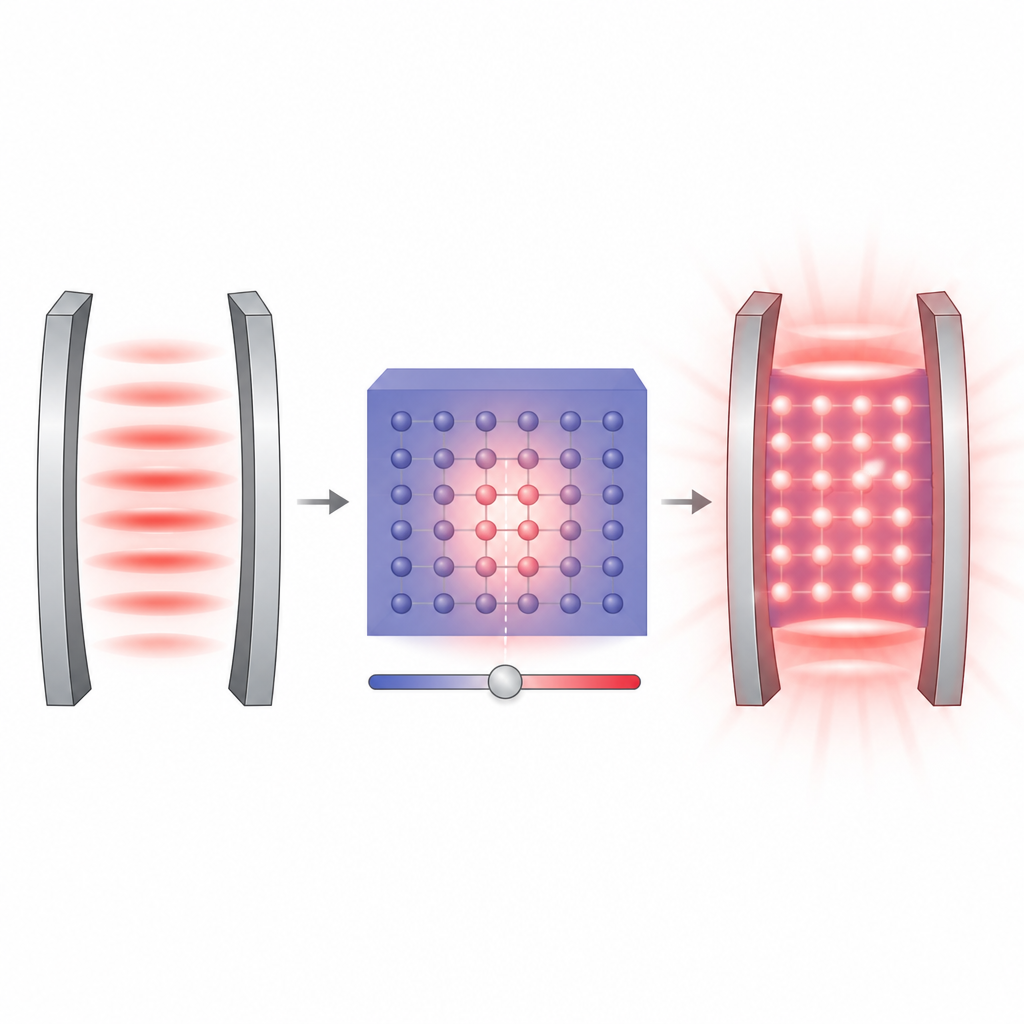
The work brings together two important themes in modern physics. One is quantum criticality, where a material is tuned to the edge between two different ground states, such as magnetically ordered and disordered phases. Near this point, quantum fluctuations become large and the material’s response to external probes is amplified. The other is cavity light-matter interaction, in which a single mode of light bounces back and forth between mirrors and interacts repeatedly with a collection of quantum objects. The long-standing dream in this setting is to reach a superradiant phase, where the cavity fills with a macroscopic number of photons and the matter develops a collective polarization. In conventional setups this requires extremely strong coupling between light and matter and faces fundamental theoretical roadblocks.
Using critical matter to ease a hard transition
The authors propose and analyze a strategy in which the cavity’s magnetic field directly couples to the very degree of freedom in the material that becomes critical at the tipping point. They model quantum magnets whose spins can be aligned or flipped by an applied field and are tuned through a quantum phase transition using this field. By choosing the orientation of the cavity’s magnetic field so it couples directly to the order parameter of this transition, they find that the strength of light-matter coupling required to reach the superradiant phase drops dramatically as the material is brought to criticality. In the ideal limit, this threshold can even vanish at the critical point, meaning that any small cavity coupling would be enough to trigger the collective light-filled state.
From theory to detailed behavior
To back up this principle, the team combines analytical approaches valid for large spin systems with advanced numerical simulations tailored to chains of spin one half, the most quantum case. They compute phase diagrams showing how the normal, magnetic, and superradiant phases appear and merge as the external field and cavity coupling are varied. The calculations reveal continuous quantum phase transitions between ordinary and superradiant states and show how the critical line bends towards lower coupling near the material’s own quantum critical point. They also demonstrate that this mechanism is robust across different spin models and persists when one accounts for more realistic situations, such as multiple cavity modes.
Enhanced squeezing and quantum links
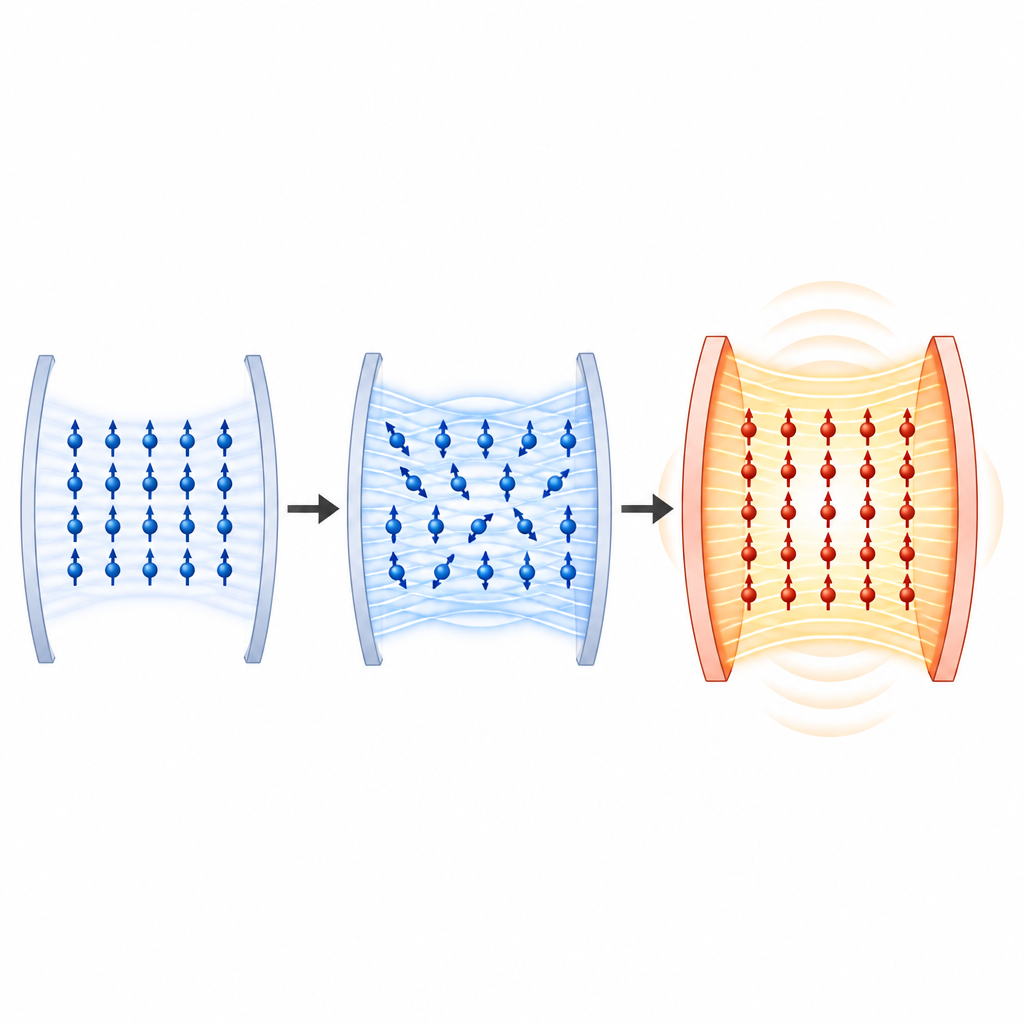
Beyond simply making the superradiant phase easier to reach, the quantum critical setting also shapes its internal quantum properties. The hybrid light-matter excitations in the cavity become strongly “squeezed,” meaning that the uncertainty in one collective variable is reduced at the cost of increased uncertainty in its partner. The authors show that this intrinsic two-mode squeezing becomes especially pronounced near the quantum critical point, surpassing what is found in the widely studied Dicke model. At the same time, the conjugate fluctuations grow large in a way that directly reflects an increase in quantum Fisher information, a standard measure of how much useful entanglement a state contains for precision measurements.
Pathways to experiments and quantum technology
The study points to several magnetic materials that already serve as model systems for quantum phase transitions and could be embedded in microwave or optical cavities. Previous experiments have demonstrated strong coupling between magnons and cavity photons, suggesting that the proposed regime is within reach. According to the authors, operating near a quantum critical point could allow future devices to harness highly collective quantum states with strong squeezing and multipartite entanglement at equilibrium. In practical terms, this principle could guide the design of quantum sensors and information platforms where carefully chosen materials do much of the work, amplifying the response of the trapped light and revealing the deep quantum correlations hidden in solid matter.
Citation: Sur, S., Wang, Y., Mahankali, M. et al. Amplified response of cavity-coupled quantum-critical systems. Nat Commun 17, 4404 (2026). https://doi.org/10.1038/s41467-026-73112-1
Keywords: quantum criticality, optical cavity, superradiant phase, quantum entanglement, cavity quantum materials