Clear Sky Science · en
Survival of the metallic state in a single-hole multiband p-orbital molecular system
Why this new metal matters
Metals are not always made from simple atoms like copper or iron. They can also arise when complex molecules share electrons in just the right way. This study explores such a molecular metal built from soccer‑ball‑shaped carbon cages called fullerenes. By carefully choosing the surrounding atoms, the researchers created a material that keeps its metallic character even when theory suggests it might freeze into an insulating state. Understanding why this “survivor” metal stays conductive could help scientists design new materials with tunable electronic and magnetic properties.
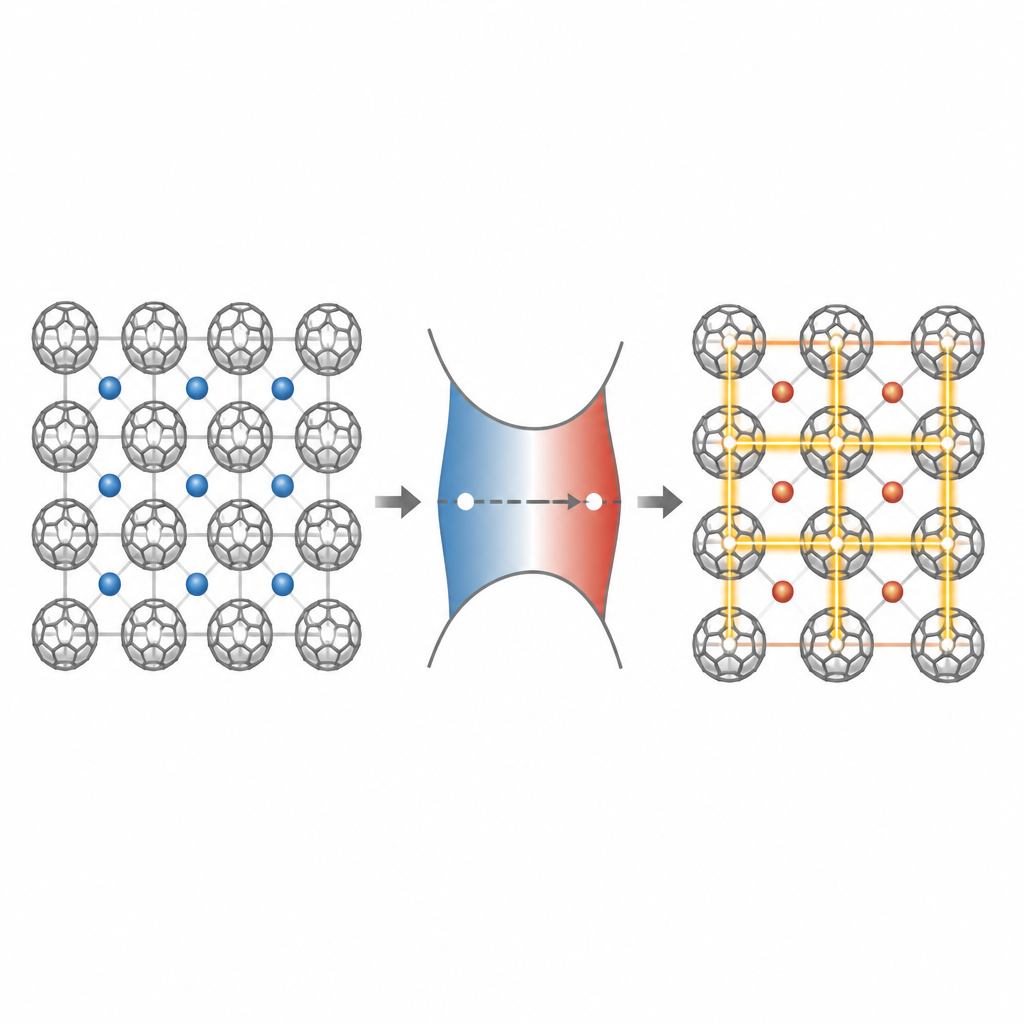
Building a metal from carbon cages
The material at the heart of the work is called Yb2CsC60. It consists of C60 molecules arranged in a three‑dimensional lattice, with ytterbium (Yb) and cesium (Cs) ions sitting in the gaps between them. Each Yb atom donates two electrons and each Cs atom donates one, so every C60 cage gains five extra electrons. That means there is effectively one missing electron, or “hole,” in a set of three closely spaced electronic levels on each molecule. This situation is the mirror image of an earlier fulleride metal that had a single added electron instead of a single hole. The new compound therefore offers a clean way to test how electrons and holes behave under similar conditions.
The crystal framework that supports metallicity
Using intense X‑ray beams and neutron scattering, the team solved the detailed crystal structure of Yb2CsC60 over a wide temperature range. Instead of the more common cubic arrangement seen in related compounds, the carbon cages form a slightly stretched, orthorhombic pattern. The C60 molecules are not perfect spheres but become gently elongated along one direction, and the Yb and Cs ions shift away from perfectly symmetric positions. These small distortions arise from electric fields inside the crystal and from subtle molecular vibrations. Importantly, the basic framework changes smoothly as the sample is cooled, with no signs of a structural or magnetic phase transition that would typically accompany a loss of metallic behavior.
Probing the electrons inside
To find out how electrons actually move in this lattice, the researchers turned to several local probes. X‑ray absorption measurements showed that ytterbium sits firmly in a 2+ charge state, confirming that the C60 molecules carry five extra electrons each. Carbon nuclear magnetic resonance (NMR) revealed that the local magnetic response of the carbon atoms is almost independent of temperature at low temperatures, a signature usually associated with metals. The rate at which nuclear spins relax back to equilibrium also follows the pattern expected for conduction electrons. These results indicate that Yb2CsC60 is a true metal, though with a lower density of mobile electrons at the Fermi level than in classic fulleride metals.
What theory says about the metallic state
Computer calculations based on quantum mechanics supported the experimental picture. They showed that the electronic bands built from the key molecular orbitals on C60 span about 1 electron volt in energy and cross the Fermi level, confirming the presence of mobile charge carriers. The ratio between the energy cost of putting two electrons on the same molecule and the overall band width is close to one, which is below the threshold where strong repulsions would typically force an insulating state. At the same time, the crystal environment slightly splits the nearly equal molecular levels but not enough to trap electrons on individual orbitals. As a result, the material avoids a so‑called Mott transition and remains metallic even though interactions are strong.
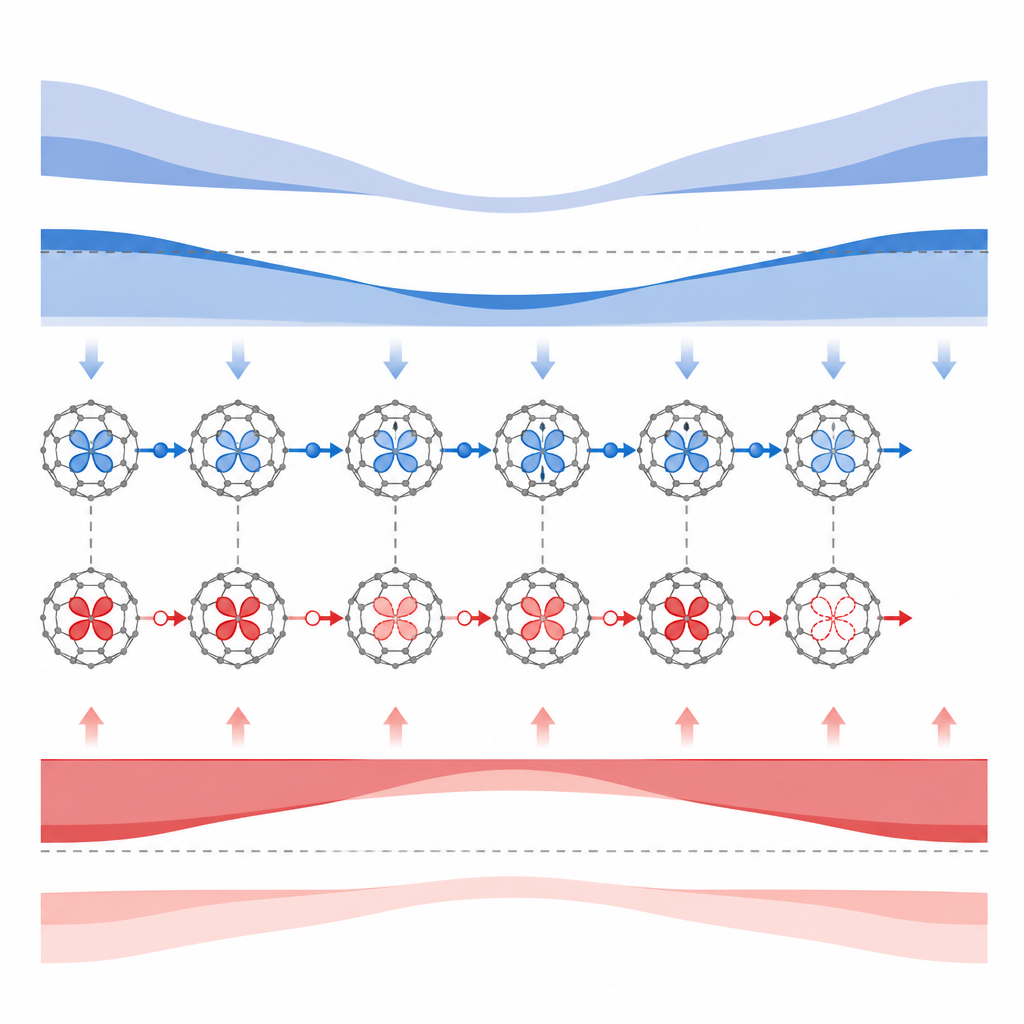
Why a single hole still conducts
Putting these findings together, the authors conclude that Yb2CsC60 is a robust metal in which a single hole per C60 molecule does not destroy conductivity. In this regime, the usual strengthening of electron correlations at half‑filled levels is weakened, allowing charge to flow relatively freely despite strong interactions. The behavior parallels what is seen in certain transition‑metal oxides, suggesting that molecular solids built from fullerenes can act as p‑electron counterparts to more conventional d‑electron systems. This new compound not only fills a missing piece in the fulleride family, but also offers a stable platform for exploring how small changes in structure, pressure, or composition might someday lead to new forms of magnetism or even superconductivity.
Citation: Matsui, K., Klein, R.A., Yoshikane, N. et al. Survival of the metallic state in a single-hole multiband p-orbital molecular system. Nat Commun 17, 4599 (2026). https://doi.org/10.1038/s41467-026-73095-z
Keywords: fulleride metal, strong electron correlations, Mott transition, molecular solids, Yb2CsC60