Clear Sky Science · en
A deep learning ECG model for identification and localization of occlusion myocardial infarction
Why this matters for heart attacks
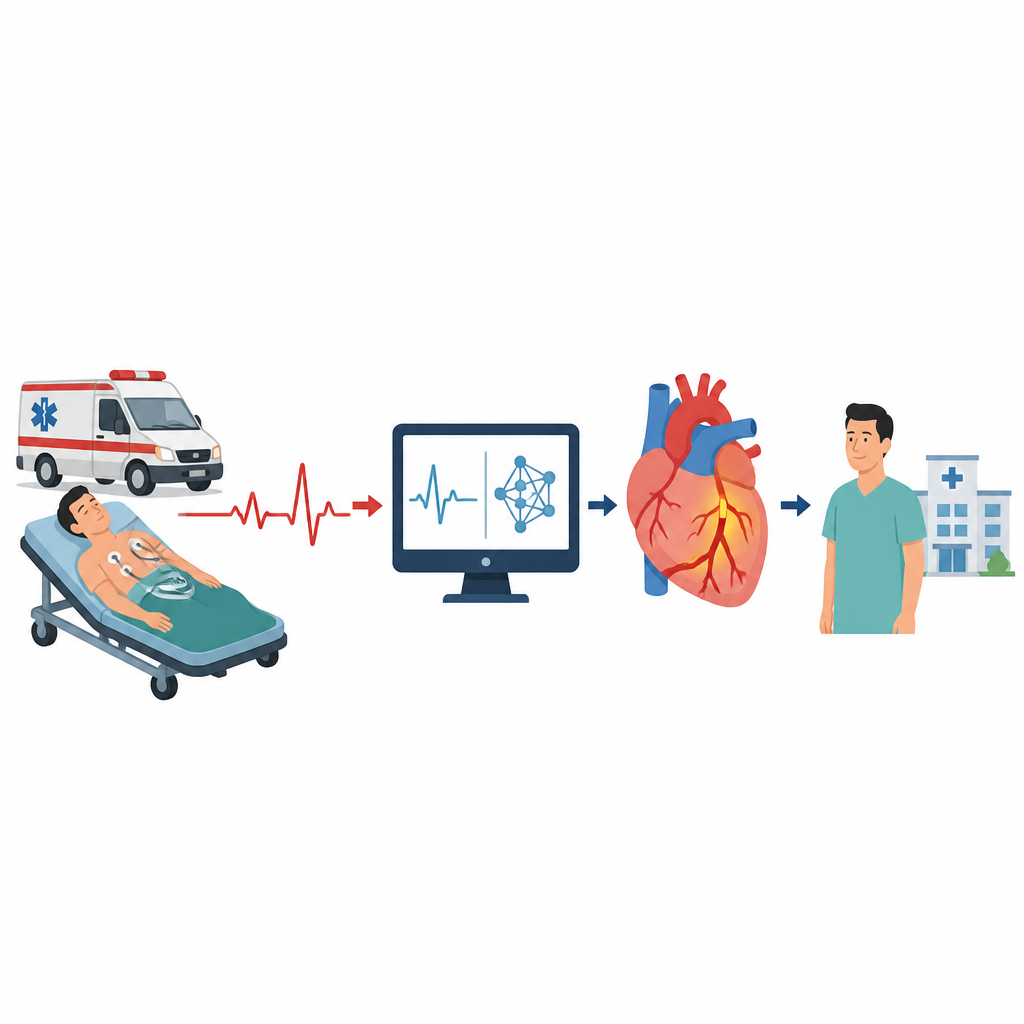
When someone has a heart attack, every minute without treatment can kill heart muscle. Doctors usually rely on a quick heart tracing called an ECG and blood tests to decide who needs an urgent trip to the operating room. But these tools often miss dangerous blockages or flag people who do not actually need an emergency procedure. This study shows how artificial intelligence can read ECGs to spot and even locate serious blockages more accurately, which could help get the right patients to life saving treatment faster.
Looking for blocked pipes in the heart
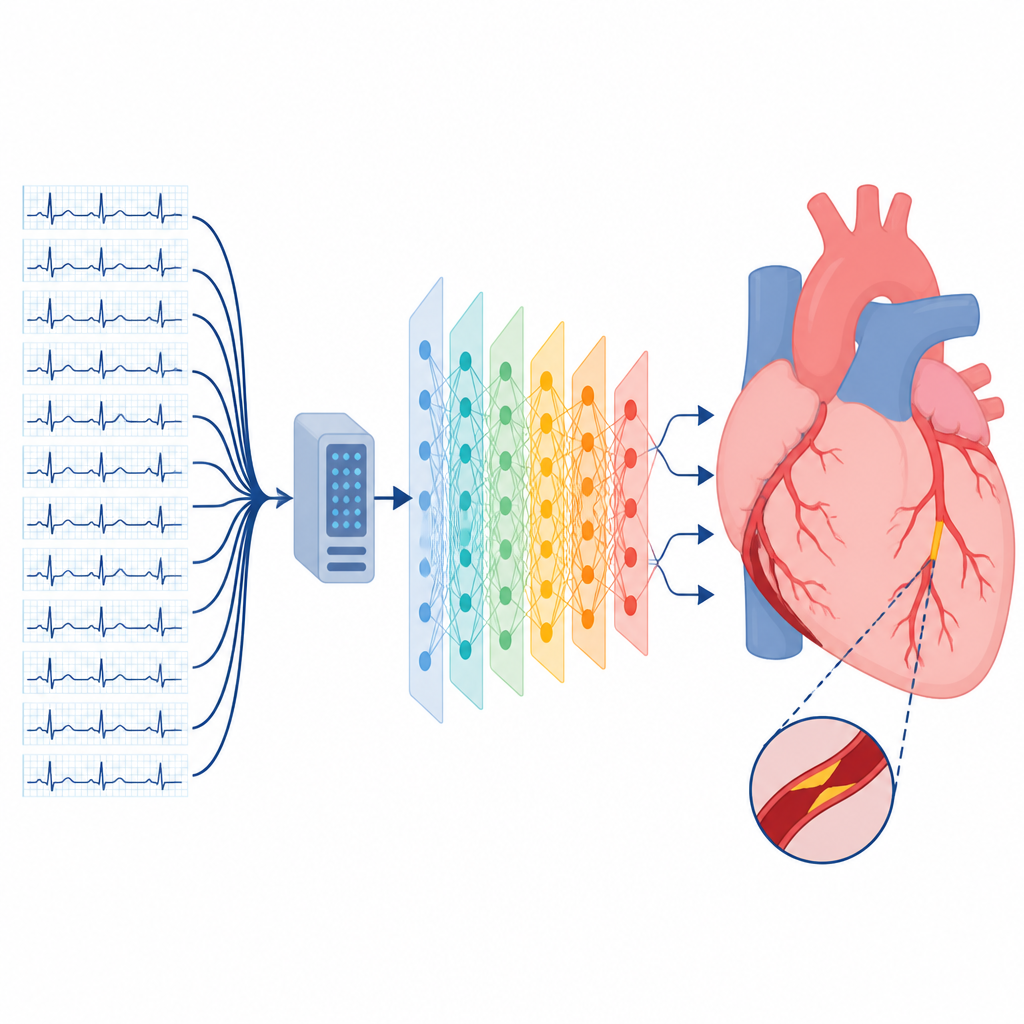
Not all heart attacks are the same. Some are caused by a fully or nearly fully blocked coronary artery, a situation the authors call an occlusion myocardial infarction. These are the patients who most urgently need a procedure to reopen the artery. The trouble is that the standard rule book focuses on a pattern called ST elevation on the ECG, which appears in only a fraction of these dangerous cases and can be caused by other conditions. As a result, some patients are missed while others undergo unnecessary invasive procedures. The researchers set out to build a computer model that could look at the raw ECG signal and recognize both the presence of an acute blockage and which of the main heart arteries is involved.
Training a model on hundreds of thousands of ECGs
The team used data from the Swedish Emergency Department Database, which links emergency visits, ECG recordings, and detailed results from heart catheterization procedures. They assembled more than 540,000 ECGs from about 226,000 adult patients who came to emergency departments in the Stockholm region between 2005 and 2016. For each heart attack case, doctors performing angiography had already determined whether there was a fresh complete blockage and which main vessel was responsible. Using these objective procedure findings as the ground truth, the researchers trained a deep learning model, a type of neural network that can recognize complex patterns in signals, to classify ECGs into multiple categories, including blocked versus non blocked heart attacks and the specific culprit vessel.
How well the model detects danger
In withheld Swedish test data, the model showed very strong ability to distinguish acute blockages from other patients. Its performance measure, the C statistic, reached at least 0.95 for detecting occlusion heart attacks and at least 0.87 for non occlusion heart attacks. At a low false alarm rate of 5 percent, the model correctly identified about 87 percent of occlusion cases. It also did well at telling which of the three main heart arteries was blocked, although separating two particular artery locations that are hard even for human experts remained challenging. Across different ages, sexes, ECG machine types, and calendar years, performance stayed broadly similar, with somewhat better accuracy in younger patients and those without certain long standing heart conduction problems.
Testing the model in other countries
To see if the tool would hold up outside Sweden, the authors tested it on three additional ECG collections from Europe and Brazil. In a Brazilian emergency cohort with angiography based labels, the model still separated occlusion heart attacks from controls well, especially for cases that did show classic ST elevation. In two large databases where only broader labels such as heart attack with ST elevation and a common conduction block were available, the model also performed strongly. In fact, for predicting ST elevation heart attacks in one of these datasets, the Swedish model outperformed another model that had been trained directly on those local human assigned labels, suggesting that training on objective catheterization results can give the system a deeper grasp of the underlying disease.
What this could mean for patients
This work shows that a computer model can use ordinary ECGs, plus basic information like age and sex, to quickly spot which patients are likely to have a freshly blocked heart artery and where that blockage lies. Because the method does not rely on blood tests or on doctors agreeing about subtle ECG patterns, it could shorten the time from first medical contact to artery reopening and reduce unnecessary emergency procedures. The authors stress that their tool still needs to be tested in clinical trials that track patient outcomes before it is used in routine care, but it points to a future where smart ECG analysis helps ensure that the right people get to the catheterization lab at the right time.
Citation: Gustafsson, S., Ribeiro, A.H., Gedon, D. et al. A deep learning ECG model for identification and localization of occlusion myocardial infarction. Nat Commun 17, 4336 (2026). https://doi.org/10.1038/s41467-026-73023-1
Keywords: electrocardiogram, deep learning, myocardial infarction, coronary occlusion, medical AI