Clear Sky Science · en
Attention-enhanced variational learning for physically informed discovery of exceptionally hard multicomponent bulk metallic glasses
Why harder glassy metals matter
Many of the devices we rely on, from tiny sensors to wear‑resistant machine parts, are limited by how quickly their surfaces scratch or deform. A special class of materials called metallic glasses can be both very strong and corrosion‑resistant, but finding the right recipe among thousands of possible metal combinations is slow and expensive. This study shows how an artificial intelligence system can navigate that vast search space to suggest new metallic glasses that are not only stable but also exceptionally hard.
Metals that behave like frozen liquids
Metallic glasses are metals cooled so quickly that their atoms never have time to line up into the regular patterns found in ordinary crystals. Instead they freeze into a disordered, glass‑like structure. This lack of crystal defects makes them very strong, but it also means that tiny regions inside the material, called shear transformation zones, control how it flows under stress. Small tweaks in chemical makeup can dramatically change how easily these zones activate, and therefore how hard or soft the material is. Because each alloy can contain many different elements, trying all possible mixtures in the lab is practically impossible.
Teaching a neural network the rules of tough alloys
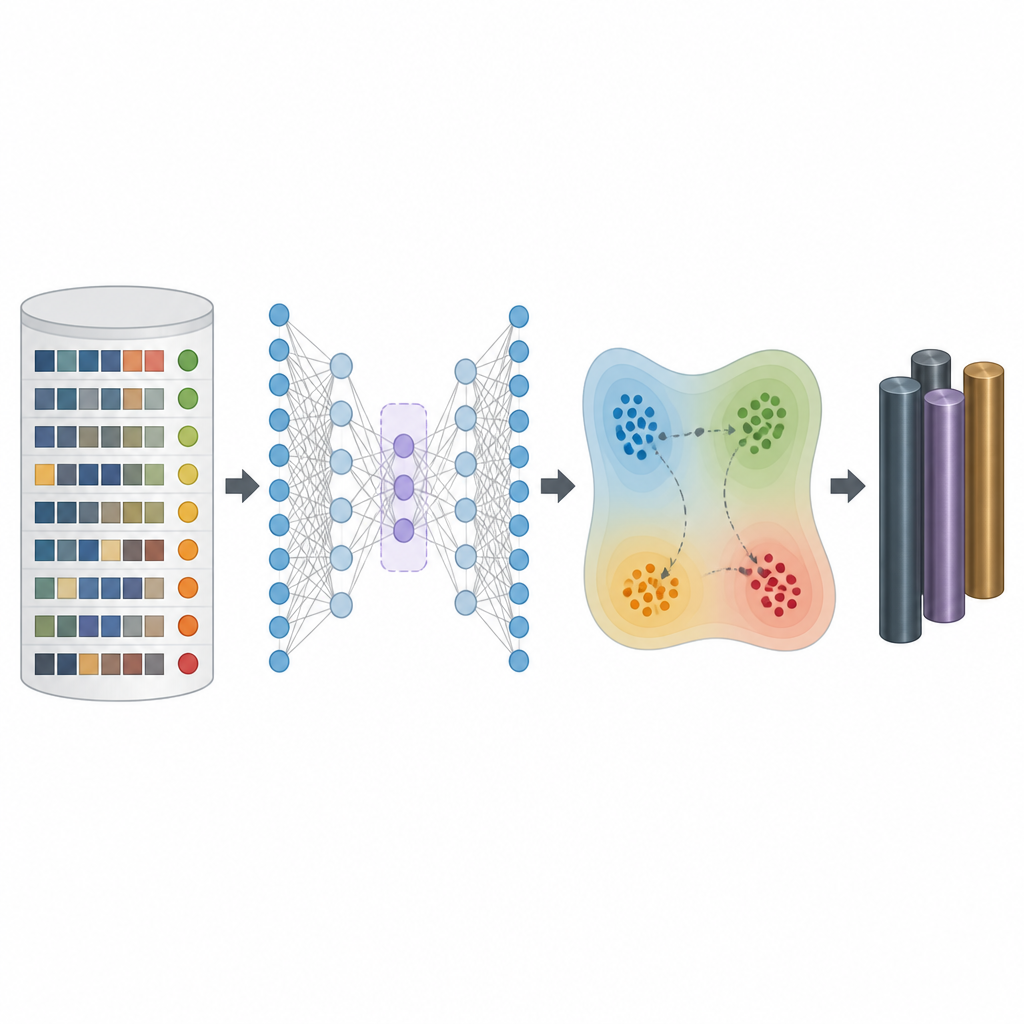
To tackle this challenge, the authors built an AI framework named VIBANN that learns from a curated database of bulk metallic glass compositions, the loads used to press on them, and the measured hardness. Instead of treating every ingredient as equally important, the model uses an attention mechanism to focus more strongly on elements that matter most for hardness. It then compresses all this information into a low‑dimensional "latent space" that still retains the key physical factors controlling performance. This compressed map allows the model not only to predict hardness for known alloys, but also to explore new combinations in a controlled way, while estimating its own uncertainty.
Navigating a hidden design map
In the learned latent space, alloys that share similar structures and hardness cluster together, forming smooth regions that can be traversed like a landscape. The researchers fit a statistical model to this landscape to identify areas where the data are trustworthy and chemically reasonable. They then used a two‑step search: first, a sampling stage that proposes many promising candidate points in latent space biased toward high hardness but low uncertainty; second, a refinement stage that nudges selected points uphill in hardness using gradient‑based optimization. Each point is decoded back into a real‑world alloy composition that obeys basic chemical constraints, such as all fractions adding up to 100 percent.
From computer suggestions to real rods
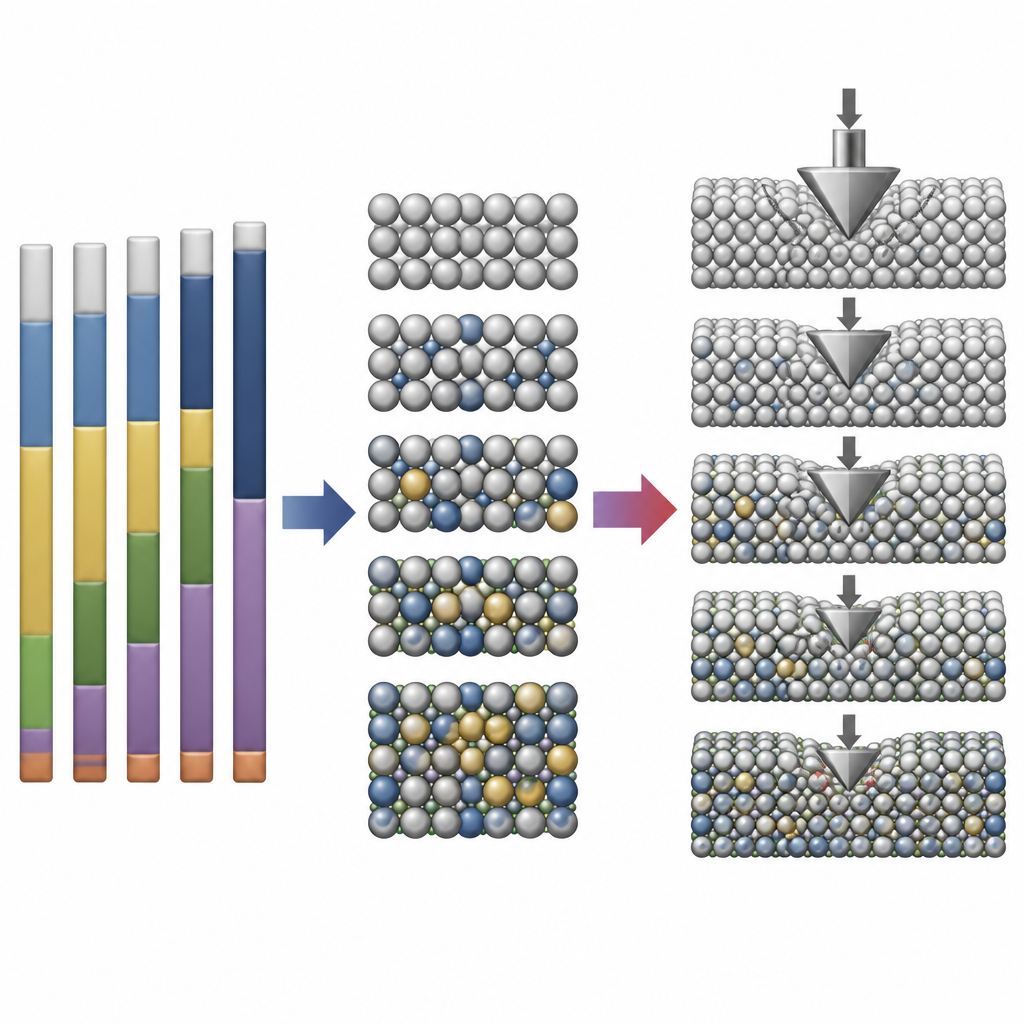
The AI proposed five related alloy recipes rich in boron and refractory metals such as niobium and tungsten. The team melted and suction‑cast these alloys into 2 millimeter‑thick rods and confirmed, using X‑ray and electron microscopy, that they formed fully amorphous metallic glass. When tested with Vickers microhardness measurements across a range of loads, all five alloys showed extremely high hardness, with one composition reaching roughly 2450 HV, comparable to some ceramics and among the highest values reported for bulk metallic glasses. The measured values closely followed the AI predictions, including how hardness changed with load after careful corrections for surface pile‑up around the indents.
What makes these glasses so resistant
To understand why the designed alloys are so hard, the authors combined high‑energy X‑ray scattering with atomistic simulations. They found that the top‑performing alloys share several traits: very dense atomic packing, a high fraction of boron‑centered environments with many neighbors, and local motifs resembling icosahedra and other tightly packed clusters. These features leave little free space for atoms to shuffle and make it harder for shear bands to spread under load. Subtle shifts in composition that reduce this dense packing lead to noticeably lower hardness, even when the overall mix of elements looks similar.
How this approach changes materials discovery
Overall, the study demonstrates that an AI model designed to be both physically informed and uncertainty‑aware can move beyond simple property prediction to actively propose and validate new materials. By showing that the suggested alloys are experimentally realizable, remain fully glassy in bulk form, and reach exceptional hardness levels, the work illustrates how attention‑based and variational learning can turn sparse, scattered data into a practical map for targeted alloy design.
Citation: Bajpai, A., Wang, J., Ratzker, B. et al. Attention-enhanced variational learning for physically informed discovery of exceptionally hard multicomponent bulk metallic glasses. Nat Commun 17, 4266 (2026). https://doi.org/10.1038/s41467-026-73008-0
Keywords: metallic glass, alloy design, machine learning, materials discovery, hardness