Clear Sky Science · en
Cerebellar growth is associated with domain-specific cerebral maturation and socio-linguistic behavior
How a Small Brain Region Shapes Growing Minds
Parents and teachers see children rapidly gaining language and social skills, but what in the brain makes this possible? This study looks at the cerebellum, a structure at the back of the brain long linked to movement, and shows how its growth from toddlerhood to young adulthood tracks with changes in thinking, language, and social behavior. By mapping how this “little brain” develops in typically growing children and teens, the researchers offer new clues to why early damage in this area can have lasting effects and how it might relate to conditions such as autism.
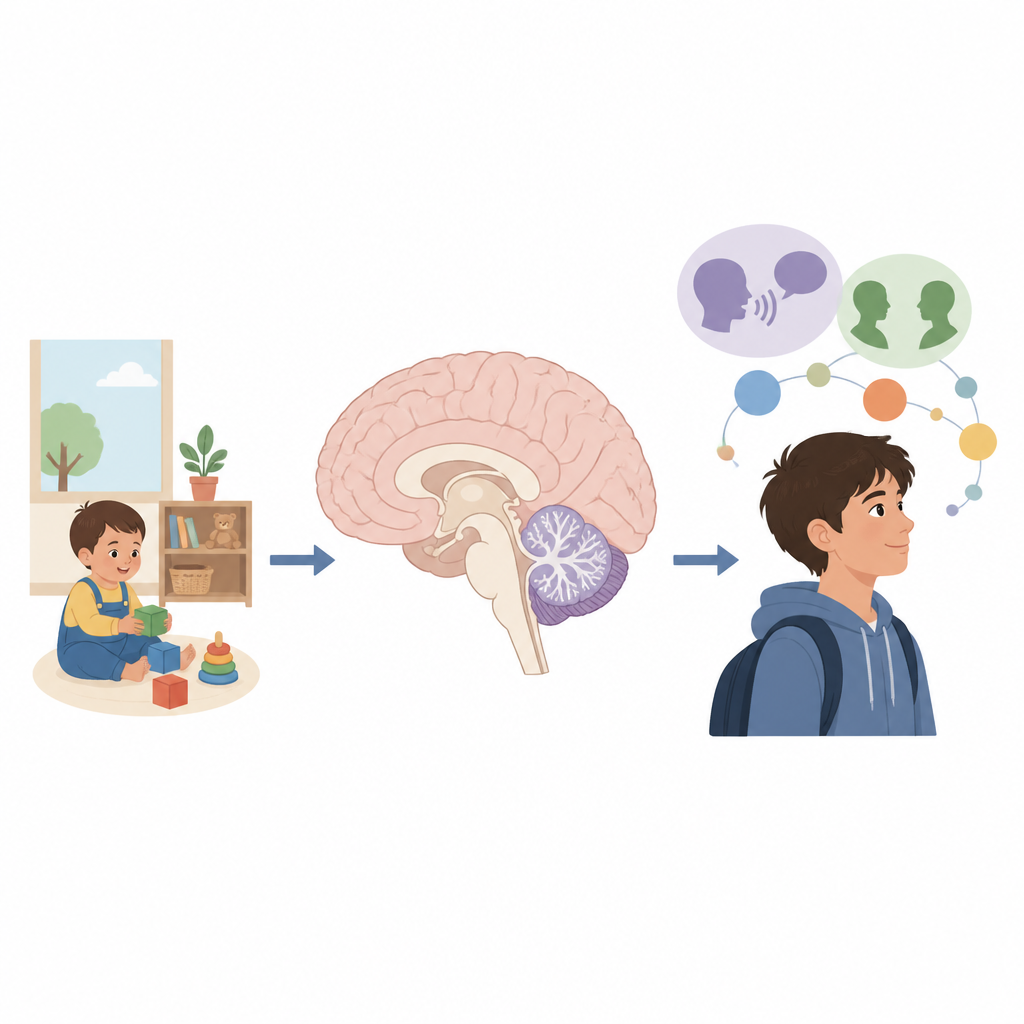
Watching the Cerebellum Grow Up
The team analyzed brain scans from 751 people between 1 and 21 years of age. Instead of simply averaging brains by age, they used a statistical approach called normative modeling to chart expected growth for each tiny region of the cerebellum, much like height and weight charts in a child’s health record. They combined data from infants and children in two large open datasets and carefully checked and corrected the images to measure the volume of many cerebellar subregions over this wide age span.
Thinking Zones Grow Faster Than Movement Zones
Across many different ways of slicing up the cerebellum, a consistent pattern emerged: regions involved in higher thinking, such as language, memory, and social understanding, showed steeper growth than regions that mainly support movement and sensation. These “association” areas sit mostly in the back part of the cerebellum, while the more slowly changing movement areas are toward the front. Both boys and girls showed increases with age, but boys tended to have slightly stronger age effects. This suggests that brain circuits for complex thought continue to refine and expand through childhood and adolescence more than basic movement systems do.
Linked Growth Between Back Brain and Big Brain
The cerebellum constantly exchanges signals with the large folded surface of the brain, the cerebral cortex. The researchers asked whether areas that work together also grow together. They compared the typical development of cerebellar regions with that of large-scale networks in the cortex, such as those for movement, attention, and inward-focused thought. Using machine learning, they found that cerebellar regions tied to social and language functions showed coordinated maturation with cortical areas in the so-called default mode and control networks, while movement-related cerebellar parts tracked with sensory and motor regions on the cortex. This pattern held across different mapping schemes, pointing to a tight, domain-specific partnership as the brain develops.
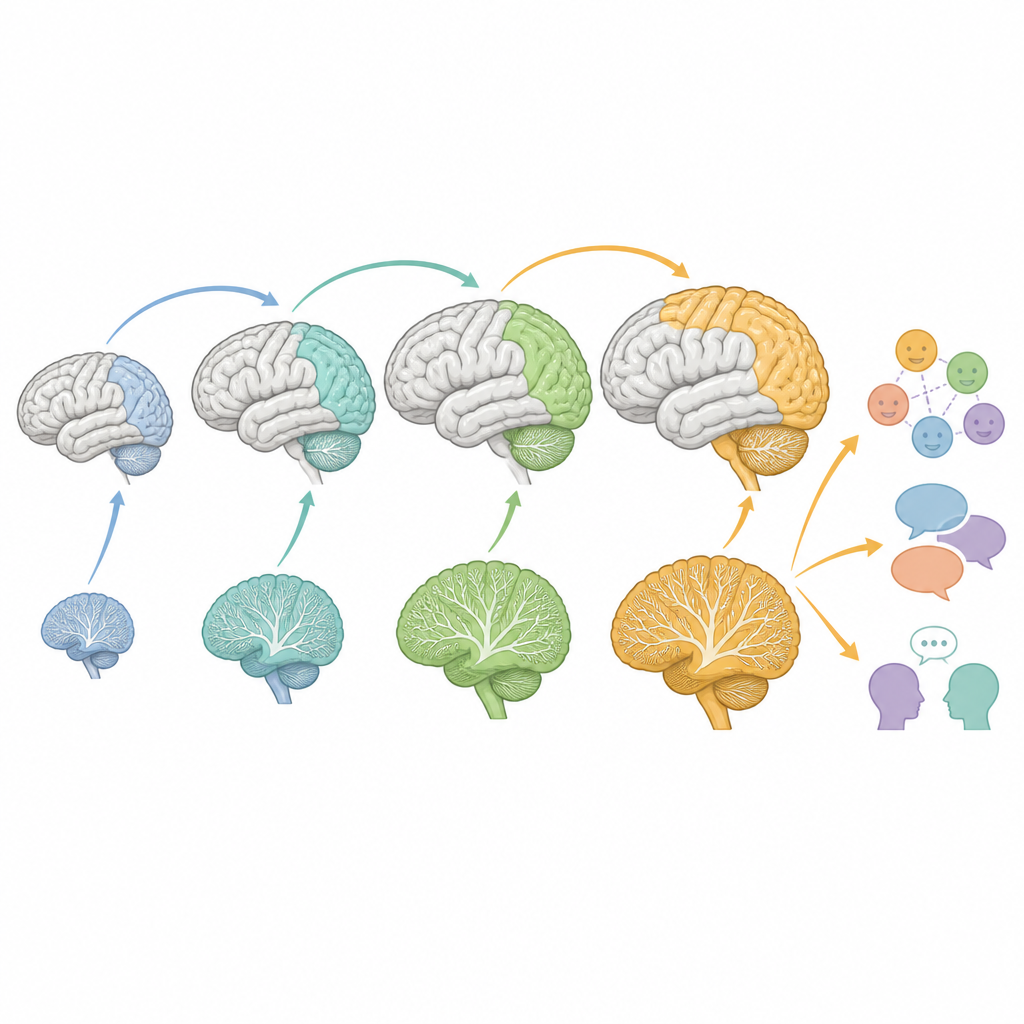
Connecting Brain Growth to Language and Social Behavior
The next question was whether these growth patterns matter for real-life abilities. In a subset of older children and teens, the authors linked each person’s deviation from the typical growth pattern to their performance on a battery of tasks measuring movement, thinking, reading, language, and social behavior. A multivariate analysis revealed that differences in the size of association regions in the back of the cerebellum were most strongly tied to language understanding, reading skill, and everyday social behavior. In particular, variation in these cerebellar areas explained social behavior better than measures from the cerebral cortex alone, and even better than combining both, hinting that this small structure carries distinct information about how social skills unfold.
Why This Matters for Children’s Futures
To a lay reader, the message is that the cerebellum is not just a motor helper, but an important partner in building language and social abilities as children grow. Its association regions keep developing well into young adulthood and do so in step with matching areas of the larger brain. Because growth patterns in these cerebellar regions are closely linked to differences in social and language skills, especially subtle social traits related to autism, these maps may one day help spot early signs of atypical development. The work does not offer treatments, but it lays a detailed reference for what “typical” cerebellar growth looks like, providing a baseline for future studies of learning, neurodevelopmental conditions, and personalized care.
Citation: Manoli, A., Magielse, N., Hoffstaedter, F. et al. Cerebellar growth is associated with domain-specific cerebral maturation and socio-linguistic behavior. Nat Commun 17, 4338 (2026). https://doi.org/10.1038/s41467-026-72940-5
Keywords: cerebellum development, brain maturation, language and social behavior, child and adolescent brain, neurodevelopment