Clear Sky Science · en
Unsupervised visual learning is revealed for task-irrelevant natural scenes due to reduced attentional suppression effects in visual areas
How the Brain Learns From What We See
Every day our eyes take in thousands of scenes, from crowded streets to quiet forests. We are not consciously studying these views, yet over time our vision becomes better tuned to the world around us. This study asks a simple question with surprising consequences: does the brain automatically learn from all visible images, or only from certain kinds, and how does attention help or hinder this hidden learning?
Seeing Without Trying
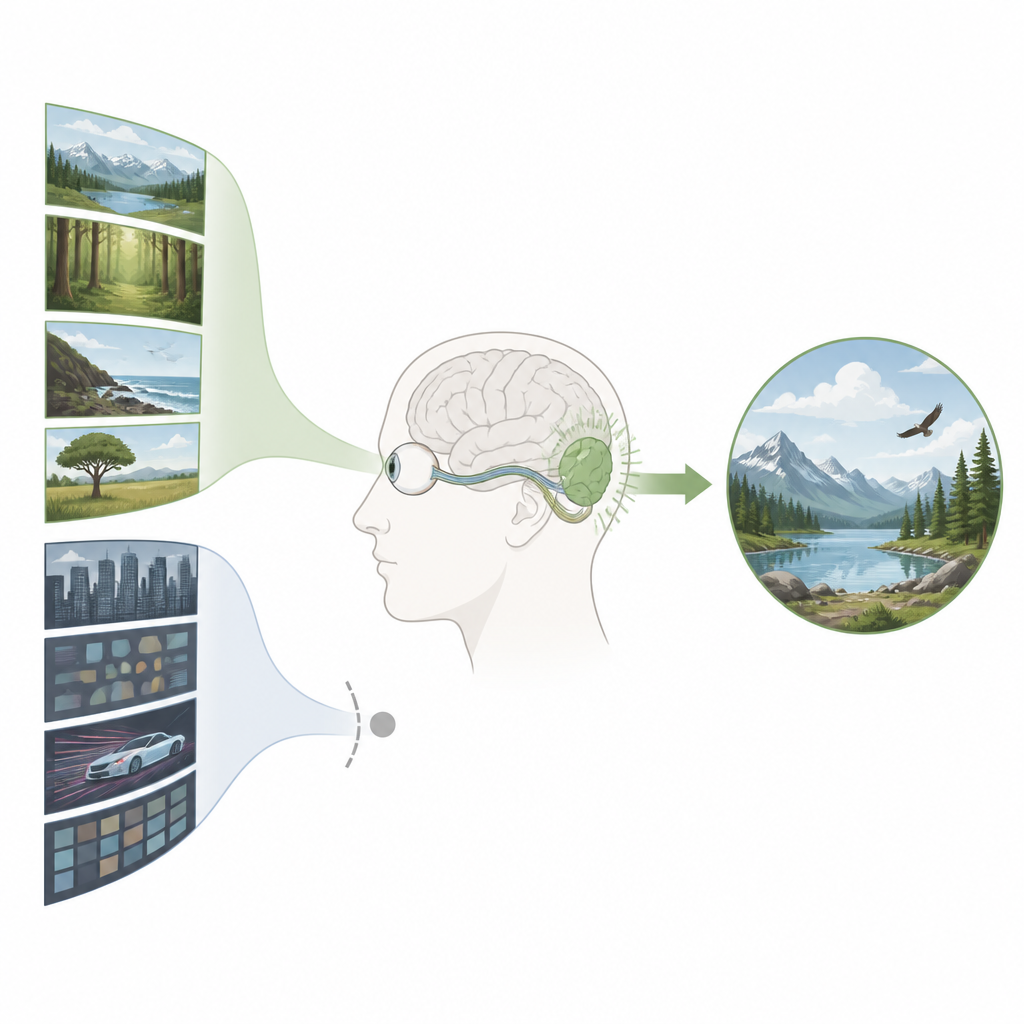
The researchers focused on a type of improvement called visual perceptual learning, in which people become better at judging basic visual features such as line orientation or fineness of patterns. Earlier work suggested that such learning often needs feedback or focused attention. But much of human and machine learning is believed to be unsupervised, driven simply by repeated exposure. To test whether this kind of passive learning shapes vision, the team showed volunteers images that were irrelevant to the task they were performing and later measured how their ability to see fine visual details had changed.
Natural Scenes Versus Artificial Patterns
Participants performed a demanding letter-and-number task at the center of a screen while, in the background, they saw either natural scenes or carefully engineered artificial images. The natural scenes looked like forests, cityscapes, or other real-world views, rich in edges, textures, and contours. The artificial images were constructed to match certain simple properties of the natural scenes, such as overall brightness, line orientation, and spatial frequency, but were scrambled so that meaningful structure was removed. After many days of exposure, people were tested on how well they could discriminate line orientations or pattern coarseness using neutral test images.
When the Brain Learns and When It Does Not
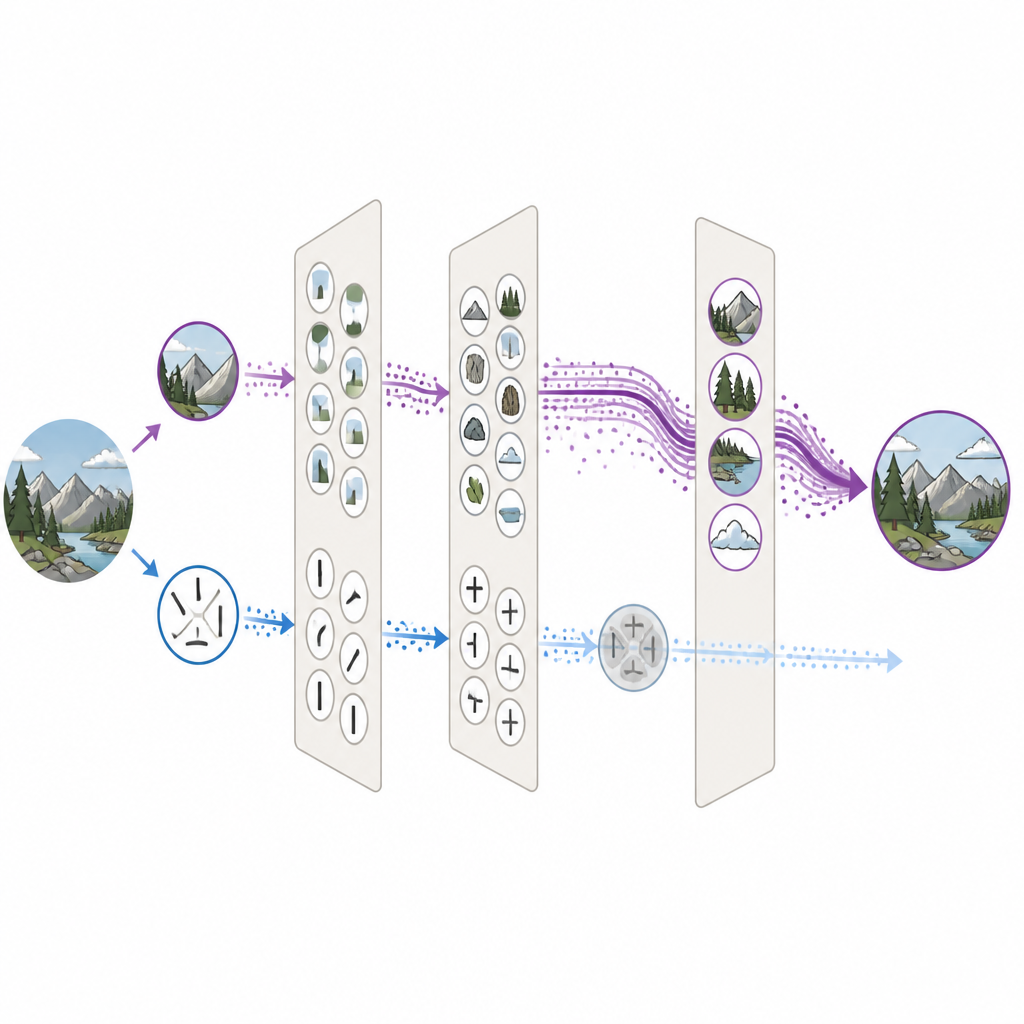
The results were striking. When images were merely viewed without any central task, both natural and artificial images led to improved visual sensitivity, showing that unsupervised learning is available in principle. However, when attention was occupied by the demanding central task, only the natural scenes produced lasting gains. Artificial images, even when clearly visible and matched in simple statistics, produced no improvement. Further experiments dissected the images into different kinds of statistical structure. Learning appeared whenever the task-irrelevant images contained complex, higher-order relationships among edges and textures, and disappeared when only simple, lower-order components were present.
Attention and Hidden Image Structure
To understand what was happening inside the brain, the team combined behavior tests with brain imaging. They found that attention systems in parietal and frontal regions sent similar suppression signals regardless of image type. Yet activity patterns in higher visual areas beyond the primary visual cortex were less dampened for images carrying higher-order structure than for simpler images. Additional timing experiments showed that the brain takes longer to extract these complex relationships from natural scenes than to process simple patterns. Because top-down suppression fades within a limited time window, the slower, more complex signals may slip through after the strongest suppression has passed, allowing unsupervised learning to take hold.
What This Means for Everyday Vision
In plain terms, the study suggests that the brain is constantly poised to learn from what we see without instruction, but this learning is filtered. When our attention is tightly focused on a task, simple, artificial patterns in the background are effectively muted and leave little trace. Natural scenes, with their rich web of relationships among edges and textures, are harder to suppress and can still reshape how we see, even when we are not paying attention to them. This work points to unsupervised learning as a basic engine of visual improvement, whose impact depends on both the hidden structure of what we look at and the way attention gates information through the visual system.
Citation: Watanabe, T., Sasaki, Y., Zama, T. et al. Unsupervised visual learning is revealed for task-irrelevant natural scenes due to reduced attentional suppression effects in visual areas. Nat Commun 17, 4232 (2026). https://doi.org/10.1038/s41467-026-72918-3
Keywords: visual learning, natural scenes, attention, perceptual learning, fMRI