Clear Sky Science · en
Pharmacological markers of HIV prevention for oral pre-exposure prophylaxis in men who have sex with men
Why this research matters
The idea of taking a pill to prevent HIV has transformed sexual health, especially for men who have sex with men. Yet there is still confusion about how strictly these pills must be taken and which parts of the body need to be saturated with drug to stay protected. This study digs into data from several large clinical trials and uses advanced computer modeling to answer a practical question with big public health stakes: which drug measurements best tell us whether pre-exposure prophylaxis (PrEP) is working, and how many pills per week are likely enough?
Different rules for different people?
Current international guidelines often recommend different PrEP schedules for cisgender women and for men who have sex with men. These differences were largely based on laboratory measurements suggesting that drug levels in vaginal tissue are lower than in rectal tissue, implying that women might need stricter adherence to stay protected. However, earlier work by the same group showed that drug amounts in vaginal tissue did not, in fact, predict how well PrEP worked for women. Instead, drug levels inside circulating immune cells in the blood, called peripheral blood mononuclear cells, tracked real-world protection far better. The new study extends this question to men who have sex with men: do local drug levels in rectal tissue matter most, or are the same blood-based markers again the key?
What the trials really show
The authors reanalyzed five major PrEP trials in men who have sex with men, including well-known studies such as iPrEx, IPERGAY, HPTN 083, DISCOVER, and PURPOSE 2. A challenge with these trials is that not everyone assigned to take PrEP actually swallows the pills regularly. To make fair comparisons, the researchers first separated time periods when participants clearly had drug in their system from periods when no drug was detectable in their blood. Using this cleaned dataset and a Bayesian statistical approach, they estimated how effective PrEP was among people who were actually taking it. Across all studies, the most likely average protection level when drug was present was very high—around 90–100% risk reduction—but only two trials, HPTN 083 and DISCOVER, had enough data to narrow down this estimate with strong certainty.
Inside the body: where protection really comes from
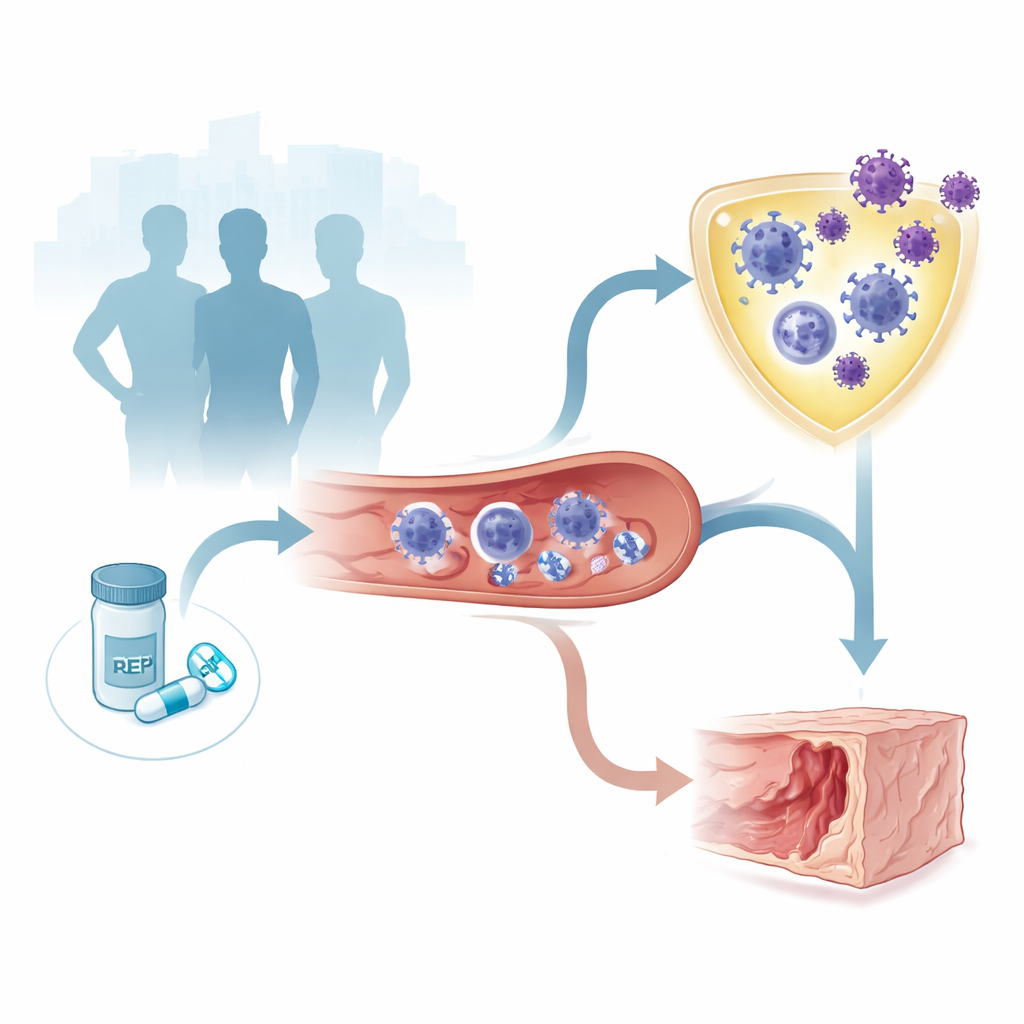
Statistics alone cannot reveal which biological measurements are truly driving protection, so the team combined the trial results with a detailed computer model of HIV infection and drug action. This model links pill-taking patterns to drug levels over time, and then to the chance that a single exposure leads to a lasting infection. The researchers tested two main ideas. In one, drug levels measured in rectal tissue were assumed to represent what HIV "sees" during anal sex. In the other, drug levels inside circulating immune cells in the blood were treated as the key marker, ignoring local tissue differences. When they ran the model under these competing assumptions and recreated each clinical trial on the computer, the rectal-tissue hypothesis consistently predicted lower protection (around 70–80%) and could not match the highly protective outcomes seen in HPTN 083 and DISCOVER. In contrast, the blood-cell marker produced protection levels above 90% that aligned closely with the observed trial data.
How many pills and how fast protection starts
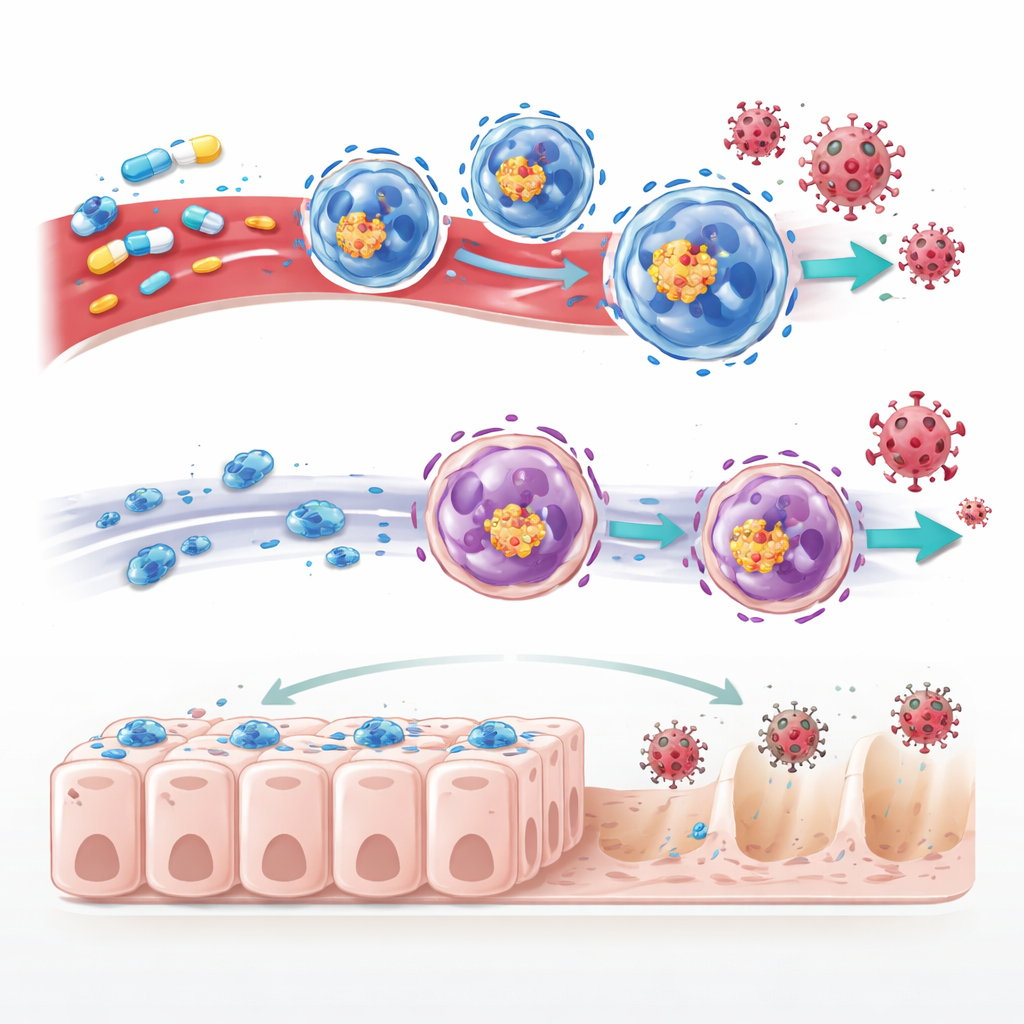
Once they had identified blood immune-cell levels as the best marker, the authors used their model to explore practical questions about dosing. They found that fully adherent daily PrEP can provide more than 90% protection essentially from the time of the first pill, because continuing doses help clear any virus that enters soon after. When daily PrEP is stopped, strong protection typically persists for about two days, then gradually becomes more uncertain as drug levels fall. For the popular "2-1-1" on-demand regimen used by many men who have sex with men, the model suggests that taking two pills before sex and two single pills on the following days also achieves high protection if exposures occur around the dosing window, with more than 90% protection lasting roughly one extra day after the final pill.
What this means for real-world HIV prevention
Overall, the study shows that for men who have sex with men, the best pharmacological sign that oral PrEP is working is the amount of drug inside circulating immune cells, not the concentration measured in rectal tissue samples. Using this marker, the authors estimate that taking three to four TDF/FTC pills per week is usually enough to reduce HIV risk by more than 90%, and that on-demand regimens can be both effective and practical. When these findings are combined with earlier work in cisgender women, they challenge the idea that women intrinsically need much stricter adherence than men. Instead, the main differences appear to come from social and behavioral barriers to taking PrEP, not from biology. Clarifying these markers and dose needs can help refine guidelines, support digital tools that coach users on dosing, and ultimately make HIV prevention more accessible and reliable worldwide.
Citation: Iannuzzi, S., Müller, M., Yu, Y. et al. Pharmacological markers of HIV prevention for oral pre-exposure prophylaxis in men who have sex with men. Nat Commun 17, 4213 (2026). https://doi.org/10.1038/s41467-026-72907-6
Keywords: HIV PrEP, men who have sex with men, drug levels in immune cells, HIV prevention modeling, oral TDF FTC